04 October 2011

Celebrating Harvest and Remembering Famine


Harvest Sunday was celebrated in early October this year; were it not for the unseasonably warm fall temperatures, we might have had to buy imported vegetables to decorate the church. Instead, though, most of the women brought a sack of goods from their gardens (the last of this year's harvest – the rest having been either consumed, canned, or stored away) to bring color and to share with one another.

Harvest Sunday has always been a day when I've taken the opportunity to talk about the bounty of creation, about the wide variety of reasons we have for giving thanks, and about the importance of the stewardship of that which we have been given.

This year, though, the sermon text1 for the day pushed me in another direction. The reading, from the prophet Isaiah, started like this:

Share your food with the hungry and open your homes to the homeless poor. Give clothes to those who have nothing to wear, and do not refuse to help your own relatives.2

On the one hand, this text speaks clearly to the people in the congregation, since they are all too familiar with most of the the social ills that were facing the chosen people at the time of their return from Babylonian exile. On the other hand, what was I to say to the congregation when they themselves have very few resources? Could I really encourage them toward more generosity when, in fact, this particular congregation shows an already impressive level of stewardship when compared with other congregations in our church?

Yet, the text kept challenging me:

If you put an end to oppression, to every gesture of contempt, and to every evil word; if you give food to the hungry and satisfy those who are in need, then the darkness around you will turn to the brightness of noon. And I will always guide you and satisfy you with good things. I will keep you strong and well. You will be like a garden that has plenty of water, like a spring of water that never goes dry.3

And so, I tried to use the opportunity to counter the popularly held notion here that “no good deed goes unpunished,” and I asked those gathered to think realistically about the ways they could extend their care to those around them, to apply their faith in a practical manner to the problems of society.

I used an example that my son, Matvey, suggested. Last year as we traveled around St. Petersburg, he would ask me about the people we would see sleeping on the street or begging for money. He wanted to help them, and we discussed how we might do that. Giving money might not be the best thing, I said, since those who beg here are frequently not allowed to keep the money themselves, but are instead being misused by others. Matvey thought that it might be a good idea to give them food instead, and our experience was that he was right. Instead of taking one apple or pastry with us when we left home, then, we'd take two – one for Matvey and the other for someone begging on the street. I thought that we could do the same thing in the congregation that day – we'd share the fruits on the table with one another, but we'd also take some as we left church – we would distribute it to those in need that we'd meet on the way home (and since all of us take public transport, all of us would see the needy).

I left a bag of fruit out in the prayer house courtyard, then, for folks to take. I didn't know how they would respond, though, until I saw that all the fruit was gone even before everyone had left.

I was surprised and happy that the experiment had worked out so well. Yet, as frequently happens here, I found that there was more to the story.

I got a hint of that on my way back home. On the bus I stood next to one of the older (yet also one of the feistier) members of the congregation, Sister Valentina. She told me that Harvest festival was always important to her, since she knew what it was like to go hungry. She had very vivid memories of that day in the fall of 1941 when, as a little girl of 7, her family was told that they would have 2 hours to pack, that they would were being deported. Valentina was the oldest of 4 children, and her efforts were key to the family's survival in the next years, especially since her father was exiled to another, still harsher climate than the Siberian steppe that was home for Valentina, her mom and siblings. She told me that she never learned to read because she was immediately engaged in helping to feed the family. At that age, that meant searching for whatever might be edible - berries, mushrooms, roots. No less important was going through the fields after harvest time, giving her a personal understanding of the Old Testament's command that “when you reap your harvest in your field and forget a sheaf in the field, you shall not go back to get it; it shall be left for the alien, the orphan, and the widow, so that the Lord your God may bless you in all your undertakings.”4

As a result of the deportation from the Volga River region in 1941, 200,000-300,000 German Russians met their deaths. Valentina, despite the suffering she has gone through, survived and helped others to survive. With many similar stories among the elderly women in the congregation, it is no surprise that they are willing to feed the hungry, having once been hungry themselves.

Can a small, poor, and mostly elderly congregation solve Russia's social problems? Certainly not. But I pray that God will give us year-round the thankful and generous hearts he gave us at Harvest, so that we might know the joy of having a connection between our faith and our living, and that we might feel that we truly are “like a garden that has plenty of water, like a spring of water that never goes dry.”

1 The lectionary here is based on a German system; there are two readings (one Gospel and the other from elsewhere in Scripture) for every Sunday in addition to a sermon text. While the two readings remain the same from year to year, the sermon texts are based on a 6 year cycle. I must admit that in my years here I've really missed our Revised Common Lectionary for a number of reasons: 1. there is always both and OT and a NT reading 2. there is flexibility when it comes to choosing which of the 3 texts works best for the sermon on a given Sunday (meaning I can't even wiggle out of preaching on Lamentations this coming Sunday!). 3. there is such a wealth of resources for those using the RCL for preaching. 
2 Isa. 58.7. Good News translation; used here since in this case the text most closely parallels the Russian translation.
3 Isa. 58.9b-11. GNT.
4 Deut. 24.19 NRSV.

30 September 2011

Installation


While attending college and seminary, I worked in tech support. Since then I've fallen far behind on the technology curve, but the word “installation” is still more associated in my mind with software and hardware than with church. And so, as I prepared for my installation as pastor here in Novosibirsk, I began to reflect on what the church is doing when it publicly acknowledges a new call in this way.

And I've come to the conclusion that I certainly wouldn't call it “installing.”* In our current usage, installation usually relates to a thing (OpenOffice, a headlight, new carpeting) not a person. And if you look at the roots of the word, it is clear that the reference is to putting something into a specific place. I do not suppose that many pastors would much like to be “in-stalled;” even in rural places no one wants to feel like they've been put into cramped quarters for cattle. The “stall” root also brings to mind other negative connotations, for example a car that has broken down and is going nowhere...

While “installation” is a word with many mechanical associations, what the church is trying to do, I hope, is something more organic. To a degree this is reflected in the way “installation” is said in the church in Russian: введение в должность (vvedenie v dolzhnost'). The first two words are translated as “introduction to,” implying a beginning, a making of new acquaintances, and movement from the outside in. The next word means “appointment” or “official capacity,” but here, too, the root indicates something more than simply a job, it is an “obligation” or “duty.”

For me this new call to Siberia has nothing to do with getting “plugged in” like some new memory module for increased performance. Instead “installation” is a movement towards carrying out a set of holy duties in relationship to the community of faith. In my particular case, in being called to the pastor in Novosibirsk I've been given a fragile gift – a small and rather isolated congregation that is becoming aware of the transitions it is going through now and are yet to come. We do not have a computer for new software or a car for new parts or a building where new carpet would be appropriate. Instead, we have only the seed of faith, our relationships with one another, and our hope that the Spirit will stir new life within us for the good of our neighbors.

Here are a few pictures from the celebration of our new relationship, our faith and our hope.
In the center is a friend of the congregation, Brother Corrado from the Franciscan monastery. To his right is Andrey Filiptsov, my former student and pastor in Tomsk. In the first row is Svetlana, a Bible study leader in the congregation and soon to be a seminarian.  
With the bishop of the Evangelical Lutheran Church in the Urals, Siberia and Far East, Otto Schaude.

22 September 2011

Observation and Action


While teaching at the seminary outside of St. Petersburg, I would frequently tell students that after they receive, they will need to spend a lot of time observing - the congregation's inner dynamics and spiritual values, the hidden conflicts as well as the hidden potential for growth. I thought that I was giving them good advice that could easily be applied to their situations in congregations. I did not realize just how difficult it would be to be patient....and I've only been here three weeks! Did I mention that I told the students that this applied to their first year?

In some ways the congregation in Novosibirsk is ready for change. As I've mentioned elsewhere, my predecessors did much to lay the groundwork for change; when I visited the congregation in May, the council decided that we would take the big step of starting to worship in Russian this fall. While I'm sure it will take a number of months for everyone to get used to this new arrangement, it is clear that they're making their best effort. I'm especially impressed by the congregation's older members, the ones that really want the German language to be a part of their spiritual life. These older women (and they are all women) could easily say - “I can read my prayers at home in German instead of taking taking a hour or two to ride on two or three buses in order to get to church. I've had enough of this.” Or, instead, they could still come to the prayer house because of the role it played in their past, but could engage (either actively or passively) in resisting the move into Russian. For example, they could show their resistance simply by saying, “We're old, and we can't see very well.  We're not even going to try to follow the worship service.”  They wouldn't even be making excuses, they'd be telling the truth! Instead, though, they search for the words and the notes that are still unfamiliar to them. Their effort really impresses me and witnesses to the fact that their faith and being a part of the worshiping community are more important to them than questions of language or ethnicity.

That said it really will take a lot of time to change the way folks think about the church and their participation in it. Time will need to go by before they are willing to respond to my offers to help them in their gardens, to come over for tea and fellowship, or to attend Bible study. A large part of me wants to be doing these and other new things (more Christian education, congregational involvement in social justice issues, talking with the council about the stewardship of our resources, getting a team together for visits to the sick and the homebound, etc.) in order to feel useful. But I need to keep reminding myself that at this point my feelings of usefulness are not what is most important. Instead, I need to allow time for relationships to develop, and that will do much to improve the likelihood for success of new ministries.
The congregation's prayer house before the congregation arrives
In the meantime, I'm trying to fulfill my need to feel useful in other ways, outside of the official boundaries of the congregation. Besides learning my way around Novosibirsk (you can find a few street scenes below), I'm also trying to develop as many contacts as possible outside of the congregation. Since community and special interest groups are significantly fewer here than in the U.S., I cannot necessarily start with those things I already know or am good at, but instead must try to determine what the needs are here and what efforts are already being made. As it turns out, in a country where new infection rates remain among the highest in the world, HIV prevention is a priority. Later in the week I'll be attending a roundtable discussion to see about participating in an intensive new testing effort in October and November.  

Next week I'll let you know more about how the roundtable went, as well as say a few words and provide a few pictures from my official installation service this coming Sunday. Until then, here are a few pictures from around the city.


One of my favorite scenes in Russia - playing chess in the park. I'm glad to see that they do it in Siberia, too.


This is the "Composer's House" in Novosibirsk. I think it is cool that there is a building specially dedicated for composers to meet and work.


The fountain in front of the Russian Academy of Sciences of library where I do research for my dissertation when I have time.


A typical street scene in the center of Novosibirsk - the enormous, Soviet-era "Theater of Ballet and Opera" is the background while a tram makes its way down the street at about the same speed as pedestrians. On the right is a building under construction.


A picture of the first person in space, Yuri Gagarin, at the subway station named in his honor.


Ascension Cathedral. Russian Orthodox Church.

15 September 2011

Worship in Siberia - a slowly evolving tradition

I prefer to keep my blog entries colorful and relatively short. This one, though, will need to be a little longer, and at the moment has no illustrations. Moreover, it is probably of interest mostly to those for whom liturgy and forms of worship are important topics.

Well, how's that for "selling" this blog entry? :)  I simply want to say that what I'm posting today is certainly not typical.

And, so, the reason I am writing this is in order to take a "snapshot" of congregational life as it has evolved here over the past century, in particular since it is clear that the congregation is on the verge of making a significant shift in its worship practice.

In order to understand what the congregation has been doing when it meets, it is important to know where they've come from. And where they've come from has been, primarily, ethnic minorities (e.g., Finns and, in my case, Germans) in the Russian Empire. Despite having been in Russia for many decades or even multiple centuries, Lutheran congregations as a rule were made to worship in the traditional language of their people. That means that Lutherans in Novosibirsk had no strong tradition of church life in the language that all had in common - Russian. The repression of the church that started after the Bolshevik Revolution led to the closing of all the churches, but when large numbers of ethnic minorities were deported to Siberia in the late 1930s and early 40s, underground congregations began to gather again. German-speaking Lutherans in Novosibirsk, for example, were gathering secretly by 1941 and openly by the early 1960s. After their official recognition by the Soviet state, they revived an intensely pious spirituality that included at least three weekly meetings, with much of both Saturday and Sunday dedicated to church. At first they had an educated pastor in their midst, but later the congregation was run by a group of elders, in particular one to three "brothers" whom the congregation acknowledged as their leaders. As the brothers grew older, they passed on leadership to the next generation. By this time, though, the piety of the congregation's leaders was to a large degree focused on preserving the heritage of the past rather than bringing the congregation into the modern world and keeping its worship accessible to those who knew neither German nor the "brother" traditions.  By the 2000s, then, while a large number of Russian Lutheran churches had updated their liturgical traditions and moved into Russian-language worship, the congregation in Novosibirsk remained relatively isolated from these developments. The general attitude was that as much from the past as possible much be preserved, even though many of the now elderly congregation members lacked the physical strength to make the hour + trip to church more than once a week.


All that does a bit to explain the way worship looked when I arrived there my first Sunday, the 2nd of September. That day, we had agreed that the German-language liturgy would be led, for the most part, by Sister Emilya, a faithful 85 year-old member of the congregation. But before the liturgy actually began at 11.00, the older women who had begun to gather at 10.15 or so started to sing hymns. This was an adaption of the Saturday meetings the congregation had in the past, which (as I understand it) were very much focused on singing. The women sang from two of the three hymnbooks they have, always a cappella, the hymnbooks having no notation. The largest and oldest hymnal, the German Volga Songbook, is apparently what was primarily used at the beginning of the century and then throughout the Soviet Period. In addition, they have two small, modern hymnals of which I do not know the origin (only that they are not the modern, official state-church hymnals used in other places). As I sat there an observed the way that the hymns were chosen, I was not sure whether to be puzzled, disturbed or amused; whenever we finished signing a hymn, there was always some debate about what would be sung next. Now I've been in Russia long enough to know that both the language itself and the manner of expression make it seem like people are expressing themselves in rude ways, and this not not usually true. However, it seems like the way they choose the hymns is likely to cause some hard feelings, even among these thick-skinned women; some suggestions were rejected for some reason (e.g., wrong time of the church year), but sometimes suggestions were simply ignored, and whoever felt they had the authority to decide or the guts to start signing first was the “winner.” 

At 11 o'clock, when the liturgy officially began, Sister Emilia stood up in front of the congregation and led opening prayers, a hymn of praise and the Psalm of the day more or less as they exist in our current, Russian liturgy. After this the congregation recited the confession of sins in unison (again, without any printed materials to read from - all the older members know it all by heart), though it seems that there were no words of absolution (unless I missed it – since everything was in German, I was always sort of guessing). Then we sang a song a had a reading from Scripture. After this we had the Lord's Prayer, a concluding prayer and the blessing. In short, this was basically a full worship service without a sermon or Holy Communion. Afterwords, though, the church council president got up and read a 19th century sermon. This sermon was from a book that acted as the sermon book for very many Lutheran congregations during that time when they were without pastors. After that sermon, I was given a chance to preach, after which we sang a Russian hymn. Except for my part here, I think that this "middle" part of the service is what reflects what traditional Siberian congregations would do on Sunday mornings. 

But we still had another whole part of the liturgy left to go. After the Russian hymn, sister Emilia led the “prayers of the people;” these prayers had a formal, general introduction, “let us pray for...” and then almost everyone got on their knees (a few remained standing) and prayed in a very interesting way – each person prayed aloud in a half-whisper in either German or Russian. It was a bit like prayer in a charismatic church insofar as everyone was speaking at the same time, though everyone was speaking in a language that they, at least, understood. After that we said the Lord's Prayer again, sang another song, and then I gave a blessing to the congregation. Again, with the exception of my blessing at the end, this part of the worship service is also clearly left from the old tradition, and was either from another day (Wednesday) or perhaps reflects some of what would happen on Sunday afternoons. 

And so - that's where we were at the beginning of September. After church, the council said that we would move into Russian language worship next week, which we did. I'll write something (shorter!) on that in a week or two. First, though (in the coming days) I'll write a bit more about the Siberian context in which I am serving. 


12 September 2011

Another Russia


After my first 10 days in Siberia it is clear that I've moved not only to a different city and a different climate, I've also made a significant change in culture.

On the one hand it seems that I've traveled backwards in time as I moved east; there are aspects of life in the city that seem to have disappeared from the bigger cities in European Russia. One example – there are probably 50 people between my apartment and the nearest subway station 5 minutes away who spend their days on the street selling their garden vegetables, the mushrooms they've collected, or (if they are really desperate for cash) nick-knacks from around the house (in that last category is a woman who sits near my apartment and attempts to sell, among other things, an old computer keyboard and a single, warn-out shoe.)
The flower sellers are the most photogenic!
Another example would be the prominence of Soviet-era buildings in the city. This trait is especially clear if one is driving or riding on the bus, since the city is organized around a series of squares...that are actually circles – roads flow out of the circle like spokes on a wheel, and lining the diameter of the circle is a row of impressive “stalinki”. “Stalinki” were the apartment buildings built during Stalin's rule and almost all have a similar look about them (you can see one particularly colorful example below), and are highly valued by the people here because they are well-built and comfortable (compared to the later Soviet apartment buildings). 

A poorly maintained, but still in-its-own-way-impressive "Stalinka" in Novosibirsk.
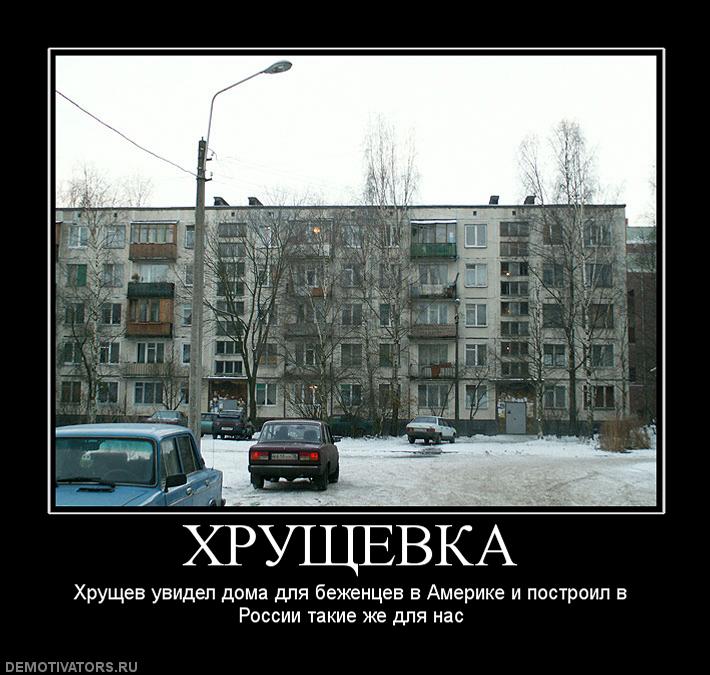
St. Petersburg has plenty of old buildings, too, but those old building in the center of the city might be 18th, 19th or early 20th century. In other parts of the city (the residential regions), you'll find many more buildings built in the 1960s and 1970s, including the infamous “khrushchevki” (named after Nikita Khrushchev, who decided to build cheaper residential buildings in order to help with the housing shortage in the Soviet Union.)
This postcard says - "A Khrushchevka - Khrushchev saw buildings for refugees in America
 and decided to build the same kind for us in Russia."

Novosibirsk is too young for old buildings. By the standards of European Russia (Novgorod, the first city I lived in, is at least 1150 years old), it is just a baby. Novosibirsk's development is tied with the rise of trade and railroad in this region a little over 100 years ago. Yet, you don't get the feeling here that Novosibirsk is behind St. Petersburg in terms of its development; instead, it feels like they are on different paths. One gets the impression that Siberians benefit, to a degree at least, from being far away from the seats of power. I'm reminded of that great line from “Fiddler on the Roof,” when the Rabbi indicates what would be a proper blessing for the Tsar: “May God bless and keep the Tsar... far away from us!” While distance from the capital means less access to some of the resources that are offered there, one gets the impression that this area suffers less from bureaucratic pressure of Moscow and from the “brain drain” affecting western Russia. Overall (and, I must admit, maybe it is just the beautiful fall weather that creates this impression) there seems to be a greater degree of calm here; people seem less stressed out and, therefore, less aggressive. If this turns out to be true, this will be a great help in my life here.


These are some of my first impressions, and perhaps it will turn out that they are way off target. Probably the winter will give a more realistic impression of what life in Siberia is really like. In the meantime, a few pictures:
Another example of feeling like I've stepped back in time - "Montana Jeans" and "Montana Coffee" have disappeared from St. Petersburg, but they were here to welcome me in Siberia. 

The sign in the foreground is all over the city - inside the heart are the letters Новосибирск (Novosibirsk). In the background is a large sign on top of a building on the other side of the street. It's a leftover from the Soviet era, and the store name was дружба ("friendship.")

There are birch and berry-heavy rowanberry trees all over the city.
And pine and cedar trees on the banks of the "Ob Sea," the large reservoir on the Ob river that flows through the city.


08 September 2011

A decade in Russia and a new beginning


It was on the 1st of September 2001 that I arrived in St. Petersburg to begin my year-long internship as a part of the ELCA Horizon Program. I was excited; I was returning to the country I had fallen in love with while a student at St. Olaf, and I would be contributing to the development of the Lutheran church as it re-emerged after 70 years of repression. It would be just one year, but I was aiming to make the most of it – to meet the other interns, to develop good relationships with my supervisors (one from the ELCA and another from Germany), and to be of use in the congregations (first in St. Petersburg and then in Novgorod).
Leading Worship in Novgorod. 2002.
Well, that single year commitment to the church in Russia has now stretched in to its second decade. So much has changed; both at St. Nikolai's in Novgorod and at the Novosaratovka Seminary, there were many moments that inspired and many others that brought disappointment. And now, as I start a new ministry as a pastor in Novosibirsk, I've decided to be more deliberate about publicly reflecting on the life of the church in this country. When I was located in European Russia, I at least had the illusion of being close to the West; now that I'm in Siberia, it is clear that I am far, far away.

Over the next few months, I hope publish updates here no less frequently than once a week. I'm sure that this discipline will give me the chance to pause and get a bit of perspective, while I hope that it will give you a window into life on the other side of the planet.  

Autumn Notes on Summer Impressions


While usually my time in the United States is focused on talking with congregations about ministry in Russia, this time around I found myself being more alert to some of the specific traits of my home country that I have not always appreciated. While I make no claims to any degree of depth here, a few observations: 
  • Public drinking fountains are great. Why buy bottled water?
  • Chicago is impressive; NYC – perhaps more so.
  • At the same time, for this rural boy at least, the drive between Havre and Lewistown through the Fort Belknap Indian Reservation in central Montana was perhaps even more impressive than the cities.
  • The lack of sidewalks in many urban and suburban areas perplexes me
  • Iowa should grow more tomatoes (even at the expenses of growing less corn)
  • I think being in Minnesota in the summer is more difficult than being in Russia in the winter. 
  • Ben and Jerry's is actually too sweet for my taste.
  • I'm thankful that I had the discipline not to even touch a few of those addictive food (Doritos and Oreos primarily) that I made not have a chance to eat again for three years.
Besides that, a few things about family:

  • My grandparents are taking full advantage of life even at their advanced age. I'm happy for them and find that they are a great example. 
  • It was really good to dedicated a few days time simply to spend with siblings and nieces/nephews this time around. I miss them.
And then, about the trip to and from the U.S.
  • After having a couple of significant layovers in the airport in Amsterdam, Natasha thinks that the Netherlands might just be the best country in the world to live in. It seems that everything there is focused on the comfort and happiness of travelers, and it was really a treat to spend some hours there.
  • My flight took me through Munich as well; free coffee and newspapers there means that I feel a special connection to Bavarians.

16 December 2009

Lutheran Churches in Russia Moving Toward Unity

In the past year, the Lutheran Church in which I am working (formerly known as ELCROS, currently known simply as the Evangelical Lutheran Church) and the other historic Lutheran church in the region (The Evangelical Lutheran Church in Ingria - Ingria being the historically Finnish region of northwest Russia), also supported by the ELCA, have made significant steps towards unifying their ministries. The latest declaration of the Lutheran World Federation National Committee, of which they are both a part, testifies to this. I've included an English translation of (most of) their common declaration here. While I see that the process won't be an easy one, it does seem clear that the church's ministries will be strengthened by more mutual interaction and a unification of common efforts.
* * *

Meeting of the National Committee of the Lutheran World Federation

On December 10th a regular meeting of the National Committee of the Lutheran World Federation (which consists of the Evangelical Lutheran Church and the Evangelical Lutheran Church of Ingria) was held. The following statement was issued by the churches:

The Evangelical Lutheran Church of Ingria and the Evangelical Lutheran Church, recognizing their common history of service in Russia, their dramatic experience of testing, repression, and persecution... in the period of atheistic dominance, taking into account the common goals and tasks before our Churches now, the high level of mutual trust, common membership in international and Russian ecumenical organizations, and being led by the words of the Savior “that all may be one”

declare together

In the context of an actively changing world and of new challenges which the contemporary secular worldview create for Christians, questions of our unity gain special relevance for us, historical Lutheran churches. In the time of the open preaching of the Gospel of our Lord Jesus Christ in democratic Russia...our Churches have gained not only an understanding of the necessity of more unity, but also created the necessary spiritual and confessional grounds for such unity. With faith in God's providence as it is realized in the church's life, we declare with hope our decision to strive for a full removal of barriers to the unification of the ELC and the Church of Ingria and call our congregational members to prayerfully support this intention.

ELC Archbishop August Kruze
ELCI Bishop Arri Kugape
ELC Vice-Archbishop, Bishop of the Evangelical Lutheran Church in European Russia, Edmund Ratz.

03 December 2009

Former ELCROS Archbishop, Georg Kretschmar

A man who did much for me personally and the church in which I am working, former ELCROS Archbishop Georg Kretschmar, passed away recently after battling illness for the past few years in Germany. Archbishop Kretschmar was a very serious theological scholar, but also a very kind man. He co-presided when my wife and I were wed in 2003, and showed me great support as a very young teacher at the seminary which was so dear to him. Below you can read a bit more about his life.
_ _ _
On November 19th former ELCROS bishop Georg Kretschmar died in Germany. He was 84.

Georg F.K. Kretschmar was born on August 31, 1925, into a family with a long tradition of serving as pastors in the Evangelical Church in Silesia (Poland). After finishing school in 1943 he was drafted into the army, during which time he was wounded. During his time in the army he visited an Orthodox church in Ukraine and from that moment on made it one of his goals to increase mutual understanding between the Western and Eastern churches.

Kretschmar began his theological studies in Tubingen in 1945, and continued his studies in Oxford and Heidelberg, where, in 1940, he defended his first thesis and became a teacher. He passed his second exam in the Wurtemburg church and did his internship there; in the beginning of 1953 he was ordained as a pastor in Tubingen, where he defended his doctoral dissertation later that year. After a few years there, he taught in the university of Hamburg until 1967, when he moved on to help found the new protestant theology department at the University of Munich. He worked there until 1990, and remained professor emeritus there until his passing.

Georg Kretschmar always understood his church service as an ecumenical service. He was involved in various working groups, and from 1959 to 1991 took part in 12 meeting between the Evangelical Church of Germany and the Russian Orthodox Church. In 1999 the Lutheran World Federation asked that he become a part of the worldwide Lutheran-Orthodox dialogues and lead the Lutheran delegation. This he did until 2004.

In 1989 the Bishop of the German Evangelical Lutheran Church of the Soviet Union, Harold Kalinin, asked Kretschmar to organize educational programs for the church. He agreed and found the job so important than he left his former position at the university. Although he did much for education in the church, this was not his only duties. In 1992 he became the assistant Bishop of the Evangelical Lutheran Church in Russia and Other States (the successor Lutheran church body founded after the breakup of the Soviet Union), and lived in St. Petersburg on a permanent basis starting in 1993. He was elected bishop of the church at the first General Assembly, and his title was changed to Archbishop after the new constitution was adopted in 1999. He was responsible for the largest (in terms of territory) Lutheran church in the world, with 7 regions churches and around 600 congregations in his care. In this period of great change congregations were re-organized and church buildings were re-claimed by the church or built anew in dozens of places. He remained Archbishop of ELCROS until health concerns forced him to retire in 2005.

Besides his work in the church itself, Georg Kretschmar did a tremendous amount of work in various academic fields, in particularly in the areas of church history and biblical theology.

Georg Kretschmar was the father of seven children, one of which has continued the family tradition of serving as a pastor in Bavaria.

26 October 2009

Saturday, October 17

After finding out yesterday that my exit visa is finally ready for me in Rostov, I was able to follow through on my plan to fly from Omsk to Moscow and then, from there, to take the train south. I'm writing now from there...at least until my battery runs out. The day was pretty uneventful, as tomorrow is likely to be – simply being on the road or waiting for the road, while Monday, besides getting my visa, I'll try to do as much possible to prepare for the next step in getting my Russian “green card” - getting a whole bunch of tests at a local hospital, getting a tax idea number... And, so, the blogging will stop until something particularly interesting comes along.

Friday, October 16


My sermon for today was not prepared when we were all held in the room, and so I was working on low sleep this morning. Again, though, I felt like I was given the right words for the situation and the people, and hopefully everyone received a word of comfort.
We spent part of the day continuing to talk about what had happened the night before – it was really important for everyone to be able to express their feelings and care for one another. Then I had anticipated that we would close off the day by trying to do something practical – make a few Sunday School lessons based on what we had covered in the days before. As it turned out, as each was describing the Sunday school situation in his or her own church, it became clear that they also had a lot to share, especially about common problems. This, too, it turns out might be important for the future, insofar as it might be the witness that was needed that makes the church do a bit more on the regional level to meet Christian educational needs in congregations (esp., it seems, in training Sunday school leaders).
The day ended with a common worship service. While my liturgical leadership was far from ideal on my lack of sleep, it was good to be together...ah, and I also need to say how, by the end of the week, I was “converted” by the song book that had been used by the congregation in Omsk on Sunday. One of the seminar participants, Denis, someone I've known a long time, did a lot of music leadership during the week; he showed me that among the 2000 (!!!) hymns collected there, there are dozens that a just fine theologically. It, in fact, made me rather sad to see that the new ELCROS hymnal had missed many good opportunities to bring out different theological aspects that still fit into the Lutheran tradition, as well as bring some musical variety – it's clear after that seminar that the new hymnal will not be able to compete with this other pan-Protestant one (“Songs of Renewal”) in terms of songs that are full of feeling (though I must say that the ELCROS hymnal is pretty good at depressing songs) and more popular with young people.
After the seminar, I had good, in-depth discussions with a couple of the students, and had the opportunity to spend a second evening with Andrey and his wife Lena, and that was a real treat...
Off early in the morning!

Thursday, October 15

Today was an interesting mixture of experiences. On the other hand, we continued our fruitful work with the Bible (not NT); in addition we talked a bit about Luther's Small Catachesis and how it can help us understand God and creation. After that, we talked about a small section of a document the Orthodox church put out - “The Social Concept of the Russian Orthodox Church.” It opened up a whole bunch of things, in particular, related to the ethics (environmental ethics, personal property, social justice) and ecumenism. While the latter didn't get very far, the former was one of the most open and interesting discussions about ethics I've had here – for students at the seminary, we eventually get to the point where they can speak about Christian ethics in a helpful way, but it is usually very difficult to get to that point. After that, we talked just a bit about prayer and then had a very moving time of prayer together.
On the other hand, the day was very hard. At our lunch break I checked my email and there I saw that my grandparents were in a serious (11 car) accident while on the way from Montana to visit my uncle and his family in Denver. We are blessed that they survived; I couldn't tell to much from my parents' email exactly how Grandpa and Grandma are feeling now, though it appears that their injuries are not too serious. Of course, I'm worried, though.
And then, as the day was ending and everyone was going back to their rooms, we learned that two of the girls had had their telephones stolen from their room. They were rather in shock and Dieter and I were sitting and talking with them when others among the church staff decided that they would call the police. When the police came, they rounded up all of us who were there and put us in one room, while trying to scare the thief into the open. It was rather crude theater, though I can understand it, considering it did really look like an “inside job” (the rooms are on the third floor and someone from the outside would be taking a big risk to go up there, besides the fact that they would have to know that we were all at the seminar and that their room would be open and empty at that time). I can even understand why they singled out a few individuals (the girls' roommates, a young many who would be leaving the next day) as suspects, but it seems to me that they went too far. One of the girls was questioned for about two hours; none of the rest of us could leave the room for 4 hrs.
The police eventually left and the phones, not surprisingly, were not found; we all felt pretty rotten after the whole experience... the last day of the seminar will be interesting.

Wednesday, October 14


I'm not sure what to think about the way the seminar is going in terms of the materials we are presenting. For example, we talked about the two creation stories in Gen 1 and Gen 2 and about the different time periods these stories come from... I would have expected some resistance to the idea, actually. But I guess a key element here is the approach we took – we didn't come in with some highly academic theory as to what the sources of OT texts are. Instead, we looked at the texts and compared them, then looked at the history of Israel and its religious development. After that, the idea that different texts were written for different times (and were written for different theological purposes (answering questions like “why?” “who?” and “what does it mean?”) instead of attempting to give accurate and scientific detail (answering the question “how?”).
The most difficult thing today for me was leading and preaching at morning prayer (which happens daily for those who work in the church center in Omsk); I was nervous and am afraid the sermon wasn't well understood. On the other hand I find that working so intensely with a group (from 9 am to 8.30 pm) is really beneficial in understanding what message might be able to reach them.

Tuesday, October 13

The theme of our seminar is “I believe in God the Father;” while at first I had had in mind to do quite a bit of work with them about the relatively difficult to grasp questions about God's existence, the Trinity, etc., we've seen that the students varying levels means that we need to stay closer to the questions that arise directly from relevant Biblical texts. As it turns out, I see how fruitful it would have been if I had started this way with my students in Novosarataovka, too, in those days when I taught Systematic Theology. Knowing the Biblical base and the wide variety of Biblical voices as the texts speak about and describe God helps in a lot of ways – it makes us humble in our claims to “know” what is really unknowable about God; it helps us open up new sides of the witness of the faithful about God (i.e.., when looking at OT names for God, I saw that Hagar calls God “the God who sees me;” it is an image that I really like and that will stay with me for a while); it helps us understand Jesus and his witness about the Father. At any rate, I'm liking it.

Monday, October 12


Yesterday evening I met the seminar's participants, and was a bit surprised by our small numbers. Last year we had around 20, and it looks like this year we'll have around 10. It seems that there are a number of reasons for this, but the prime one being that not many places got the invitation on time. After today, though, I see that our small numbers are not really that much of a disadvantage – we have a few people in the group who are really new to church life (in addition to being quite young), so I'm happy we'll be able to work with them in a smaller group and address the various levels among the students. There were 4 people back from last year, all of whom are quite experienced; I hope we'll be able to make it interesting for them. One of them, Andrey, is a preacher in Magadan, in the northeast part of the country. It turns out that he was on the same flight as I was yesterday. That means he flew first 7 hours to Moscow to the west and then 3 hours to Omsk to the east! Apparently that's the cheapest way to go – there is no train service up there...and don't even ask about roads.

22 October 2009

"I Believe in God the Father." Seminar in Siberia. October 2009.

Since I did not have regular email access on my recent trip to Omsk, I've decided to publish my daily thoughts on the trip a week late. Hopefully, these entries will give a bit of insight into what daily life is like when I'm teaching seminars here.

* * *
As with my travels last year to Omsk, the days rather run together on this trip. Public transport got me to the airport just in time to make my flight to Moscow...where I had to wait 7 hours in the Vnukovo airport before the plane from Omsk was to take off. Vnukovo isn't the type of airport where you can really find things to do for 7 hours, so I tried to read and make suggestions to drafts of student thesis and forget about the clock. The flight took about 3.5 hours, and was relatively unremarkable except for the large quantity of food that they gave us and the scariest moment I think I've ever had in an airplane. At one point, about an hour from Omsk, it felt like we were just plan dropping. Three times in about 30 seconds there was a a loud swooshing... followed by a free-falling sensation. What was particularly strange is that no explanation was given... it did remind that I am thankful for life. :)
My former student, Andrey, picked up me and others at the airport; Omsk isn't a big city (somewhere in the range of 300,000 people?), but its airport is particularly small; what is more surprising, however, is that when you fly in, a bus takes you to the edge of the airport territory and just drops you off outside – you can go over to another building if you have baggage to claim, or simply walk through the airport territory gates.
Omsk is 3 time zones east of Moscow...and that puts you only in western Siberia. The country really is enormous. At any rate, this made it morning but, since I hadn't slept, I was happy that I didn't need to get up except to make it for the Russian language service at 2 pm, which would be just in the other side of the Christ Church Center, where I'll be sleeping for the next week in the “Erlangen” room.
The congregation gives a good impression – their friendly and well-organized and today's preacher (Dean Dieter Grimmsmann, with whom I'll be teaching) was good. The only hard part for me at their services is the hymns they sing. The problem is not at all with the musical style (which I don't know how to describe other than “Baptist,” meaning not classical, yet not quite contemporary piano music played at quite a lively tempo), but the theology of the texts completely contradicts what the Lutheran church tries to teach. I'll have to talk with Grimmsmann about that...

21 September 2009

Third General Synod of ELCROS Undertakes Major Structural Reform

Over 40 delegates from around the Former Soviet Union took part in the General Synod of the Evangelical Lutheran Church of Russia and Other States (ELCROS) September 16-19 in St. Petersburg. They were joined by guests and friends, both local and international, from both Lutheran churches and ecumenical partners.
The Synod, the first since 2005, gathered together around the theme “Fellowship Over Borders;” it was the reality of borders (in particular, cultural and political changes in the post-Soviet climate) that presented the greatest challenge for the delegates. For while all of the churches do face a number of common problems (searching for a new, multi-ethnic Lutheran identity first among them), the legal and financial challenges of remaining together were particularly apparent in the months that led up to the meeting. In the end, delegates made changes to the constitution of the church so as to avoid the legal ambiguities caused by the previous situation, i.e., a single, multi-national church.

The way these changes are to be incarnated are yet to be seen. What is clear at present is that the legal entity that was ELCROS has now become the Evangelical Lutheran Church, uniting two regional churches - the Evangelical Lutheran Church in European Russia in the west and, in the east, the Evangelical Lutheran Church of the Urals, Siberia and Far East. Delegates chose Bishop August Kruze (background, below) of the Siberian church to be the new Archbishop, though Dr. Edmund Ratz (former ELCROS Archbishop - foreground) will remain on for some time to assist in the transition.

The Russian churches will be united with the churches abroad (the largest of which are the German Evangelical Lutheran Church of Ukraine and the Evangelical Lutheran Church of Kazakhstan, which are joined by smaller bodies in Kyrgyzstan, Uzbekistan, Georgia and Belarus) by covenants of agreement and through common ministries, regulated by a committee of delegates from all member churches. At present it is planned that the Russian churches will continue to provide educational, public relations, and women's ministries resources for all of the former ELCROS congregations.

The changes undertaken at this meeting were vast, and it is likely to take a number of years before the effects of the changes become clear. The needs of Lutherans in this area, as they strive to preach the Good News despite small size, isolation, and meager resources, are still great. It is not clear, in fact, that the new structure will meet these needs. And yet, I feel privileged to be accompanying my brothers and sisters here on their journey, and am confident that God will continue to work wonders even through all our flaws and all the challenges we face.

10 September 2009

Dorogi - Russian Roads

There is a saying here attributed Nikolai Gogol - "Russia suffers from two grave misfortunes - fools and roads." When traveling by car here, the latter is particularly apparent. But when it comes to Russia's other roads, its railroads, they make getting around here a relatively easy, if relatively slow, process. Last week, the boys and I helped along our cultural re-integration after the summer away and took the train (36 hrs each way) to Rostov. The reason for this? That takes us back to the first misfortune of Gogol's quote.

That's probably being too harsh. But over the past two years of trying to find a way to avoid the hassles of getting a visa every year (with that chance that I could be rejected), I've not yet learned to love the Russian bureaucracy (or, for that matter, to learn how to spell bureaucracy without spell check). As I attempt to get permanent residency here, I have to get all my documents processed in Natasha's hometown, even though it is one, nation-wide agency that works on immigration questions. In way with my current status I have to get a new exit visa every time I want to leave the country - that happens only in Rostov (where there are only 4 hrs a week available for submitting such
applications), and only after the FSB (the successor to the KGB) does a background check on me (which takes up to 6 weeks). And so, I'll be going to Rostov again in October in order to have the chance to leave Russia in an emergency, or to get to Finland to talk with my dissertation adviser.

Yet, this little adventure is not so bad, preciously because the "fools" seem to have so little in common with the actual people I meet when traveling here. In the 3rd class wagon that we took, sure we were a little crowded (with the 3 of us all sleeping on one of the bunks you see to the right), but the boys and I had lots of people to talk and play with, people who,
inevitably, shared their food and their stories.

The way back to St. Petersburg was particularly
interesting. There our wagon was full of families
with young children, coming back from their vacations in the resort areas or with families in the south. Our neighbors across the aisle were traveling with their 8-month old son, Andrey, who really was interested in his older peers. Since our train got in at 3.50 n the morning, nearly 2 hrs before the subway opened, his parents, Marusa (Maria) and Tolik (Anatoly) kindly offered to give us a ride home with their friend who was to pick them up. This sounded great. And here, Gogol's two grace misfortunes meet.

Maria and Anatoly's friend stuffed all our things into his Russian station wagon and we were off. On the way from St. Petersburg to the seminary (a little over a mile outside of the city limits), we have to pass by a police post. The police can stop any car without reason, and, this time, the Russian station wagon looked like a good target. Our driver got out of the car and showed the police his documents...and didn't come back. 10 minutes. 15. 20. Finally, Tolik went to look for him. Our driver, it turns out, was driving with a suspended license. He was deep into negotiations with the policeman, who was threatening a jail sentence of 15 days. And so, we waited some more. All the money we had between us wouldn't be enough to get him out of the situation, though this was obviously the policeman's hope. And so, eventually, our driver worked it out that the policeman would take him to his apartment to get the remainder of the $1000 it was going to take to get him and the car out of there.

By then, though, the Buerkle clan had already split. It was 5.30 in the morning, and we had been given the rare chance to take an early morning walk down our last stretch of road. For now.

31 August 2009

"Home"

Every two years, as the days of my home assignment draw to a close, I get hit by a rather strange nostalgia - "this will be the last free continental breakfast I'll eat in two years;" "time to stop expecting strangers to make conversation;" "I wonder if it will get over 80 degrees in St. Petersburg in the next 12 months?" These little things that pull me back to my home country, it seems to me, are part of my coping mechanism - they help distract me from the hardest thing about going back to Russia - people. While I'm quite blessed by those with whom I have a chance to serve, our travels this summer helped me realize once again the great group of friends and supporters we are leaving behind, both among those whom we saw and those whom we did not. If you are reading this from the U.S., know just how much I appreciate you. If you are reading this from Russia, know that, even if I might seem a little homesick for the next couple of weeks, I really do consider my life here as my call. I feel privileged to be even a very little part of all of your lives.

01 August 2009

Visits to Sponsoring Congregations

In July, Natasha, Matvey, Martin and I visited congregations throughout the great state of Montana (and its not-so-shabby neighbors, Idaho and Wyoming) as part of our "home assignment" for ministry with Global Mission of the ELCA.


View Summer 2009 in a larger map

If all goes well, here you'll be able to see a map of where we've been so far.

After that I'll be going to Missiouri and California to visit great sponsoring congregations there.


03 April 2009

Russian Orthodox Church Elects New Leadership - the effect on other Christian churches

Elected in the year before the fall of the Soviet Union, Patriarch Alexei II died on December 5th, 2008, after heading the Russian Orthodox Church for 18 years. Alexei, while born into an Orthodox family, had experience with other confessions from his youth - he was born in the capital of then-independent (and mostly Lutheran) Estonia, Tallinn, and spent many of his first years in church service in congregations in that country (by then already a part of the Soviet Union). Alexei rose quickly through the church hierarchy (something which at that time could only happen with the blessing of Soviet officials) and was an active participant in ecumenical affairs in the years before the fall of the Soviet Union. Alexei’s growing up in a predominately Lutheran country and his good relationship with former ELCROS Archbishop Kretschmar certainly contributed to the better-than-average relations between the two communions in Russia.
However, the 1990s showed a slow but consistent movement by the Orthodox church to hindering the work of other Christian confessions here, especially by influencing the laws of registration of religious groups and by attempting to gain a monopoly on the teaching of religion in schools. Granted, many groups deserved to be treated harshly - without seriously attempting to understand Eastern Christianity, it was dismissed as "not Biblical," and therefore no meaningful dialogue was possible. It was no surprise, then, that once elected Patriarch, Alexei did all he could to regain the church’s position in the country (and in the Orthodox world in general) after 70 years of repression. In this he no doubt had a great measure of success. Literally tens of thousands of congregations have been re-opened since the fall of the Soviet Union, and Alexei did much to organize the structures, funding, and educational programs that such restoration required. It is here, however, that there is the most room to criticize Alexei’s (and his successor's, Kirill's) legacy. The church clearly has business interests, though there is no transparency or financial accountability for them. Some have speculated about the wisdom of the symbiotic relationship between the church and the state that has developed in which the church is given access, influence and financial advantages by the while the church gives unquestioning support for government decisions (in particular during the two Chechen wars). In addition, Orthodoxy in Russia faces a challenge insofar as structures of the church are now so closely tied to the surrounding culture that in some ways they also reflect the weaknesses of the culture (for example, corruption).
The importance of Alexei for Russia can be seen by the reaction of the public to his death. Between eighty and one hundred thousand people lined up outside of the Church of Savior in Moscow to pay last respects to Alexei as he lay in state.
The Orthodox Church was fortunate to find a worthy successor of Alexei in Metropolitan Kirill. Kirill was well-known in Russia even before his election as Patriarch in the end of January - he was the Church’s media representative, and led a well-produced weekly program on state-run television. It was this program and some of the things Kirill had to say during its broadcast about other Christian groups that made many non-Orthodox Christians rather nervous when they heard, after Alexei's death, that Kirill was a leading candidate for the post. On the other hand, it also became clear as the months went past that Kirill was not from the "right-wing" of the church - not by far. A recently excommunicated Bishop in the Russian Far East was an example of a reactionary form of Orthodox (rather apocalyptic in character, very anti-ecumenical) that is relatively popular among "serious" believers.

Non-eastern Christians, then, can be glad that the council of the church elected a very talented new leader – a competent theologian, an able administrator, and a successful populizer of Russian Orthodox values in wider society. And while it is probably not realistic to hope for great gains in ecumenical dialogue under Kirill (despite his activity in ecumenical circles early in his career), the Orthodox Church under Kirill should at least have the resources to resist those elements within itself that would tear it out of dialogue with other churches. This gives us good reason to pray for this man, whose influence is great, that he might enable all Christians here to work for clear preaching of the Gospel of Jesus Christ in our words and in our deads.

13 September 2008

Southern Ossetia


After 70 years of particularly cruel treatment by Soviet authorities, this mountain people (for centuries subject to one or another of its stronger neighbors) longed to gain independence. And, as was the tradition amongst nearly all the peoples of the Caucuses, they were willing to take up arms to defend themselves. The fight frequently looked like clan-warfare – kidnappings and public executions, pillaging and rape, blood feuds that could simmer for decades, waiting for the time to be ripe to reap revenge. Yet, this was more than a local conflict – larger powers (with their larger geo-political and economic interests) were involved, carefully planning the course for their goals to be met, regardless of what happened to those ordinary folks who called this mountain country their home.
These words apply not only to the violence in Southern Ossetia and Georgia. Sadly, they could be used to speak of many conflicts (the most well-known of which are the wars in Chechnya) in the past 15 years.
The understanding (and, even more so, the media coverage) of these conflicts look quite different from those writing on different sides of the struggle; western and Russian sources each seem to enjoy painting a black-and-white picture of events that turns one side into a hero and the other side in to “the aggressor.” But what is clear from here is that both sides were aggressive – Russia in laying all the groundwork for war by giving people in break-away regions outside of their country Russian passports (thereby having a reason to come to “the defense of our citizens”) and by resisting changes to the status-quo of de facto independence for Southern Ossetia and Abkhazia, which de jure remained Georgian territories. Russia was even less adept in finding an opportunity to improve its image abroad in its response to what apparently was a military operation initiative by Georgia – instead of remaining as actual peacekeepers, it is clear that the Russian military desired to punish Georgia and, particularly, its president, for trying to re-integrate these regions. Russia’s response was clearly over the top if it were truly interested only in how the peoples of these lands were living. Yet, clearly Russia alone is not at fault. The status quo, no matter how bad it was, was less violent that the all-out war of the early 1990s; these small ethnic groups did truly desire independence and suffered under Georgian rule. It seems that Georgia’s supporters in the West, directly or indirectly, gave the Georgian President reason to think that he could and should take a “now or never” opportunity to bring the territories back into Georgian control. However, Georgia succeed only in pushing the republics further (much further, no matter what one might think about Russia’s recognition of independence for the two territories) away.
And while all of this politics is going on, thousands of refugees pour in Russia from Tskhinvali and surrounding regions, while the Russian military causes enormous damage as it pounds its way through Georgian cities, villages and ports far from the actual zone of conflict.
The last weeks have been filled with two countries’ PR-campaigns, each selling its own version of the war. One sells the story of a victim, beat up by an aggressive bully-of-a-neighbor with no respect for international law or even human life. The other side tells the story of delusional president whose love of power at home (while boot-liking abroad) led him to attempt a “genocide” of one (or two) of the proud peoples of the Caucuses. If one thinks even for a moment about the positions the two sides take in other conflicts (e.g., Kosovo, and especially if one considers the West to be unconditionally supportive of Georgia, as is frequently portrayed here), one loses any illusion that either side is defending any sort of moral principle; instead, each defends their own self-interest (and interest in making the other look bad) at the expense of the simple people who are most affected by these political games.
The human suffering has already been great. The ripple effects are likely to be wider – Georgia is today threatening to cut diplomatic ties with Russia. Does that mean that the young woman the Georgian Lutheran Church who was planning to send to study at our seminary will not be able to make it? Will the rhetoric eventually simmer down, or will we continue to see headlines such as “Will there be War with America?” as one popular and respected Russian news weekly asked on its cover this week?
I would ask you to pray for all political leaders involved in the conflict in one or another – they will need great wisdom to bring the people of the region safely out of the mess that has been made. Prayers, too, that the political conflict does not take on an even more distinct ethnic character – if it does, the up to one million Georgians in Russia and the thousands of Russians in Georgia could become the target of violence. I’d ask you to pray for the churches here, that they could raise a collective and prophetic voice in defense of those who suffer.
As I write this, it seems to me that the worst days of this conflict are behind us. I pray that, by God’s will, I am right.