Showing posts with label Novosibirsk. Show all posts

01 July 2016

Learning in the Northern Caucasus

      It all felt vaguely familiar, until it felt not that familiar at all. The rolling hills, the scrub brush, the empty roads... Yet roaming this landscape were Saiga Antelope instead of the Western Pronghorn of my Montana home.
 

When we did see people, it became clear that not only was I far from the American West, I was far from the Slavic-majority parts of Russia. Instead of the churches (many of them new) dotting the landscape over the previous hundreds of kilometers from St.Petersburg, here the places of worship were Buddhist temples - Kalmykia is the only region in Europe where Buddhism is the most widely practiced religion.

Buddhist temple in Elista, the capital of Kalmykia
     As daylight faded away, we moved further south and west, closer to the Caucasus. It didn't feel like the mountains yet, but as we drove through Budyonnovsk in the pitch dark, we felt close to the region's recent, violent past; we have family friends that witnessed the terrorist occupation of a maternity hospital there in 1995. In the coming week again and again we would find ourselves in places which caused cognitive dissonance when we met with peaceful people in idyllic surroundings (Nalchik, Beslan), knowing the horrible tragedies that had happened there. We wondered frequently – have things really called down, or is it dangerous? Have the peoples of the Caucasus really decided that they feel better as a part of Russia than outside of it, or is the whole region a powder keg?

       But my family and I weren't there primarily to learn about politics; we had come to the Northern Caucasus at the invitation of area Dean Sergei Maramzin in order to take part in congregational events...and only second to get acquainted with the region's nature and culture. We arrived in the small city of Prokhladny (“cool” as in “cool weather”) in Kabardino-Balkaria in time to get settled and have some rest before guests began to arrive for the deanery gathering. That first morning two of our stereotypes were confirmed – yes, there really were a lot more Ladas (Russia-made cars) in the south than in the north. And, yes, Caucasians really know how to do hospitality – the congregation had a refrigerator full of food waiting for the guests who had come from afar. Reflecting back, however, it seems to me that it was only on the roads (where traffic police seem less informed about anti-corruption campaigns than in other parts of the country and where drivers tend to have rather vague understands of the traffic laws) where our stereotypes of the Caucases were once again confirmed. As a rule, we found ourselves surprised...
     One of the ways was through getting acquainted with the congregation in Prokhladny. 
While I knew that some German Russians had formed colonies in the N.Caucasus, I hadn't known that the foothills of Kabardino-Balkaria had become a gathering point for those who wanted to leave their places of Stalin-imposed exile in Siberia, Kazakhstan and Central Asia.
Caucasian generosity on display among Russian Germans in this picture
from the congregations annual harvest festival. 1970s.
The congregation was apparently visited by Bishop Kaunis from Latvia (center).


     The congregation that formed upon their return was strong in the pietist “brother” tradition, much like the congregation I served in Novosibirsk; when it was registered in 1971, it was the biggest Lutheran congregation in the Russian part of the USSR. It had become a gathering point for ethnic Germans since many found it impossible to return to their homelands (especially on the Volga). In Prokhladny Russian Germans purchased a single-residency home and transformed it into space for worship where probably 150 people could sit if they were willing to be stuffed in; they built on and added places for another 50 or so, but old timers told us that many times people would not find a place in the building and would participate in the service while standing in the courtyard. 
     Today the congregation, celebrating 45 years of existence, is small. They were hit hard by a very early wave  of emigration (already in the 1970s), but they did their best to remain true to what they knew. With time they moved the worship service into Russian (with the exception of the hymns, which still are usually taken from the Wolga Gesangbuch), and they try to be good stewards of what they have – taking care of the elderly, of their buildings (including a parsonage – very important if they are going to have a chance to attracting a full-time pastor), and their faith. One advantage they have over “brother” congregations in other places is that that in the Northern Caucasus valuing one's elders and one's heritage is considered very important. For that reason many more young people show up in church than in other comparable congregations; from my short contact with people there, I think that some of them are there to stay. It was a privilege to have a chance to talk with them (and with guests from neighboring Maisk and from other congregations in the region) about critical aspects of Reformation history that might be relevant for congregational life today.


Valery with the older boys at the amazing feast of local, Chechan
food that our new friend and host Said arranged for us.
     Part of long weekend together with believers in the region was a day trip to into mountains; our guide for the day (and our family's great helper for the rest of the week) was Valery Fogel, the head of the congregation in Maisk. Valery has played an important role in the region (and as a synod council member for the whole ELC-ER) for decades; he was born in Kazakhstan and still loves his hometown of Almata, but he's come to appreciate life as in the Northern Caucasus. He has great respect for those who take their faith seriously – whether they be Lutheran, Orthodox or Muslim. He knows the region and its people well; he showed us many sides of life in the region – from the Tsey glacier on the border with Georgia to the moving (beyond words moving, actually) monuments in Beslan (where over 300 children and adults where killed when terrorists occupied the school) to the quaint beauty of Nalchik to Grozny, the pride of the Chechen people as their republic is being rebuilt after the war. I learned much from each of these visits, and I also had a wonderful time growing to know Valery as a brother in faith. 
    A week's visit, though, certainly couldn't give me a clear and full impression of the Northern Caucasus. I was confused (and remain so) about how in Grozny there is now no sign of or memorial to the war that flattened the city just over a decade ago; in Northern Ossetia I wondered about the revival of traditional (shaministic?) forms of faith at the expense of the Orthodox church... I noticed time and again the tensions among the  Caucasian peoples – is there a chance for long-term peace when people have such heightened awareness of tradition (including traditions of disliking certain neighbors)? Why did we see so many positive images of Stalin in the region (on vodka bottles, car stickers, mountain murals) when so many of these very peoples who honor him were targets of repression?… On a less serious note, I still don't know what to think about all the drinking of and bathing in mineral water that seems to be a big part of local understandings of health...
A museum in downtown Grozny with tradition clan defense towers.
It seems that it, and everything else in the city, is brand new.
Martin testing out a mountain
mineral water bath.
     I'm not sure thaat I gained a handle on what is going on in the Northern Caucasus, but after visiting there I'm happy to join Dean Sergei Maramzin's encouraging words - “I wish you a happy upcoming Reformation anniversary, dear Church! You are young, fresh and fit, like a daughter of the Caucasus mountains!” With God's blessing, Sergei, Valery, and others will continue to work so that the message of peace and God's steadfast love continues to echo throughout the mountains and foothills of this beautiful and very interesting region. 

03 November 2012

Days set apart


In Russia not many people celebrate Halloween; fewer still know of Reformation Day or of the western church's celebration of All Saints on November 1st. 

Yet the calendar is full of holidays during the fall, and I've been thinking about them this week. These days are not filled with joyous celebration, but are "holy-days" in the sense that they are "set apart." 1 They are set apart for remembrance.  

The content of that set-apartness, though, varies widely among individuals in this society still recovering from a traumatic past. For some the most important day is no longer celebrated in an official way, though it was the most important of days in Soviet times - November 7th, the day of "The Great October 2 Socialist Revolution."

For others November 4th  is an important day, at least insofar as it is a day off of work; "The Day of the People's Unity" was established in the mid-2000s as an alternative to "The Great October..." The idea behind this holiday is to recall events from the distant past when the Russian people resisted outside invaders. In current practice, however, the day tends to be an excuse for nationalists to get together in rallies and marches.

For a smaller, though no less significant group of people, the true holy day of the autumn is "The Day of Remembrance of the Victims of Political Repressions." On October 30th every year time is set aside to remember those who suffered as a result of political repression in the time of communism, especially in the years of the height of the Stalinist terror, 1937-1938. 


The Resurrection Cathedral
In many cities throughout the country the day was marked by prayer services in Orthodox churches and a public gathering at memorials. In Novosibirsk a priest at the Resurrection Cathedral began the liturgy with a few words of comfort for those in attendance; those present (mostly elderly) held candles and flowers as lists of names were handed to the deacon who chanted them out as the choir echoed "Lord, have mercy."

Last Sunday we in our Lutheran congregation also recalled the victims of political repression. The text for the day could have hardly been more appropriate - Jeremiah 29:  
Thus says the Lord of hosts, the God of Israel, to all the exiles whom I have sent into exile from Jerusalem to Babylon: Build houses and live in them; plant gardens and eat what they produce. Take wives and have sons and daughters; take wives for your sons, and give your daughters in marriage, that they may bear sons and daughters; multiply there, and do not decrease. But seek the welfare of the city where I have sent you into exile, and pray to the Lord on its behalf, for in its welfare you will find your welfare...  For thus says the Lord: Only when Babylon’s seventy years are completed will I visit you, and I will fulfill to you my promise and bring you back to this place. For surely I know the plans I have for you, says the Lord, plans for your welfare and not for harm, to give you a future with hope. Then when you call upon me and come and pray to me, I will hear you. When you search for me, you will find me; if you seek me with all your heart, I will let you find me, says the Lord, and I will restore your fortunes and gather you from all the nations and all the places where I have driven you, says the Lord, and I will bring you back to the place from which I sent you into exile. (NRSV)

The story of exile is familiar to those in our congregation, as much from the pages of their family albums as from the pages of Scripture. If my calculations are correct the parents and grandparents of those in our congregation (Germans from Russia) would have read these words as they gathered secretly in homes in 1948, 1956 and 1964. What might they been thinking? Were they, like the ancient Judeans, searching for meaning in it all? 

It would have been hard to find meaning in Stalin's madness. Perhaps it would have been harder still to listen to the prophet's encouragement to "seek the welfare of the city where I have sent you into exile, and pray to the Lord on its behalf." And most difficult of all might have been believing in the promise offered to the exiles: "For surely I know the plans I have for you, says the Lord, plans for your welfare and not for harm, to give you a future with hope. Then when you call upon me and come and pray to me, I will hear you."

More than 70 years have passed. Germans from Russia still are unsure about their homeland - is it Germany? The Germany their ancestors left two centuries ago no longer exists. Is it the Volga or the Black Sea? Decades of war, misuse and neglect have changed those lands dramatically...and even where the land has been restored, no one is inviting former residents to return. Is it Siberia? If it is, the prophet has words of comfort. He promises that the Lord has a plan; he uses images from Paradise (the garden, the directive to multiply) to help the people of faith to see that God is giving them an opportunity for a new start. 

Part of our ministry here is to encourage German Russians to see that God has accompanied them here, and that God will accompany the next generation of believers as well. If we can encourage them to grow in that trust, it is my hope that we can be a force for the "welfare of the city," that we might cultivate new life here, thus witnessing to our neighbors of God's goodness, even in and through our trials, in days set apart and every day. 


1. reflecting what is said to be at the heart of the Old Testament understanding of holiness.
2. "October" because pre-revolutionary Russia had not switched from the Julian calendar, which is currently 13 days behind the Gregorian calendar. 

26 June 2012

Past, Present and Future


This month I've come face to face with questions of the past, present and future of our church.


Pastor Gernot Friedrich on one
of his trips to the USSR.
Picture from a recent feature
 in the German magazine Spiegel. 
Pastor Friedrich, holding his book,
during his visit to Novosibirsk.
The past came alive to me when our congregation in Novosibirsk had the privilege of welcoming back an old friend, Pastor Gernot Friedrich. Pastor Friedrich is a man with a very adventurous spirit. He has visited dozens of countries and learned a number of languages...but not just for the sake of his own entertainment. In fact, Pastor Friedich was one of the rare people from the West (if one can consider East Germany to be the West!) who had the gall to travel illegally in the former Soviet Union, making friends and visiting Christian congregations along the way. He wrote a book about his adventures called “Through the Soviet Union with a Bible and a Camera;” I had enjoyed reading this book a few years ago...but I was very surprised when he showed up once again in Novosibirsk! It was from him that I learned that he continues to make trips here every other year; he no longer has to sneak Bibles in through customs, but he still brings spiritual (sermons, postcards, home visits, his wonderful singing voice) and material (his offerings helped the congregation install energy-efficient windows a few years ago) support from Germany. Pastor Friedrich knows about the “good old days” of the congregation, when the prayer house would be overflowing with brothers and sisters in Christ, united around their German identity and their Lutheran faith. His faithfulness even in times of drought, like now, is an important sign for the congregation not to lose hope, and not to find value only in being successful in the ways they imagine that from the past. Gernot also by his example continues to live in the present – he went with the new pastor in Novosibirsk to the banya, for example, and after Russia he be traveling on to other new adventures.

The students picked questions at random from each of
the 5 major disciplines taught at the Seminary. They then
had 40 minutes to prepare their answers, which they
presented to us orally.
I was touched to receive a "teacher trophy" from the
students, who also sang a song. 
Then, just last week, I had the opportunity to think about the past, present and future all in a very short time and in one place – Novosaratovka, the Theological Seminary where I worked for most of 8 years. I was invited by the ELCUSFE to go there to take part in the graduation exams of the full-time students. I knew these students well, and had maintained contact with a number of them. The students and staff at the seminary had a very hard year – it was the first year of an experiment with one-course-at-a-time curriculum, developed both with the hope of expanding the potential for participation in the seminary's educational program as well as being the result of simply having too few full-time teachers. Together with the on-going financial and leadership challenges the church faces, it is not quite certain what lies ahead for the seminary – more of this experiment? A different experiment? A pause in educational plans? But for the students (all of whom passed their exams, by the way), there is the burning question of the present – the beginning of their internships. When they finish, they will continue to carry the church towards its future by taking on important leadership positions, as have seminary graduates in Moscow and St. Petersburg, Odessa and Astana, Tblisi and Baku, and to serve as faithful pastors to their flocks throughout the former Soviet Union. Knowing what these graduates have done and will continue to do, I will certainly be an advocate for theological education in this church. How or whether this will be related to Novosaratovka I do not know, but I am convinced that Lutherans in this part of the world will continue to need educated lay and ordained ministers, and I hope that solutions can be found for the financial and leadership problems currently being faced.    

Siberia as Urban Space


In Russia every large urban center finds a day, usually in the summer, to celebrate their “city day.” Novosibirsk's was this past weekend.

Founded in 1893 as “Novo-nikolaevsk” (“novo” meaning “new” and “nikolaevsk” in honor of Tsar Nikolai II), it must have been hard to imagine at that time that the city had the potential to grow into Siberia's largest city. To the north (Tomsk), south (Barnaul), west (Tobolsk, Omsk) and east (Krasnoyarsk, Irkutsk) were cites more than a century old that already functioned as trading and cultural centers for the vast region. Novo-nikolaevsk had really only one reason to be established – to serve as a base for building the railroad bridge across the Ob River. This, apparently, was one of the tricker parts of the building of the Trans-Siberian, and as the bridge was being built it became clear that the location of the settlement provided a number of serious strategic advantages for commerce and transportation.

The city grew quickly in the pre-Revolutionary years, but it did not earn its place as the region's unofficial capital until after World War II. Today the city is a large and growing metropolis of more than a million and a half people, but at the same time it is still in some sense seeking its identity. A recent article I read "Waif-cities" (“Goroda-besprizorniki.”A. Kozmin, S. Chernyshov, A. Popov. Ekspert.#24 (336). 18-24.06.2012. 10-18) put it this way: “Novosibirsk, born almost 120 years ago...quickly turned into a large trading center thanks to its advantageous geographical position. During [World War II] the city gained its industrial identity as a result of factories being evacuated from the European part of the country. Then Academgorodok,” one of the Soviet Union's most significant centers of scientific research, “was built there... but despite all these obvious advantages, there is still no true synergy between these parts of the city, they have been 'sewn together' by history in a chaotic way.”

The state of cities in Siberia is quite important for the fortunes of the territory as a whole, despite the fact that a significant amount of the region's vast mineral resources are located in very isolated areas. Approximately 70% of the population of our state is urban; this is consistent with the rest of Siberia... and urbanization continues. Yet, few of the cities have actually planned well for the changes that have faced them in the past two decades; instead, they've been busy “putting out fires.” Despite a dramatically improved economic situation, there are whole aspects of life that are difficult even to consider (e.g., the state of apartment buildings built in the 1950s-80s), though these problems will only increase. In the meantime the long-term problems of city development affect people on a daily level. To quote from the article again: “morning for a resident of any large Siberian city is full of inconveniences. Leaving his apartment building, the city dweller immediately falls... into infrastructure hell. He has a choice – either to go to work on public transport that is so overcrowded that to he  must use force to push his way through, or else to go in his car and inevitably stand in traffic jams for an hour or two. Just outside of his apartment door he runs into the "charms" of utility companies, Soviet clinics, dying factories, run-down parks and dozens of other urban problems, all of which make it impossible to feel comfortable. At the same time the official press turns out a stream of positive information – about constant road repair, building new bridges and interchanges, opening up new hospitals and parks. But from a subjective point of view it seems that the problems of cities are not being solved in a systematic way. And the government, distracted by impressive, but isolated projects, is not capable of finding real, serious solutions.”

One local architect, Tatyana Taychenacheva, says that the problem is that “we do not have a clear definition of a contemporary city.” This is in contrast to the “subjective feeling that we get from visiting, say, European cities – a person feels comfortable there on an subconscious level.” As the article notes “the economic growth of the 2000s did not bring about an equivalent growth in the level and standard of living...The expectation of people have risen together with their incomes, but their places of living (cities, towns, villages) have almost not changed at all. They still fail meet contemporary demands either in terms of their infrastructure or in terms of the quality of services. The result – a stable migratory pattern to the western part of Russia and to places abroad.” 

This post is getting rather too long, but I hope that it does a bit to explain the context in which I am working...and I cannot help but wonder, perhaps in the case of Novosibirsk, some of its problems could be solved by considering its origin. It was founded in order to build a bridge. If Novosibirsk, located directly in the east/west geographic center of the country, could be the bridge city today, it would be a meeting point for Russia's neighbors from relatively near-by Mongolia, China, Kazakhstan and Central Asia while still being a part of Russia's (mostly) European culture. Of course it is my hope that our churches, too, might make a positive contribution to this bridge-building work between cultures as well as providing a moral voice that calls for the protection of the most vulnerable as new ways of development are sought.  

13 June 2012

Russia Day

The paradoxical nature of Russia was well-captured in the
recent art exhibit "Rodina" ("Motherland,") which opened
at the end of May after twice being banned.
It is appropriate that the holiday named "Russia Day" is one that provokes ambivalent or even paradoxical reactions among those who live in the nation for which the holiday was named. It couldn't really be Russia Day otherwise.


While June 12 was never officially "Independence Day," that is what many people called it for a number of years. And they asked themselves - "Independence? From what? From whom? Wasn't it better to be together (even with tension) than to 'enjoy' the kind of 'independence' we have now?"


The images above contrast various aspects of society
and culture today and in Russian history.

And now, more than 20 years after the fall of the Soviet Union, on a day that was intended to invoke national pride and be a signal of a new way of organizing society, some opposition leaders and ordinary citizens are being harassed just because they want to make their voices heard. On the other hand the country is working hard on many fronts to improve its image and the standard of living of its citizens. There are many, many ways in which Russians can now truly celebrate independence.

Paradox exists both on the level of society as a whole and on the level of interactions between individuals. I've frequently been surprised here both by the way upstanding people could be openly aggressive and offensive, while I've had some of my most interesting (and sometimes quite intellectually and spiritually challenging) conversations with those are drunk or who live a life of crime.


A fire blazed on the upper levels of one
of Novosibirsk's most modern
buildings...while a Soviet-era firetruck
 stands by helplessly.

The fact that this country is full of paradox is why I was attracted to it from the beginning. Russia provides no simple answers. In fact, it is much better at supplying no answers at all, but instead dwelling on the "eternal questions" - "Who is to blame?" "What is to be done?"
Because of this, very little is settled and stable here. As a consequence few people experience a true and deep happiness. Even as a guest in this country, I am not immune to this situation. And, of course, Russia's complicated past and paradoxical present affect the life of the Lutheran church here as well. We as a church still do not“fit in” in so many ways, and it sometimes feels like Lutheranism could fall between the cracks of all of Russia's contradictions.


Yet, maybe we don't need to fit in exactly. Maybe it is enough to share a love for the questions and to avoid the easy answers. We might not be happy, but we are authentic. And true to life, with all its paradoxes.

That is what I will be celebrating as this “Russia Day” draws to a close here in Siberia.


Even after living here more than a decade,
I am sometimes confused by the
things that I see. This picture is
from my neighborhood.


If you look very closely at the picture with
the car parts, you'll see this church
 in the background.


12 June 2012

May Flowers

In my last blog post I promised to provide pictures of May flowers. I've been suprised to see here in Siberia how much time and energy people put into growing tulips, narcissus,  etc. even in the public courtyards that are otherwise simply bare ground, weeds or worse. Perhaps in this way they compensate for the harshness of the winter. In any case I know that observing their efforts to cultive beauty despite real challenges (social and climactic (!) conditions) is one of the things that brings me happiness. The first two pictures are from outside our church building.  


24 May 2012

April and May showers, waiting for flowers...

While Lent saw me spending most of my time in the congregation in Novosibirsk, April and May have "showered" us with guests and with opportunities for travel.

First, Pastor Stephanie Fendler (one of the clergy couple who had responsibility for the Novosibirsk congregation before I arrived) made a brief visit to Novosibirsk before traveling on to Omsk to lead seminars for women and for married couples the ELCUSFE. Our congregation very much appreciated seeing their former pastor, and I certainly enjoyed reflecting with her about the life and development of the congregation. Stevie and Michael are continuing to work for my employer, ELM (Evangelical Lutheran Mission in Lower Saxony), in the area of partner congregation relationships, so I'll be blessed with further opportunities to be in contact.  
Pastor Stephanie is second from right.
While Pastor Stevie was an old friend of the congregation, the next weekend saw the congregation welcoming new guests. Two of them were also from Hermannsburg (where ELM is based), while two others were from Omsk. Niels von Türk and Ingrid
Höse had led a seminar for youth workers in Omsk the week before, together with Vladimir Vinogradov, a recent graduate of the extension program of the Theological Seminary and the coordinator for youth programs in the ELCUSFE. In our congregation Vladimir preached, while Pastor Evgeny Phillipov, the president of the ELCUSFE council, acted as translator and guide. Niels and Ingrid have been in charge or organizing weekend retreats for youth in Germany, usually based upon life and questions of faith in some foreign country. Therefore, in addition to the congregation, I tried to show them some of the sights in Novosibirsk, so that they might get a feel for life in the "capital of Siberia." Niels even joined me in the trip to the banya before my regular Bible study in the rehab center on Sunday nights.

When these four young visitors left for places further south and east, after a few days I moved in the same general direction...but to that in a minute.

The older woman appreciated the opportunity to hear a sermon in
 German; one of the woman in the congregation that morning,
Tamara, kindly agreed to translate for Helmut..
For now I'll remain concentrated on Novosibirsk where, for the third weekend in a row, we had a guest – Pastor Helmut Grimmsmann, Asia secretary for ELM. Helmut has loads of international experience and has been traveling to Russia for 5 years now...so I was proud to be able to offer him something new – a trip to the opera and ballet theater. As I've mentioned in previous posts, it is enormous and pretty impressive. We went toe theater's birthday concert, so were treated to segments by the symphony, both classical and modern ballet, and opera that included an attempt to bring together Stalin, the theater's birth as a part of the Soviet propaganda machine, and the current political environment. I'm not sure that I can say that we liked everything at the concert, but I very much respected their attempts to both entertain and to challenge their audience. Yet, the main purpose of the visit was to speak with Helmut, and he was helpful in talking with the church council about a few practical questions in addition to giving a powerful sermon.

Immediately preceding and in between these visits, I was away from Novosibirsk. First I traveled to Omsk, where 5 days were split between a meeting for all the pastors of our church and the synod consistory (much like a synod council). This visit to Omsk helped me learn a lot more about the life of our congregations in the far west (Urals) and Far East, as well as about the administration of the church. I was once again impressed by the development of ELCUSFE's structures; they show a maturity that compares favorably to some of the other Lutheran churches in the former USSR. At the same time the church structures are still young. One example – until now there have been no written guidelines for determining the process of ordination. Bishop Otte Schaude shared a draft text on this question with the consistory, though discussion with the synod and the pastors and approval of the document will happen only in the coming year.

My second trip took me the farthest east I have ever been – to Krasnoyarsk. There pastors connected with ELM met for two days of Bible study and business. Pastor Gleb Pivovarov was our host, and it was joy to be in his congregation, one of the most rapidly developing in our church. Below left: Gleb talking with Niels; we met with them again in Krasnoyarsk. Below right: a view of the Yenisei River outside of Krasnoyarsk.


In between all of that, regular life in the congregation in Novosibirsk continued. I must admit that I'm struggling a bit to write about congregational life as such, since a blog is probably not the best place to express one's frustration. A short way to express things would be to say that, for cultural and historical reasons, mistrust is the norm for many in Russia, and particularly among the Russian-Germans. This presents particular and rather peculiar challenges to ministry; most concretely right now I am feeling how this slows down the process of new birth (new initiatives and ministries) in the congregation. So, while nature around us is blooming (more pictures related to that to come), May's flowers have yet to break through the soil in the congregation.

Yet, Sunday is Pentecost, a reminder of how God can suddenly breathe new life on to and into a group of weak and scared believers. We'll be praying for the Spirit, and ask your prayers as well.

10 April 2012

Holy Week and Easter

Unfortunately, camera malfunctions meant that I missed what turned out to be one of the highlights of Holy Week - the very beginning, Palm Sunday. That said, I did get my camera working by the end of the week, when it was easy to find people selling willow branches - in Russia, Palm Sunday is "Willow Sunday," palms being rather hard to find in Siberia. 


Palm Sunday was a joy because we did something new and the congregation actually seemed to like it! I was surprised, to be honest. It was nothing too special - we simply gathered outside of the church, carrying our willow branches, said a prayer, listened to the Gospel reading, and walked into the prayer house singing. "We've never done that before!" I heard some of the older woman say after church. And they said it with a smile.


That said, the Maundy Thursday and Good Friday services, which were planned according to fairly traditional western models, were a little too much change all at once. I heard "we've never done that before!" again, though this time there was no smile.


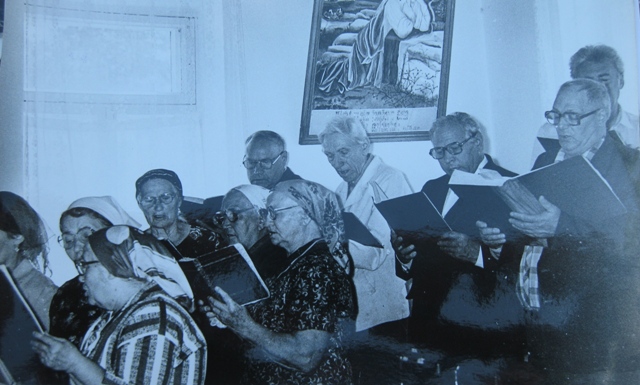
Yet, our woman are tolerant and faithful, and they kept coming. Below are two pictures from the traditional time of singing before the service on Good Friday. Further down are pictures from our Easter morning and Easter Monday services.  


One of the best parts of Easter this year was seeing kids in church again! I hope that we'll be able to build on the small re-start of Sunday School that we had on Easter. 


...but then again, when kids come to church their grandmothers frequently want them to recite poetry in front of the congregation - maybe that's what's scaring them away! :)


I was completely overwhelmed by the flood of baked goods the women of the congregation brought for me on Easter morning - don't be surprised if the latest pictures you see of me make me look a kilo or 5 heavier.


As usual on Sunday nights, together with Slava (far right) and another young man from the Ingrian congregation, Max (far left), we visited the rehab center and led a Bible study on Easter. The resurrection has special meaning for those, like Igor (center) who are in recovery.