Showing posts with label Siberia. Show all posts

15 April 2017

Holy Week in Khakasia

"What do we need to do?"
  This is the question I run into very frequently in all sort of areas of congregational life...but none more so than in the area of worship and ritual. I'm not sure how much of it has to do with the "hardening" of various norms that took place during the church's underground (and later semi-official) existence in the Soviet era and how much of it has to do with the "folk Orthodoxy" shared by many of our neighbors here, a piety that is very rule-based (while at the same time, ironically, not usually very serious about following all of the rules). In any case people are concerned that they do the "right thing"... ad are usually pretty sure that the solution be in the singular. 
  For that reason there is a certain barrier to working on renewing worship here. Church leaders recently dealt with the issue at a seminar for extension students in Novosaratovka, while during Holy Week I had the opportunity to work on this issue "on the ground" as I visited south central Siberia. 
 
With confirmands in Bograd
Palm Sunday in Kuragino


 The region's four viable congregations and other preaching points are served by three dedicated, competent lay ministers who continually seek out ways to improve their ministry skills and to gain knowledge that will help them fulfill their responsibilities. Together with them and Area Dean Vladimir Vinogradov, we decided that it would be good if I could visit them in order to provide them with some additional pastoral support and to introduce them to some of the options for enhancing liturgical worship during this special time of the year. 
  Maybe it's their Montana-like landscapes, maybe it's the people's warmth, but I always feel a bit like I'm coming home when I visit Khakasia. I was privileged to interact with them in an intense week of worship services, theological discussions, Bible study and planning for the future. The preachers, who now have mastered the basics of leading worship, were surprised and excited to hear about the ways our services can be enhanced or altered  on Lenten holy days. They saw and their congregations saw, as I had hoped, that a renewed experience of worship can help us feel closer to the events that took place in Christ's life and bring us deeper into our sense of what that all has to do with our lives.
  I hope that after this seminar lay leaders can feel more confident so that we might dream together of asking not "what do we need to do?" but "what might we be able to do?" 
Zoya Heintse, the region's coordiator, leading worship.

22 October 2013

Walking Together, Though the Road Stretches Seven Time Zones - ELCUSFE XXII Synod Assembly, 18-20 Oct 2013

 ELCUSFE Bishop Otto Schaude, in his opening report to the synod, noted that such assemblies always have to deal with a certain amount of official business. Yet for this church the most crucial thing at these annual gathers is to see that we are not alone, that we are really on the road (-od) together (syn-). While we constantly feel the enormous challenges that come with our being scattered over such great distances, there is a positive side - it is completely obvious that we need and have much to learn from one another. 
  We did engage in important practical questions - from next year's budget to a small-group discussion about new mission congregations, from the blessing of lay preachers to elections for the synod council. Yet the richness of our gathering was felt less in our (nearly unanimous most of the time) voting and more in our sense of being together on the way, despite our differences in pieties, priorities and experience. 
  Below you'll find pictures from our days together - days spent in listening to reports on various ministries (for youth, for women, for men; diaconal, educational, and musical) from our 4 deaneries. I can look at the official assembly minutes if I need to remember the details of one or another of the decisions we made. But the conversations I had with brothers and sisters in faith, their concern for one another and for their neighbor, will stay with me; they convinced me, more than ever, that we are on the road together.  


Nikolai, one of the delegates of our deanery (Krasnoyarsk.)
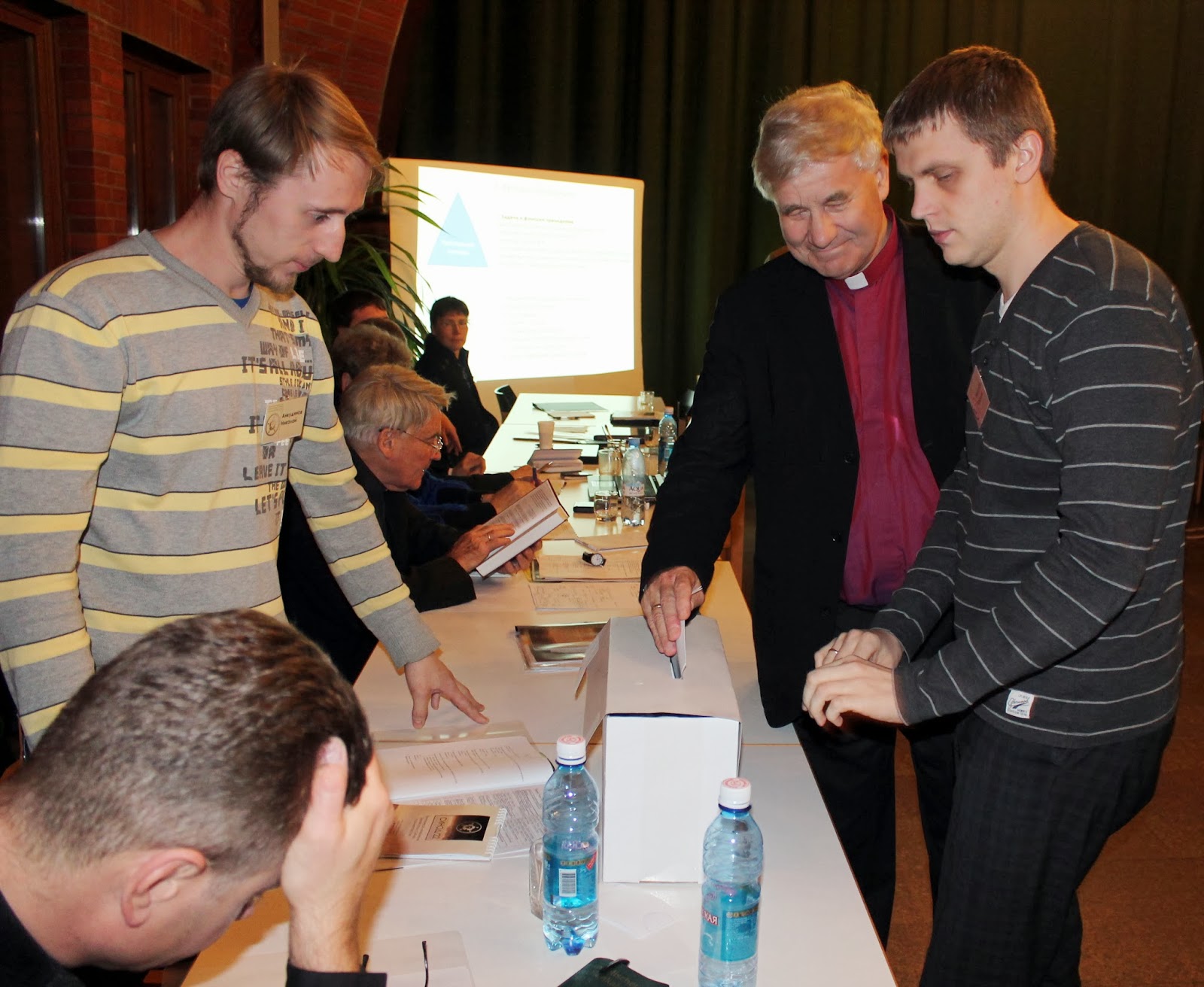
Bishop Schaude voting with a number of delegates from
our deanery in the foreground - Pastor Dimitry from Abakan
(bottom left), Nikolai and Vasily from Tomsk (far right).
Our small group proposed a variety of priorities 
for the development of ministries in our church. 
Synod President Pastor Evgeny Filipov and 
Assistant to the Bishop in the Evangelical Lutheran
 Church of European Russia, Norbert Hintz.
At synod assembly Sister Heidi (who usually serves
  in the Omsk region) and I agreed that she 
would visit  a few of the  congregations in 
my deanery that are dealing with pastoral vacancies.
"A Prayer for the Workplace" will return 
with Vladimir to his home in the Urals.  
Andrey (above) and Evgeny (below) shared the stories 
of their faith journeysbefore being blessed as preachers
 for Magadan (Far East) and Azovo (Omsk), respectively. 

Not just the obligatory group photo, 
but the family of faith, on the way together.  

* * *
  I'll add a few words here for those of you interested in news of the synod itself.
  On the first day of the synod the schedule called for a guest speaker. While Bishop Schaude gave an interesting report in its place, we were saddened not to have had this guest with us. I would usually give his name, but in this case I've decided to be extra cautious - you see, the Central Asian country that he is living in has forbidden him to leave. Our guest not being able to come (as well as the strict limits on his actions within the country) is just one example of how difficult it is for Christians right now in that part of the world. 
  In other news - delegates to the synod assembly are selected here for 5 year terms. This year was an election year, meaning that delegates began new terms and elected a new synod council. Zoya Gentse, the lay person in charge of congregations in the Khakasia region of our deanery, was elected secretary, while Pastor Evgeny Filipov was re-elected synod president.
  As usual we discussed the budget plan for next year; while progress is slow, I see that congregations here are making progress toward the goal of doing more in terms of financial stewardship. This is a particularly important issue here, since most of the staff working throughout the church are paid through the central offices. Offerings from congregations to support ministries continue to increase.
  Based on what I heard at the synod assembly, 2014 should prove to be a very interesting year for our church: recent positive developments in building projects (e.g., in Ekaterinburg and Shelekhov) could mean new walls going up in those two places; a number of church partners plan to visit us (including church and Scout groups on the train); the Omsk congregation will celebrate the 20th anniversary of the church center with a number of events (including a conference co-organized with the state university here - "300 Years of Lutheranism in Siberia"); and we can expect further developments in educational ministries (an area in which I hope to be involved). 

10 October 2013

Abundance in Siberia

  One of the most surprising elements to me of life in Siberia has been the food. After living in Russia for so many years, I thought that I had tried it all - from the sweet and juicy tomatoes of my wife's home in Rostov-on-Don to the cucumber-smelling korjushka (smelt) fish that swim down the Neva in St. Petersburg every spring. 
  
  But I was wrong.
  
  Even today as I was preparing to write this, I tried something new - "zelts." I had to look it up in the dictionary. "Headcheese." I had thought that the aspic-with-floating-meat that I had been eating (or, rather, usually avoiding) throughout the years was headcheese. Wrong again.

Berries in the market
 Thankfully, my learning about food here has not always been related to meat products. This summer, for example, I was in Tomsk at the height of berry season. Every day of the two weeks that I visited the congregation there, I sat down to an enormous bowl of fresh berries, gathered by the family of my host, Ella Romanovna. Honeysuckle. Wild strawberries. Garden strawberries. Raspberries. Gooseberries. The I-don't-know-how-their-names-are-translated berries. Usually with fresh country cream. My days got off to a slow start as I took my time feasting on such goodness. 

Ella's dacha. Strawberries
drying in the foreground. 
   It was there in those days that I was struck again by the fact that stereotypes about Siberia are (usually) quite far from reality. Despite the harsh winters, this is an amazing abundant land. And it was with joy that I had the opportunity last weekend to celebrate that abundance together, once again, with our congregations in the Tomsk parish.
The eyes of all look to you, and you give them their food in due season. Ps. 145:15
  This is the verse of the week, the week of the church's annual Harvest Festival.


 Preaching in Anzhero-Suzhdesnk and Tomsk I spoke about God's abundant grace and about thankfulness as the lens through which we can interpret our life. Despite the fact that many of them face material hardship, they, too, could point to many ways that God was good to them. Even without a pastor of their own, they were thankful that they could together every week, to remind one another that all eyes look to the Lord. Despite a sense of being at a bit of a loss during this intermediate time, they meet to hear again that God gives growth in due season. To be reminded of God's abundance. Even in Siberia. It was reason to celebrate. 
   

A photo of those whom I caught after the meal we shared in
Anzhero-Suzhdensk during the Harvest Festival.


16 May 2013

Siberian Circuit Riders

Earlier this week, I arrived back in Novosibirsk after a trip that lasted two days short of a month. The train took me as far west as the capital of the Urals, Yekaterinburg, and as far east as Lake Baikal.   

The enormous distances in Russia do mean that quite a bit of time was spent simply on the road. While that has a beauty of its own (even in 3rd class train wagons!), the more significant part of the journey involved visiting the people of our congregations. 

My traveling partner for most of the journey was also my boss - Pastor Helmut Grimmsmann, the Asia Secretary of my employer the Evangelical Lutheran Mission of Lower Saxony. I very much enjoyed Helmut's company - asking him about his experience as a missionary in the Central African Republic (25 years!) and reflecting with him about the theology and practice of mission service.

I felt like we were 21st-century, Siberian versions of the circuit riders of the Old West, traveling from one congregation to the next. As a rule Helmut would usually preach and I would translate; it was fortunate for me (since my knowledge of German is so very slim) the Helmut is completely fluent in English. We would then usually have "tea" (which is, more often than not, a very richly prepared mix of sandwiches, salads, cakes and candies) and talk with the people about whatever problems or issues might be facing them. 

Our congregational building in the mining town of Anzhero-Suzhdensk
Visiting with the older women after worship
(while the younger women are preparing "tea")
By the time we arrived in the south-central Siberian region of Khakasia, we had been away from home for more than a week; it would be fair to say that we were not exactly fresh. Yet five intense days of visits in the region lay ahead. One of the Abakan congregation's recent adult confirmands, Marina, took us into her home that first morning and for the next few to follow; her hospitality (and the hospitality of our long time member, Erika, who housed us in Chernogorsk) made it easier to prepare for the days of worship service, business meetings, and many kilometers of road that lay ahead.

The church council president in Abakan, Alexander, made our "circuit riding" possible by driving us faithfully from Kuragino and Roshchinsk in the east to Shira and Bograd in the west. In between he showed us some of the natural and man-made wonders of the region, including the Sayano-Shushenskaya Hydroelectric Dam and, together with folks from Bograd, the Borodino cave.

As we traveled I was struck again how every congregational situation in the region is unique - some are tied with German-Russian heritage, others are not. Some are open and welcoming, others are tightly knit. Some are urban, others are rural. A person with such rich missionary experience as Helmut, however, was able to provide both challenge and comfort to each of them. I was challenged, too, not only by tasks, on the one hand, as translator and the other hand as area dean, but also by Helmut's approach. While in my ministry I have put great effort into being understood by the congregation (i.e., coming as closely as possible to their mindset and values in order that they might hear the Good News in a way they could accept), Helmut put more emphasis on the way the Gospel brings something new into our lives. With such an approach he risked being misunderstood (or, even more likely, not understood at all) by many people in the congregation; on the other hand I was impressed by his willingness to take risks and challenge his listeners' assumptions. I saw that this really resonated with some congregational members, especially those around the “edges” of the church. 

Helmut (foreground) and the congregation in Bograd
Some of the questions that came up repeatedly in our time in the Abakan region were: the need to think creatively about finding long term solutions for community space when in most places we do not own our own, the necessity to improve congregational singing and worship leadership training for lay leaders. In addition Helmut and I thought about and discussed how our congregations' identity and mission are related to the issues above. One of the instruments we use in the U.S. to  help congregations understand better who they are and who they want to be is the mission and/or vision statement. In the coming months I'll be thinking about ways to help our congregations analyze themselves so that they might become more focused on the way God does and can use them as an instrument of challenge and grace in their environments. 

07 December 2012

Khakasia

As I have frequently mentioned in this blog, Lutherans in Russia are quite literally few and far between. This creates a number of challenges for those trying to offer spiritual support for believers here, and one of the ways that this is addressed in the Evangelical Lutheran Church in the Urals, Siberia and Far East is through the ministry of 4 area deans ("probsts"). In some situations the dean acts as the representative of the wider church, in others the most important thing is to be an organizer and fund-raiser, in still other cases the dean's job is focused on education and /or pastoral care. I was appointed "acting dean" for the Central and Eastern Siberia deanery at the synod assembly in October, and the last few weeks had me moving into this role in a new way as I once again left Novosibirsk for travels to other congregations.

My first stop was with the small group associated with our church in Barnaul. As I frequently notice when visiting our congregations, the quality of church members does much to compensate for their small quantity. The women in this congregation, despite their age and weakness, have a serious prayer life and desire to know and apply Scripture in their life. Their dedication impressed me...

But I couldn't stay there long; I needed to be many kilometers east in Khakasia in 2 days time, but simply could not find a direct route there. When I saw, before I left Novosibirsk, that the best option was to take the train and spend a whole day waiting for a transfer in Novokuznetsk, I decided that it was time to think creatively - perhaps I do something useful with those 16 hours? I remembered, then, that there is an independent Lutheran congregation in the city of Prokopevsk, about 30 miles away. I made contact with one of their leaders, and we arranged that I would come to Friday evening prayer service. "A Friday evening prayer service?" you may be asking. Yes. This congregation, with strong piestist roots, has been able to preserve some of the central practices of that tradition, despite the changing times. Perhaps most importantly, they made a decision early (that is, in the 1990s) to start having worship in Russian. This meant that they were able to pass their faith on to the next generation and attract new people as well. I spent quite a bit of time that day with two of the congregation's leaders, Brother Peter and Brother Viktor. They took me around, engaged me in their worship service, and showed great hospitality. I hope that our contacts with that congregation can continue, especially insofar as I find them to be a very good example of how central aspects of older ways of doing things can be maintained and modified in order that the Gospel reach people today.


By the next morning I had arrived in Abakan, where I was able to start the main portion of the trip - more than a week getting to know the numerous congregations scattered through the state of Khakasia and the southern portion of the Krasnoyarsk krai.
The red dots on this map mark the congregations that we
visited in the region. 
Until May of this year the region was served by Pastor Stephan Waganer, who worked for the Evangelical Lutheran Mission of Lower Saxony, as I do. In the meantime, the congregations have had to rely on their own resources. Zoya Gentse, recently blessed as the lay coordinator of the region, has helped them in their journey. I arrived there a few days after the arrival of Pastor Dimitri Schweitz, currently serving in Omsk; he had already visited the two "city" congregations (in the capital of Khakasia, Abakan, and its large suburb, Chernogorsk); ahead lay many kilometers of travel through the steppe of south central Siberia.

The landscape there, especially in the region we visited on the first day, in western Khakasia, reminded me very much of my home in southeastern Montana - rolling hills, wide open spaces, more livestock than people, snow blowing across the road and into the ditch... I immediately felt at home. I also immediately felt that I was visiting a region that is even more seriously affected by poverty than other rural areas I've visited here. One of the two congregations we visited that day (Borets) was very much 
like Barnaul - faithful elderly women who met weekly on their own, even if they hadn't seen a pastor for the better part of a year. In the much larger village of Shira, the congregation was facing quite different challenges; despite having more people engaged in congregational life, they were having a hard time meeting without the presence of a pastor. Part of the problem was practical it is hard to gather everyone together since they live far apart and there is no serious public transportation), while another part of the problem was both practical and spiritual - they do not really feel confident enough to lead worship themselves. Pastor Schweitz, who was born in the USSR (Uzbekistan) and whose family moved to Germany when he was a young man, connected immediately with the people in the congregations - I was happy to have him lead worship, while I considered my main job to be observation and acting as sign of the larger church's care and concern.


In Shira and Borets we saw (without knowing it) examples of the two of the three main types of congregations in the region - one elderly, German-based, and capable of meeting in homes weekly for worship, and the second younger, not necessarily German, and less capable of maintaining congregational life on their own (though with significant potential for growth in this area). It was already clear that one of the areas of ministry for the next pastor in the region would be to work intensely with lay leaders in this second group to help them reach a level where they could meet weekly even without a pastor.


The third group is those 3 congregations in the region that are organized and strong enough to be officially registered. Overall we held Holy Communion services in 8 different congregations (and would have had one more joint worship service for two other congregations were it not for mis-communication regarding time), and were present at a meeting of the "parish council," responsible for joint ministries of the congregations. It is clear that there are a lot of different needs (from a Communion set in Chernogorsk to a new roof for the prayer house in Bograd, from worship leadership training to Bible study), but more than that, what stuck out for me was the gifts that the Spirit had already given to these small communities, and dreams for how ministries in the region might develop further. 

After worship in Bograd, where we blessed their prayer house
after the completion of renovations to the interior.
As we made our way from one congregation to another, the 10th anniversary of my ordination slipped by unnoticed. I thought about it only after my return, when I considered the ways in which God has blessed me in this decade as a minister of Word and Sacrament. It was appropriate that I was "on the move" at this moment; my days as a pastor have not been filled with stability, but have constantly kept me on my toes as I look for what the Spirit might be preparing to do next in my life and in the life of those with whom I serve.

Below: a few more pictures from our journey. 


(All photos provided by Pastor Dimitri - a big "spasibo" to him!)


17 October 2012

21!

In the U.S. the number "21" is almost immediately associated with the age at which young people are no longer legally considered minors. By that time they should have reached a certain degree of maturity, society has determined. Attending the 21st synod assembly of the Evangelical Lutheran Church in the Urals, Siberia, and Far East (Oct. 12-14), I could see that the same can be said of our church. On its 21st birthday, there is already a lot of life experience to look back upon - miraculous developments, tragic mistakes.... And all of it now can be seen in the light of moving towards spiritual maturity. 

This synod saw me "maturing" into my call by giving a sermon at the opening worship and being made Acting Dean ("probst") of the Central and Eastern Siberian Deanery, but much more important was what I saw and heard from others there - the founding of new congregations in the Urals, the pursuit of theological education by people in the Far East, the ordination of a young man from Omsk who grew up in their Sunday School and the installation of a local leader for women's ministries, just to give a few examples.

As with any 21 year-old, there are probably even more challenges lying ahead than behind. This church will continue to grow into maturity as it strives to work on stewardship, questions of theology and liturgical practice (Holy Communion was noted as an area that the pastors will look at during their meeting in the spring), as well as congregational redevelopment in those places that have not been able to adapt to the changing situation here in the past two decades (most especially the emigration of large numbers of German Russians).  

Now it is time to let the pictures do the talking. 

Bishop Otto Schaude reading his report to the assembly.
Bishop of the Evangelical Lutheran Church in European Russia and our Acting Archbishop, Dietrich Brauer, conversing with a delegate from our region, Elma. 


I gave a report on our region, as did leaders from the Far East, Omsk and the Urals.
Pastor Dmitry leading the closing worship.
Youth choir in the Omsk congregation
Ordination of Vladimir Vinogradov


Installation of Tatyana Serebrova as head of women's ministries.
Synod delegates as guests
After the Synod Assembly there was a seminar for
church leaders; I was given the opportunity to feel
 like a teacher for a little while again.

Anastasia was one of my students
in Novosaratovka. She has just
now begun her internship in Omsk...
and she also just celebrated her birthday. 


03 September 2012

Deportation Day Remembered


Citing danger from behind the front lines to to the Red Army as it fought against Hitler, in August of 1941 Joseph Stalin ordered that German Russians be deported from European territories to far-flung corners of the Soviet Union.

By then ethnically German Russians had already been living on the Volga for more than two centuries. Some of them supported the Bolshevik revolution; even for those who did not, the Soviet Union was their homeland, and they were as ready and willing as anyone to defend it from fascism. 

This is one of the reasons why remembering the deportation is particularly painful for German Russians today. They had no sympathy for Nazism, yet because of their language, faith and cultural traditions, they were associated with the enemy. Now, every 28th of August, German Russians gather together to remember the injustice of Stalin's regime (and the regimes that followed) and the innocent suffering their people experienced.  In this part of Siberia a very large percent of Lutherans have their roots in the Volga region; some even remember their childhood homes there. Yet for decades they had no chance to return, and now there is nothing to return to...

Though more than seven decades have passed, for many it has been hard to reach a point of healing. One of the reasons for this is the fact that ethnic Germans (unlike many other minorities that Stalin suppressed) were never officially acknowledged as a “repressed people;” it is as if the government is saying, somehow, that the deportation was justified. And it painful. Both Father Clemens Wert (S.J) (right) at the Catholic cathedral and I tried to address their pain and to bring words of comfort. It wasn't easy, though, insofar as it was not clear the degree to which we could speak with those gathered (first at the Cathedral, then at a chapel outside of the city) as those sharing with us one faith.

Knowing how small our own, Lutheran congregation is, I had hoped to see that the participants (more than a hundred) in the day's services were practicing Catholics (since so few of them are practicing Lutherans). Yet, it was clear by their confusion during the prayer service that that was not the case. Perhaps German Russians today, in terms of religious affiliation, are similar to the wider population, which, to a large degree identifies themselves with a particular faith tradition based on family history, though does not actively participate in any congregation. It comes to mind that, because of their history, perhaps Russian Germans are even more alienated from their traditional faith than others here. 

The day was filled with memories, with prayers, and with the desire to take some lessons from these events, insofar as younger participants are now generations removed from that fateful fall when their grandparents or great-grandparents were  loaded in cattle cars and brought to Siberia.


Retreat in Krasnoyarsk


In the Russian Lutheran church the term “retreat” is unfamiliar (in fact, if any of my Russian-speaking readers know a good translation for the word, please tell me!), as is the practice. However, one of the congregations in our region, the one most willing to experiment, decided to do something new. For 3 days in mid-August, more than a dozen congregational members and friends gathered outside of the city at the dacha of their church council president for Bible study, prayer and fellowship.
Pastor Gleb Pivovarov (above left) organized the event, and chose challenging Biblical texts for study - Jacob's wrestling with a man /an angel/ God (Gen. 32), the book of Job, and Christ's temptations in the desert.

I was asked to lead Bible study on the first day, and I had the joy of dealing with one of my favorite Biblical narratives – the story of Jacob. Many in the group were relatively new to the church, and it was moving to be reminded again together with them of the ways stories of faith that come to us through Scripture can change our outlook on life.
  

Although I could attend only two of the three days, I can say that experiment was a fruitful one. In many of our churches there is a certain degree of passivity, and the congregational makeup is fairly uniform; more concretely, most of our members are elderly, ethnic German women. The congregation in Krasnoyarsk has always differed from the norm in this regard, but in the year and half since Gleb has been in the parish, there has been a large influx of young members. It was really heartwarming to be in a church gathering here with old and young together, going deep into Biblical texts, singing, cooking, and playing games. I hope that the example of Krasnoyarsk will encourage other congregations to expand their ministry in new ways in the future.