Showing posts with label Omsk. Show all posts

13 April 2017

A Retreat in the Russian Forest

  While it certainly wasn't the taiga, the vast forests of more isolated portions of Siberia, the tur baza (more or less like a camp) called “Russian Forest” still made for a good spot for folks from the Omsk region to get away from the city and its cares and to come together to think and pray about how God is calling them to develop.
  If you read this blog regularly you will know that last year Pastor Len Dale (from the Central States Synod) and I made a trip to a number of sites in order to lead short seminars on strategic congregational development. Dean Vladimir Vinogradov liked that seminar enough that he asked that I come back to his region this year for follow-up.

  In mid-March, then, 12 congregational leaders from 5 congregations (Beryovovka, Zvonarev Kut, Kazanka, Azovo and Omsk) in addition to myself and Dean Vinogradov got together for a weekend retreat. Dean Vinogradov led morning and evening prayer based on the Biblical theme of the weekend – Mt. 9.38 – while I led the lessons related to analysis of the congregation's situation, it's gifts and it's potential call as the people of God in that place. In addition to study and application of the book of Acts, we also covered materials that are applicable to almost any organization regarding life-cycles, focus and goal-setting. The mix of the practical and theoretical, of the human and divine elements of the church, brought a lot of life to our discussions, work and plans.
  I'm especially pleased with that result given that it is the first time I've led this topic on my own. We were hindered a bit by a lack of time such that we did less concrete ministry planning than I had hoped. On the other hand, it must be acknowledged that these topics are totally new for most people here, and so it may be unrealistic to expect to move so quickly.
  Because we saw the need for continued work in this area Dean Vinogradov and I agreed that it will be important to find good ways to follow up with those who attended. One option would be to plan a similar seminar (though introducing different tools and with the attempt to go deeper) for next year. A second option would be to try to gathered representatives of larger congregations together insofar as they face a common set of challenges and have significantly more opportunities than congregations with fewer human resources. Another option would be consultation, where someone would come in to help congregations analyze their ministries and mission opportunities. We will see where God leads us, as through the “Equipping for Service” program we strive to continue to increase the capacity of the Russian church to spread Christ's love.


Area Dean Vladimir Vinogradov


28 March 2017

Men's Ministry in Russia

  My years in Russia have taught me that some of my pre-conceived notions about mission and ministry are misguided...or, at least, that they are not completely applicable to this context. One of those examples is "men's ministry." In the past I had a notion that this was a way for men to assert their authority in the church and in their families. This looked a lot like encouraging patriarchy, certainly not something in which I would want the church to be engaged. 
  Here, however, in addition to there being a different set of issues around gender and roles than in the West, there is is the problem of an almost total absence of men in many congregations. "Men's ministry," as I see it being developed here in the Omsk region of Evangelical Lutheran Church in the Urals, Siberia and Far East, is not about re-asserting men's power, but is instead an attempt to help men see that there is a place for them in the church and to give them the opportunity to be surprised both by their potential usefulness and by the support which they didn't even acknowledge that they needed. 
  For that reason I've been hoping to find a way through the "Equipping for Service" program to support an idea I heard at the last synod assembly of the Evangelical Lutheran Church in European Russia. There my successor as pastor of St. Nikolai Lutheran in Novgorod, Igor Zhuravlev, mentioned the lack of men's ministry (despite a thriving women's ministry) at the last ELCER synod. I suggested to him and then to the folks in ELCUSFE that he and I travel to Omsk, where they've been doing such work for a few years. He agreed, and our hope was to go a see a model that we might use to replicate (with certain modifications) in European Russia. 
  We arrived on Friday morning and left Omsk for the  “Admiral Makarov” camp in the early evening. One of the most impressive things about the seminar was the way different types of activities were planned and balanced. We started with bowling and a meal Friday, while on Saturday we had activities that were more about listening (morning prayer, Bible study) or about talking (stereotypes about men, a survey of questions about our live's most significant moments), were more focus was on the physical (winter soccer and capture the flag) or the mental (chess with living figures). 


  Sunday morning was used for morning worship, another activity reflecting on mens' roles, and final reflections before leaving back for Omsk around noon.  By the end of the weekend the seminar's 13 participants had had the opportunity to reflect, be encouraged, experience renewal, and come away with a new sense of brotherhood. 
  If the original goal of this seminar was to help Igor and myself gain confidence and motivation to run a seminar in ELCER, that goal was met. While it would be wrong to underestimate the importance of the unique character of the gathered group (Omsk has a good team of leaders that know one another well) we came away from the seminar with the realization that, because this is a need that is not currently being met, it actually might not be as challenging as we thought to hold a similar activity. Igor and I felt inspired to make further plans, and we hope to test out our ideas at the first men's seminar for the Northwest Russian deanery in May. Dean Vinogradov also saw the potential to build on what has already been accomplished, and he and I are making plans for a church-wide (including participants from other parts of the former Soviet Union) coordinators' seminar in September. 

19 October 2015

Familiar / Unfamiliar

  After a ridiculously long break, today I'm finally renewing work on my blog. Many of those who will read this have already read my newsletter, though, in which I described various events of the past spring and summer. That means that I'll limit myself here to my reflections upon events of the past month, when I've been blessed once again to have the opportunity to travel through Russia to teach through the "Equipping for Service" program.

  In one sense these travels were nothing new. I've been to the Northern Caucuses many times (in fact, the capital of the region, Krasnodar, was my home as a student and then English teacher in 1997 and 1998), so its farm land, hills, mountains and sea are quite familiar... The relative warmth of the region was also quite welcome at a time when St. Petersburg had already seen its first snowfall. On the other hand every visit to the region through the church brings me something unfamiliar. Unfortunately I didn't even know about the existence of a Lutheran church in the region back in the 1990s; today I've been to the congregation's building, met it's church council chair and had many good discussions with the region's new area dean and my former student at the Novosaratovka Seminary, Sergey Maramzin. He has invited me to take part in the regions twice-yearly seminars, organized by the former area

Dean from Germany, Oswald Wutzke (with whom I, regrettably, don't share a common language...otherwise he is clearly a person with whom it would be interesting to speak and learn from his experience both as a politically active pastor in Germany and as a person who for many years has visited the congregations in the Northern Caucuses, including organizing aid for victims of flooding in Krymsk (2012) or for victims of the Beslan tragedy.) Being involved in the seminars is a great way to get acquainted with congregational leaders in this region, which in the past has suffered from a lack of pastoral attention. I saw the familiar situation of ethnic German clubs being the basis upon which congregations originally gather, but rather unfamiliar was the very fact that ethnic Germans remain in the Caucuses. In discussions with participants I also ran into some things that point to a somewhat unfamiliar mindset - on the one hand there is a respect for their Muslim neighbors that I don't see as much elsewhere, while at the same time I ran into more openly patriotic (bordering on nationalistic?) feelings than I usually see in St. Petersburg. Thankfully that generally anti-Western feeling was coupled with a generally positive relationship to me as a western there, so I didn't feel (too?) uncomfortable...(which rather well reflects my general state at the moment...) I hope that I was able to present participants of the seminars there (in the spring - "Images of Jesus," and in the fall "The Apostle Paul") with something unfamiliar enough that they felt like they were learning, but familiar enough that it was all comprehensible.
   My next stop - Khakasia in south-central Siberia. As I've mentioned before, I feel at home there because Khakasia is a Russian version of "Big Sky Country" - rolling hills and mountains, fields and forests, small towns, really good people (even if they are outnumbered by livestock).... Before serving in Siberia, I would have never guessed that such a place was hiding in Russia. I use the word "hiding" not by accident - when I tell people in St. Petersburg that I'm going to Khakasia, they rarely have an idea where that is; it's their own country, but it's unfamiliar....just like almost an Montanan will tell you about conversations he or she's had about our state while visiting big cities in the U.S.
  The theme of the seminar was quite familiar insofar as "conflict" tends to be the most popular topic I teach...on the other hand, congregational leaders in the region wanted me to address humility as well. The challenge was to find a proper understanding of the latter that would help participants see conflicts not only as destructive, but potentially as agents of positive change.

  Later, in Moscow, I ran into familiar people (former students at the Theological Seminary, current students at the seminars that I organize for distance education students) in a familiar place (the dining room behind the altar at St. Paul's Lutheran) while teaching a familiar topic (History of Israel). What was unfamiliar was the first in what it is hoped will be a series of seminars that will lead directly to commissioning of lay leaders for the Central Deanery of the ELCER. There are high expectations for this program, so a particular challenge will be to fit the necessary material into a limited amount of time, but in general this is the kind of unfamiliar that brings me particular joy - signs of development in the church that will be important for its long-term health.

  The tension between familiar and unfamiliar is in its own way productive. After all, if nothing is familiar, then I fee like nothing more than a tourist. If everything is familiar, then I feel like nothing more than a local. If can't help but feeling both at the same time, then I feel like nothing more than a missionary.

20 April 2015

Risk

There are times here in my ministry that I feel like I'm one of the armies in a game of Risk, being
shifted from "Russia" to "Urals" to "Siberia" to "Irkutsk" and back. (I'm still waiting for the opportunity to be shifted to the real Yakutsk or Kamchatka...too bad we don't have any congregations there!) Last week I had the rather odd series of experiences: transversing the continental divide between Europe and Asia 4 times in two days, visiting one of Russia's most vibrant provincial cities (Ekaterinburg) and one of its rather depressed (but in its own way beautiful) industrial neighbors (Nizhny Tagil), of spending time with a congregation that has been without a pastor for almost two years and in the congregations in the "capitals" of Russian Lutheranism, Omsk and Moscow.

The topics of two of the short seminars that I led fit well with the image of "Risk" - Conflict and Introduction to Christian Ethics. I led the latter in geographically-European ELCUSFE congregation in Polevskoe. I've know the congregation's pastor, Denis, for quite a long time, both as a student at the Theological Seminary in Novosaratovka and as a colleague. Since he and his wife live in nearby Ekaterinburg (officially in Asia) our hour-long bus rides took us to a new continent. Denis is quite open-minded, and it seems to me that a small city like Polevskoe particularly needs people like him; there our congregation can be a place both for those with German-Russian roots and for "lost souls" seeking a community.

After two days there I went to visit a fellow missionary living and working two hours north of Ekaterinburg. Mattias and his wife Lena have committed themselves to the "long haul" in circumstances that are far from easy. It was wonderful to share with them a moment of joy along the way; after a few years of meeting in an apartment, the congregation has been given the opportunity to use a former store as their center. They've done renovations there that make it very comfortable, even if the surroundings outside of the walls are not. I will hope and pray that this opportunity for their congregation will open up new doors form them in ministry.

South and east (already outside of "Urals" and in to "Siberia"), Tjumen is a quickly developing city thanks to income from gas and oil in the north part of the state ("oblast") of which it is a capital. The congregation there, too, is a mix of elderly Russian Germans and younger folks who felt attracted by our congregation for one reason or another. People from both of these groups were engaged participants in short lessons that I led about images of Christ and about conflicts.

Fun facts about Tjumen: 1. During WWII Lenin's body was evacuated from the mausoleum on Red Square and brought secretly held in a building of the regional Institute of Agriculture. 2. Rasputin's hometown is not far from Tjumen. Although I didn't make it there this time, I've heard that it is run by a man whom claims to be the grandson of that wild-man monk. 3. Apparently the abundance of newly planted pine trees in the city is a result of influence of a local bureaucrat whose family name ("Yelkin") shares a root (pun intended) with the Russian word for the tree ("Yelki").

And overnight's trip further east still (but still part of western Siberia, 3 hours ahead of Moscow
time), Omsk is a familiar and friendly place (OK, at least the congregation there is. Not everyone gets that excited about the city itself), and I was happy when the newly-appointed Dean of the region, Vladimir Vinogradov, talked with me about the possibility of running a number of seminars there. My experience, though positive overall, convinced once again that it is difficult to give even a short introduction to Christian Ethics in one, 5-hour day.

Catching the plane back west early the next morning, I arrived in Moscow to see that Spring had sprung while I had been away. That said, despite the green grass appearing everywhere, the day was scattered with snow storms. At worship I was privileged to witness a joint service of the "local" congregation and the francophone Protestant congregation that has been celebrating its 15th anniversary.

The theme for the discussion planned with extension education students in Moscow - “Jews and Christians – Paschal Reflections” came about as a result of my experience with inter-religious dialog in Tomsk. There a representative from the local Jewish congregation mentioned that from his point of view, there was no need for the Incarnation, death and resurrection of Christ. While on the one hand this was obvious, I decided that it would be worthwhile to explore the question of what believing Jews of the 1st century might have said about this, especially regarding the sacrificial aspect of Jesus' death and the way various movements did or did not expect bodily resurrection and why. However, we had to keep my program short because of an extra-long worship and because the opportunity arose to make a group excursion together with the congregation's confirmands to Moscow's main synagogue. (Perhaps more about that later). It seemed to me that it would be better to use this opportunity to meet representatives of the Jewish community instead of just hearing me talk about Judaism, and I don't regret that decision. The topic still interests me, though, and I hope that I'll have the opportunity to further develop the material and use it one day.

Now I'm firmly back near the border with "Scandinavia," and have a couple of weeks to recoup before my next turn - headed south for my first visit to the deanery of the North Caucuses. More about that in May.

05 November 2014

Fall Seminars

  The past months have been filled with new opportunities for the “Equipping for Service” educational program for which I am responsible. The core idea of the “Equipping...” project remains the same – “to maximize accessibility to quality educational opportunities in the Evangelical Lutheran Church through a program that is collaboratively planned, flexible, and decentralized,” but in marked contrast to the events of the first part of the year, recently I've been engaged not only in teaching, but also in organizing events.
  The first of these came together at the last minute – “Two Issues in Christian Ethics,” held
in the congregation in Krasnoyarsk. This is an active congregation that values educational opportunities, so I knew that it was possible to try an experiment there - we would talk about Christian ethics. In a society that leans towards either a legalistic or a nihilistic approach to ethical questions, Lutherans sometimes would prefer to avoid the question altogether. But given the conflict between Russia and its neighbors and the influx of refugees from Donbas that have come even to Siberia, it seemed important to me to help our congregational members use their faith to engage these questions. While I hoped to look at the question of "Peace and War," in our two evenings together we only had time to look at the more general question of whom we help and why, which lead us in to the underlying question of how we go about moral decision making in as Christians. The two evenings brought together a total of 24 participants, which I consider to be quite successful given that people needed to take public transport to the church after work in order to attend. I was also very pleased to see congregational members interested in applying their faith to concrete ethical and social questions that surround them. I plan on doing more work in this sphere.


  The second event was south of Krasnoyarsk, in the region of Khakasia.  The region has 10 congregations spread over a 150 mile radius; most of them get only monthly visits from their pastor, Dmitry Schweitz, who was instrumental in helping organize this retreat, which we called "I am a Servant." The
main idea was to support the team of people leading congregations on a week to week basis. We hoped to reach this goal both through fellowship and through thinking about the following questions together - “What does it mean to serve? When do I feel like a servant? How can one serve effectively?” In the process we talked about the way service is understood in society and in the Bible, Jesus as a model of service, love at the center of Christian service, the Lutheran understanding of internal and external call, and our communal call as the church in this place. A number of concrete ideas were raised that the leaders intend to bring to realization – e.g., fund-raisers to help those in acute need, printing fliers about Lutheranism for distribution, and a cooperative attempt to form a new youth group in one of the congregations.  


  And this last month I was very pleased to welcome Pastor Chris Repp back to Russia.Chris had been my mentor when I came to Russia at as a seminary intern in 2001. About 2 years later, he passed on to me the position of teacher of Church History, Systematics and Ethics at the Novosaratovka Theological Seminary. When the opportunity arose to invite him for participation in an academic conference co-organized by the church, we decided that it would be great if he could also have contact with others through the “Equipping...” program. Chris and I chose to lead two 3-day seminars, one in Omsk (Siberia) and one in Ulyanovsk (in European Russia on the Volga). We thought that the title, “Law, Gospel and the Lutheran Confessions Today,” would attract mostly pastors and students. We did have participants from these groups, but it turns out that the topic had wider appeal than we might have expected. In Omsk there were 9 full participants (along with 7 others who were in and out) and in Ulyanovsk a week later we had a very large number – always more than 20, and most of the time around 30. Although the theme of the seminar was the same, Chris and I had to seriously adapt our material to the different audiences we saw, but in both cases I believe that the time we spent together was meaningful. 
  In Omsk the main thrust of my teaching was to help participants see that we do have official confessional documents, though we are far from familiar with their contents and that we need to familiarize ourselves with them in order to decide for ourselves what role(s) they are to play in the life of our church. Chris Repp focused on the issue of Law and Gospel as address in the Augsburg Confession and the Apology, demonstrating why this was important and how it applies to the interpretation of Biblical texts. (In this he has been influenced by the theological approach of the Crossings Community). In Omsk Seminary President Anton Tikhomirov was also with us and he first spoke about the confessions as a textual expression of Luther's Reformation break-through and then traced the development of Western (especially Protestant) theology from that time forward. In Ulyanovsk we kept things simpler, giving the most attention to the uses of the law and Biblical interpretation. In both places local leaders (a special thanks to Tatyana Muramtseva in Omsk and Vladimir Provorov in Ulyanovsk) did an excellent job of solving logistical issues.
Seminary participants in Omsk. Seminary President Anton Tikhomirov is 2nd from left; Chris Repp far right.
Seminary participants in Ulyanovsk. Pastor Vladimir Provorov (red, center) was our host. 
  Many thanks to you for your prayers and support (through the Hermannsburg Mission and the ELCA.) If any of you or your congregations are interested in making a special gift to help cover the expenses related to the “Equipping...” project, you can learn more about that through the ELCA's “Always Being Made New” initiative.

22 October 2013

Walking Together, Though the Road Stretches Seven Time Zones - ELCUSFE XXII Synod Assembly, 18-20 Oct 2013

 ELCUSFE Bishop Otto Schaude, in his opening report to the synod, noted that such assemblies always have to deal with a certain amount of official business. Yet for this church the most crucial thing at these annual gathers is to see that we are not alone, that we are really on the road (-od) together (syn-). While we constantly feel the enormous challenges that come with our being scattered over such great distances, there is a positive side - it is completely obvious that we need and have much to learn from one another. 
  We did engage in important practical questions - from next year's budget to a small-group discussion about new mission congregations, from the blessing of lay preachers to elections for the synod council. Yet the richness of our gathering was felt less in our (nearly unanimous most of the time) voting and more in our sense of being together on the way, despite our differences in pieties, priorities and experience. 
  Below you'll find pictures from our days together - days spent in listening to reports on various ministries (for youth, for women, for men; diaconal, educational, and musical) from our 4 deaneries. I can look at the official assembly minutes if I need to remember the details of one or another of the decisions we made. But the conversations I had with brothers and sisters in faith, their concern for one another and for their neighbor, will stay with me; they convinced me, more than ever, that we are on the road together.  


Nikolai, one of the delegates of our deanery (Krasnoyarsk.)
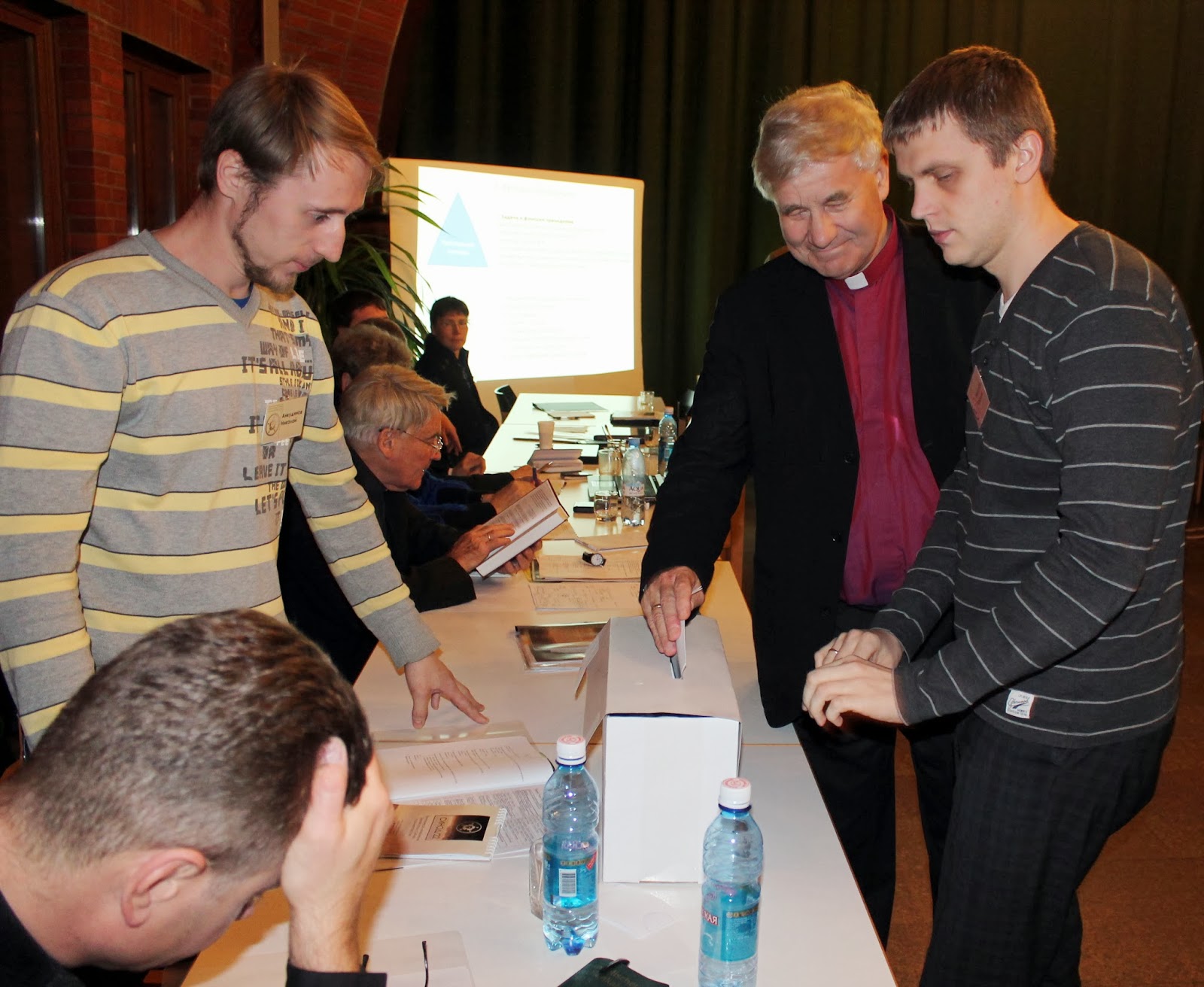
Bishop Schaude voting with a number of delegates from
our deanery in the foreground - Pastor Dimitry from Abakan
(bottom left), Nikolai and Vasily from Tomsk (far right).
Our small group proposed a variety of priorities 
for the development of ministries in our church. 
Synod President Pastor Evgeny Filipov and 
Assistant to the Bishop in the Evangelical Lutheran
 Church of European Russia, Norbert Hintz.
At synod assembly Sister Heidi (who usually serves
  in the Omsk region) and I agreed that she 
would visit  a few of the  congregations in 
my deanery that are dealing with pastoral vacancies.
"A Prayer for the Workplace" will return 
with Vladimir to his home in the Urals.  
Andrey (above) and Evgeny (below) shared the stories 
of their faith journeysbefore being blessed as preachers
 for Magadan (Far East) and Azovo (Omsk), respectively. 

Not just the obligatory group photo, 
but the family of faith, on the way together.  

* * *
  I'll add a few words here for those of you interested in news of the synod itself.
  On the first day of the synod the schedule called for a guest speaker. While Bishop Schaude gave an interesting report in its place, we were saddened not to have had this guest with us. I would usually give his name, but in this case I've decided to be extra cautious - you see, the Central Asian country that he is living in has forbidden him to leave. Our guest not being able to come (as well as the strict limits on his actions within the country) is just one example of how difficult it is for Christians right now in that part of the world. 
  In other news - delegates to the synod assembly are selected here for 5 year terms. This year was an election year, meaning that delegates began new terms and elected a new synod council. Zoya Gentse, the lay person in charge of congregations in the Khakasia region of our deanery, was elected secretary, while Pastor Evgeny Filipov was re-elected synod president.
  As usual we discussed the budget plan for next year; while progress is slow, I see that congregations here are making progress toward the goal of doing more in terms of financial stewardship. This is a particularly important issue here, since most of the staff working throughout the church are paid through the central offices. Offerings from congregations to support ministries continue to increase.
  Based on what I heard at the synod assembly, 2014 should prove to be a very interesting year for our church: recent positive developments in building projects (e.g., in Ekaterinburg and Shelekhov) could mean new walls going up in those two places; a number of church partners plan to visit us (including church and Scout groups on the train); the Omsk congregation will celebrate the 20th anniversary of the church center with a number of events (including a conference co-organized with the state university here - "300 Years of Lutheranism in Siberia"); and we can expect further developments in educational ministries (an area in which I hope to be involved). 

17 October 2013

Harvest Festival Pictures

In my last post I mentioned the Harvest Festival. Here are a few more pictures from celebrations in our church.

This is from my first congregation, St. Nikolai's in Novgorod
The rest of these are from Lutheran congregations in the Urals and Siberia.
Chelyabinsk
Chelyabinsk
Tomsk
Omsk

Omsk
Omsk


04 October 2013

Siberian Summer Camp

  Summer? In Siberia? Despite this region's legendary cold and in contrast to widely-held stereotypes, Siberian summers (at least here in the south) tend to be warm and pleasant. As I saw this year, it's just the kind of weather that is needed for church camp.
Beating the Siberian heat with water games.

   I hadn't worked at a camp in Russia since 1997, when I came to the country for the first time (through Camp Counselors Russia.) Then my Russian was primative, but that seemed to fit the atmosphere of the place where I was working - a complex near Moscow left over from Soviet days and filled with children whose parents seemed to want to get rid of them for the summer. Although that was a good learning experience, I felt much more at home (thanks to my experience in 1995 as a counselor at Red Willow Bible Camp) in the camps held north of Omsk for children of the Western Siberian Deanery this past August. Many of the church's active young people grew up in these camps and have gone on to be experienced and caring counselors; I felt priviledged to work together with them as a member of their team. Although I was only able to visit the young adult camp for one evening, I had the chance to fully participate in the week-long children's camp as one of the camp chaplains. The days were long and intense; this gave me a good opportunity to note that I'm not as young as I used to be! On the other hand diving into all the creativity surrounding games, skits, Bible studies, worship service, etc. not only benefitted the kids, but helped me break out of the rut of thought and action that can accompany "typical" congregational ministry, even in such a non-typical place as the Lutheran church in Russia. 


  I came away from the camps full of hope for the future of the church. I saw gifted and commited young lay ministers who shared God's love with the children; I saw children whose lives were touched thanks to the attention of their counselors and their encounters with the Good News. Knowing that similiar camps are held in various regions throughout the country, I felt blessed to be a part of the ministry of this church.