Showing posts with label Equipping for Service. Show all posts

13 April 2017

A Retreat in the Russian Forest

  While it certainly wasn't the taiga, the vast forests of more isolated portions of Siberia, the tur baza (more or less like a camp) called “Russian Forest” still made for a good spot for folks from the Omsk region to get away from the city and its cares and to come together to think and pray about how God is calling them to develop.
  If you read this blog regularly you will know that last year Pastor Len Dale (from the Central States Synod) and I made a trip to a number of sites in order to lead short seminars on strategic congregational development. Dean Vladimir Vinogradov liked that seminar enough that he asked that I come back to his region this year for follow-up.

  In mid-March, then, 12 congregational leaders from 5 congregations (Beryovovka, Zvonarev Kut, Kazanka, Azovo and Omsk) in addition to myself and Dean Vinogradov got together for a weekend retreat. Dean Vinogradov led morning and evening prayer based on the Biblical theme of the weekend – Mt. 9.38 – while I led the lessons related to analysis of the congregation's situation, it's gifts and it's potential call as the people of God in that place. In addition to study and application of the book of Acts, we also covered materials that are applicable to almost any organization regarding life-cycles, focus and goal-setting. The mix of the practical and theoretical, of the human and divine elements of the church, brought a lot of life to our discussions, work and plans.
  I'm especially pleased with that result given that it is the first time I've led this topic on my own. We were hindered a bit by a lack of time such that we did less concrete ministry planning than I had hoped. On the other hand, it must be acknowledged that these topics are totally new for most people here, and so it may be unrealistic to expect to move so quickly.
  Because we saw the need for continued work in this area Dean Vinogradov and I agreed that it will be important to find good ways to follow up with those who attended. One option would be to plan a similar seminar (though introducing different tools and with the attempt to go deeper) for next year. A second option would be to try to gathered representatives of larger congregations together insofar as they face a common set of challenges and have significantly more opportunities than congregations with fewer human resources. Another option would be consultation, where someone would come in to help congregations analyze their ministries and mission opportunities. We will see where God leads us, as through the “Equipping for Service” program we strive to continue to increase the capacity of the Russian church to spread Christ's love.


Area Dean Vladimir Vinogradov


10 April 2017

Reformation and Partnership

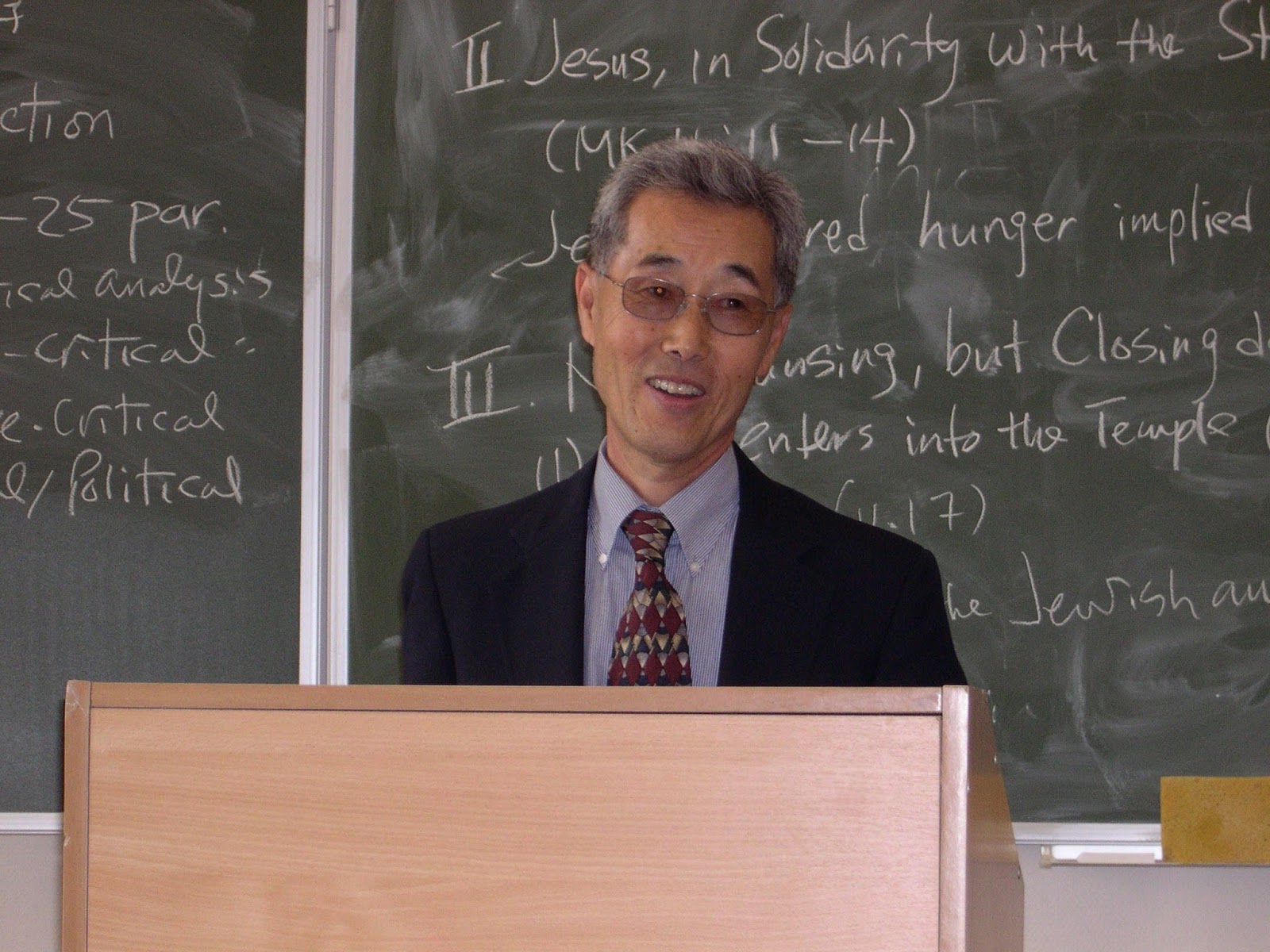
Rev. Dr. Joseph Kang
  From my first year in Russia I've been blessed by the presence of mission workers from the Presbyterian Church (USA) here. THE PCUSA has a very interesting vision of mission here; instead of trying to establish congregations of their own denomination, they put their efforts into helping those churches that have historical roots in the country. Most of their contacts have been with the Baptist and Orthodox churches, but they've supported the Lutheran church in significant ways, too. Two of those that have been most significant in my ministry - Joseph Kang's teaching of Biblical subjects at the Theological Seminary in Novosaratovka, and Ellen Smith's work partnering congregations.
  Ellen has been a good friend and colleague throughout the years, and together with her husband Al they have been really good people with whom to reflect on life and ministry here. We've had ideas about how to actually work together in the past, but only this year did it gain concrete form....and in two different ways within one week. More about the second of those in another post, but the first is related to my latest trip to the Northern Caucasus deanery near the end of March.
  Dean Sergey Maramzin and I had spoken about the continued need of folks in his deanery to gain a sense of what the Lutheran branch of the Christian family is and what it might mean for us to build up the church in this region. With that general idea in mind, we developed a couple of goals for a seminar through the "Equipping for Service" project: 1. To help congregational leaders become “local experts” on Luther and the events of the Reformation in this important anniversary year. 2. To make a first attempt to use the new deanery retreat center in Makhovsevskaya (Krasnodary Krai, not far from Maikop, Adygeya) as a place for educational events Sergey has been working very hard to construct (much with his own hands) a building that could be used for deanery-wide events or simply for individuals looking for a place of spiritual restoration. Having the seminar planned pushed Sergey to make the place livable by the date we had set, and he accomplished that, even if there is still work to be done.
Dean Maramzin, Pastor Pavel
Tkachenko and Ellen Smith
in the church in Novorossisk
  While we were planning, we learned that Bishop Dietrich Brauer had suggested to Ellen that it would be helpful if she try to establish partnerships for our churches, too, starting with the Northern Caucasus region. Ellen, Sergey and I decided that we could combine these things; she and I flew down, then, to visit two congregations (Krasnodar, Novorossisk) and to meet regional leaders at a day-long seminar.
  12 people (including the 3 pastors) from 4 different locations were in attendance; Dean Maramzin kept the number deliberately relatively low insofar as this first use of the retreat center was an experiment; more will get invitations in the future. As it is, though, we were together for most of a good day. While it wasn't too much time (particularly because some of us had to travel great distances - 5+ hours – to get home and the road conditions were poor), it was of high quality - we had fellowship, a meal, conversation, a short sermon on the occasion of the Annunciation (it was March 25, after all), and a basic course on Luther's life and the Reformation. Besides getting to know one another better, the participants also had a good chance to meet Ellen and to hear from her how PC(USA) envisions partnership.


  Sergey, Ellen and I, as we reflected on the weekend, were filled with hope for the potential of what God might do with us and the congregations with which we are in contact. The deanery retreat center has now been "tested" and Sergey mentioned afterwards that now he feels more comfortable using the space for other (education and not-strictly-educational) activities. This was a very important achievement, in my mind, and Dean Maramzin is to be praised for his hard work to make a place for retreat for the church. It is still certainly a work in progress and there is much potential to do more, but even now it is quite usable, with sleeping places (up to 7), seating (for more than twice more than that), a place to prepare food, wash, and a place for outdoor activities. Ellen was also able to get an impression of congregational members in the region and has already started praying for and sharing potential partnerships... and is already recruiting staff for the region's plans to do a day-camp this summer... For my part I heard from seminar participants that they appreciated the way Reformation-area materials were presented in a way that was understandable and accessible, that it helped them bring order to their scattered thoughts on the subject.


  Overall we can see that God has provided for the people of this region and, after a long period of stagnation, how something new is happening there. It is a blessing to be a part of it. 

21 November 2016

Equipping for Service in Perm

The art museum has a large collection
of wooden carvings of Christ, all set
during his trial. I've never seen anything like
this anywhere else in an Eastern Orthodox
context.
   It promised to be a long week.

   When Len and I went to St. Mary's Lutheran in Perm on the first morning of our four day seminar, we found that the pastor (Area Dean David Rerich) had come to the morning session. As had Lilia, a faithful member of the church council. That was all. A large amount of the material we had planned to use would work most effectively only if there were at least four people in the group. I was wondering if we would have to move to “plan B,” which was my doing Bible study lessons around the theme of “hope.” While I would not have been opposed to doing this, I really hoped that the congregations could take full advantage of having the unique opportunity to hear from Len – after all, God willing they'll be able to hear from me some other time!
   The first meeting, though, was not indicative of the rest of the week. After the slow start, by the evening session planned on that first day attendance had increased, and that meant as the week went on we had the chance to cover a full (or at least reasonably full) “tool box” of activities that the congregation could use as part of a concerted effort to work on transformation. Having adequate time allowed us to present more than just a snippet of the process (in contrast to other places on our trip), but instead to show the material according to its natural flow  – starting with the Bible and then moving from there to speak in a wider sense about the ways in which it is possible to live out the Great Commission...or, rather, in the ways this congregation can live out the Lord's call to mission in their particular place. 
   Their place, as it turns out, is really quite wonderful. I was really surprised at how much I
enjoyed the city itself - its history, culture, architecture, and natural surroundings - and congregational members were happy to show us around. They felt blessed to live there and that God has provided them with a historic church building in the city center; they've responded by taking great care of the building and have begun to use it for concerts as well as worship. They also have what is one of the only a few parsonages to have survived the Soviet era. They have room there for the pastor's family to live as well as other space that can be used for various purposes – including, this time, for housing me and Len. They have an active church council and a group of lay leaders outside of the council, some of whom are young and many of whom are well-educated. They've also benefited by having stable leadership; while Pastor Rerich (far left in the picture above) is moving toward retirement (not without some bumps along the way for him and for the congregation) having a reliable leader throughout the years has allowed the congregation to weather the storms that it has faced. 


  Stability, though, is not an eternal or absolute value. Change is also necessary, ,and after our visit to Perm I feel confident that God brought Len and me to the right place at the right time, “equipping for service” in that place for the work God has for them as they move in to the future. I feel privileged that I'll have the opportunity to follow up with them to see how their plans (including living in their draft mission statement and trying new ministries in December and January) have worked, whether they be successful or “excellent failures” (i.e., those failures from which we take something useful for our future development). 

14 November 2016

Transsib |trænz-SÍB| verb [intransitive]
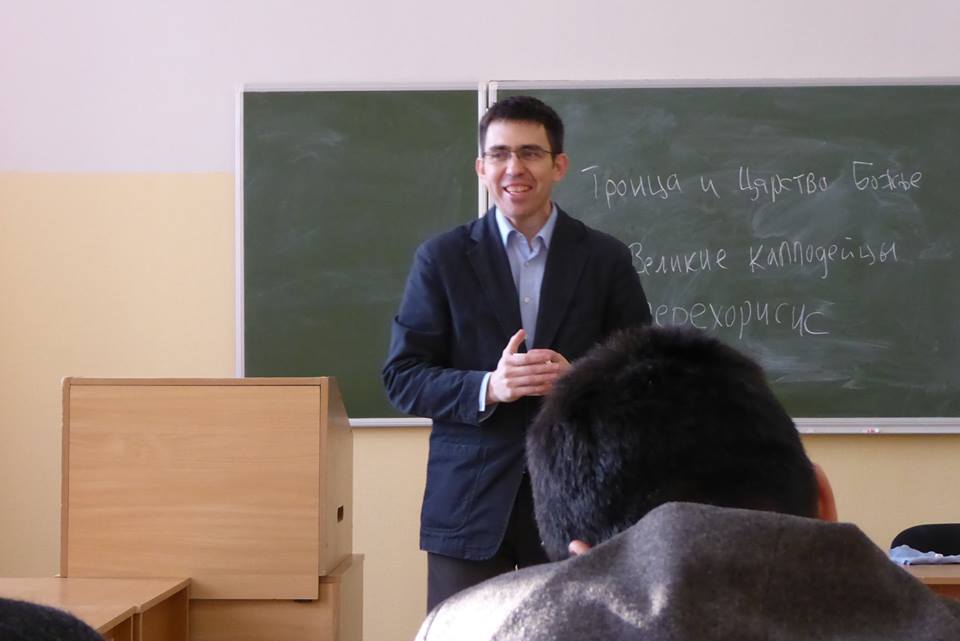
   The title of this entry includes a word that, of course, exists in no other dictionary than the one in my mind. But some words virtually demand to be brought into existence. Riding through northern Asia on the train is certainly a unique mode of travel, and after celebrating its centennial recently I think that the Trans-Siberian Railroad deserves its own verb. 
   Len Dale and I were not on a leisure trip, of course – if  we were we would have found a train that left Khabarovsk at a reasonable hour and whose wagons would have been new and modern. As it was, however, for us the scheduling of congregational events held priority and that meant getting on the train after midnight and putting up with an antiquated system of heating the passenger cars that slowly roasted us over the next few days and nights. 
   I had ridden significant portions of the Trans-Siberian before, mostly in my time in service as a pastor and acting dean based in Novosibirsk. In western and central Siberia it can seem like the birch forests and fields of cereal grains go by at 50 mph for  whole days at a time. There was some birch in the east, too, but also a greater variety of hills, steppe, thick coniferous and mixed forests, rivers and streams. On this trip stops between Khabarovsk and Chita (our next destination) were even less frequent than in other places of the “magistral” – about twice in 24 hours there was a stop of 20 minutes or more, with 1-2 minute stops every four hours or so. I knew that this area (“Zabaikalsky krain” and the “Amurskaya oblast”) was among some of the least densely populated areas along the Trans-Siberian, and we rode through abandoned villages with some frequency. At the same time, there were enough people living there that I thought of what life must be like in rural Siberia, and it made me miss home. 


   As we approached Chita and saw the spreading urban development, I couldn't help thinking about what it is like coming in to Billings – a place that is not very large in terms of its population, but important insofar as it is the biggest town for many miles around. Chita, though, is bigger, older, and draws in people (for shopping, trade, and work) from an entire time zone. As with Magadan, Chita has a reputation in Russia as a city where the people (as the joke goes) have been in prison, are in prison, or are planning to go to prison in the near future. Our experience there, however, was wholly positive; we stayed in the charming older part of the city which, like with almost all Russia cities, has a mix of new buildings, restored older buildings, and buildings that are still occupied though they should be condemned for safety's sake. 

The oldest building in Chita, now a museum, formerly a
church used by the Decemberists who were exiled to Siberia
   We spent three days with the tightly-knit, multi-generational Lutheran congregation there, made up of two or three extended families and explored with them how God might be calling them to develop their ministries. We introduced ourselves and our work there by reading the story of Paul's meeting with Christ in Acts 9, using the very simple method of asking three questions about a text: “What is God doing here?” “What are the people of God doing here?” “How does this apply to us?” These discussions helped us get a sense of what was important to them, which was, most of all, raising their kids (which are many!) in the faith. One of the men there, Viktor, shared how he taught his kids to pray in part because his parents never taught them, and he knows his own life has been enriched thanks to prayer. Together with them we realized that God had put among them a desire to grow in discipleship and Christian education at all levels.
  That is a long-term goal; Len and I were able to meet some of their immediate needs by leading worship with Holy Communion, baptizing a newborn, and preaching at a mid-week worship service arranged to coincide with our visit. Congregation members provided hints that their worship life has suffered recently, mostly due to a lack of a clear leader in spiritual questions. Dean Manfred Brockmann in Vladivostok has made efforts throughout the years to support the congregation by sending interns there, but one of their clear needs is to develop their own lay leaders; Chita is not moving anywhere closer to any other city and the nearest full-time pastor is still two time zones away (in either direction.) I hope that I was able to provide them with the resources they need in order to take steps toward resolving this issue for themselves. We left the city knowing that there is much more to do there and with prayers that they can gain strength both through developing internal resources and by finding new ways to relate to those outside. 


   Then Len and I hoped on the train once again, continuing our westward journey another day to Irkutsk, where Pastor Thomas Graf Grote met us VERY early at the train station. He was our kind guide around the area for the day we were there, taking us to the amazing Lake Baikal – where our walk turned rather meditative as we stopped trying to shout over the wind – and to the impressive museum of wooden architecture, Tal'tsy.

   As we drove around the area and as we conversed with Thomas in his home, he spoke to us about his ministry. This helped prepare us for meeting congregational leaders in Shelekhov, an Irkutsk suburb, late that evening. We began only at 8 pm, since a number of key people were busy until that time either at work or at their (para-church) ministry with developmentally challenged children. (This ministry, together with the other aspects of Pastor Thomas' story, are worth a separate blog post some time...)
 The group of congregational leaders gathered that evening once again brought us hope – they were clearly people who cared deeply about their faith and were open and energetic enough to think creatively about the ways the church might develop. Len spoke with them about congregational life cycles and re-assured them with words he repeated frequently throughout our travels; they sound something like this when translated back into English from the Russian - “God gives you everything you need for mission in this time and this place.” Insofar as the congregation anticipates changes in the next few years, it was a timely conversation, even if it was only a start. From discussions with Pastor Thomas both immediately after the meeting and when we met again a couple of weeks later I learned that in Shelekhov they intend to continue their work together in order to grow in their sense of the Spirit's leading. 
   From Irkutsk we needed to make it quickly to Omsk in order to take part in the last day of the ELCUSFE synod assembly. Regretfully, then, we exchanged the train for a plane in order to catch one of the relatively few flights that directly connects Siberian cities with one another. While the flight was fine, I already missed the train's rhythms, the gently swaying cars, contemplating the scenery for hours on end...everything, actually, except the heat. It was good to know that, though the longest trips were behind us, we still had plenty of transsibing to do before the month was through. 

Transsib |trænz-SÍB| verb [intransitive]

   The title of this entry includes a word that, of course, exists in no other dictionary than the one in my mind. But some words virtually demand to be brought into existence. Riding through northern Asia on the train is certainly a unique mode of travel, and after celebrating its centennial recently I think that the Trans-Siberian Railroad deserves its own verb. 
   Len Dale and I were not on a leisure trip, of course – if  we were we would have found a train that left Khabarovsk at a reasonable hour and whose wagons would have been new and modern. As it was, however, for us the scheduling of congregational events held priority and that meant getting on the train after midnight and putting up with an antiquated system of heating the passenger cars that slowly roasted us over the next few days and nights. 
   I had ridden significant portions of the Trans-Siberian before, mostly in my time in service as a pastor and acting dean based in Novosibirsk. In western and central Siberia it can seem like the birch forests and fields of cereal grains go by at 50 mph for  whole days at a time. There was some birch in the east, too, but also a greater variety of hills, steppe, thick coniferous and mixed forests, rivers and streams. On this trip stops between Khabarovsk and Chita (our next destination) were even less frequent than in other places of the “magistral” – about twice in 24 hours there was a stop of 20 minutes or more, with 1-2 minute stops every four hours or so. I knew that this area (“Zabaikalsky krain” and the “Amurskaya oblast”) was among some of the least densely populated areas along the Trans-Siberian, and we rode through abandoned villages with some frequency. At the same time, there were enough people living there that I thought of what life must be like in rural Siberia, and it made me miss home. 


   As we approached Chita and saw the spreading urban development, I couldn't help thinking about what it is like coming in to Billings – a place that is not very large in terms of its population, but important insofar as it is the biggest town for many miles around. Chita, though, is bigger, older, and draws in people (for shopping, trade, and work) from an entire time zone. As with Magadan, Chita has a reputation in Russia as a city where the people (as the joke goes) have been in prison, are in prison, or are planning to go to prison in the near future. Our experience there, however, was wholly positive; we stayed in the charming older part of the city which, like with almost all Russia cities, has a mix of new buildings, restored older buildings, and buildings that are still occupied though they should be condemned for safety's sake. 

The oldest building in Chita, now a museum, formerly a
church used by the Decemberists who were exiled to Siberia
   We spent three days with the tightly-knit, multi-generational Lutheran congregation there, made up of two or three extended families and explored with them how God might be calling them to develop their ministries. We introduced ourselves and our work there by reading the story of Paul's meeting with Christ in Acts 9, using the very simple method of asking three questions about a text: “What is God doing here?” “What are the people of God doing here?” “How does this apply to us?” These discussions helped us get a sense of what was important to them, which was, most of all, raising their kids (which are many!) in the faith. One of the men there, Viktor, shared how he taught his kids to pray in part because his parents never taught them, and he knows his own life has been enriched thanks to prayer. Together with them we realized that God had put among them a desire to grow in discipleship and Christian education at all levels.
  That is a long-term goal; Len and I were able to meet some of their immediate needs by leading worship with Holy Communion, baptizing a newborn, and preaching at a mid-week worship service arranged to coincide with our visit. Congregation members provided hints that their worship life has suffered recently, mostly due to a lack of a clear leader in spiritual questions. Dean Manfred Brockmann in Vladivostok has made efforts throughout the years to support the congregation by sending interns there, but one of their clear needs is to develop their own lay leaders; Chita is not moving anywhere closer to any other city and the nearest full-time pastor is still two time zones away (in either direction.) I hope that I was able to provide them with the resources they need in order to take steps toward resolving this issue for themselves. We left the city knowing that there is much more to do there and with prayers that they can gain strength both through developing internal resources and by finding new ways to relate to those outside. 


   Then Len and I hoped on the train once again, continuing our westward journey another day to Irkutsk, where Pastor Thomas Graf Grote met us VERY early at the train station. He was our kind guide around the area for the day we were there, taking us to the amazing Lake Baikal – where our walk turned rather meditative as we stopped trying to shout over the wind – and to the impressive museum of wooden architecture, Tal'tsy.

   As we drove around the area and as we conversed with Thomas in his home, he spoke to us about his ministry. This helped prepare us for meeting congregational leaders in Shelekhov, an Irkutsk suburb, late that evening. We began only at 8 pm, since a number of key people were busy until that time either at work or at their (para-church) ministry with developmentally challenged children. (This ministry, together with the other aspects of Pastor Thomas' story, are worth a separate blog post some time...)
 The group of congregational leaders gathered that evening once again brought us hope – they were clearly people who cared deeply about their faith and were open and energetic enough to think creatively about the ways the church might develop. Len spoke with them about congregational life cycles and re-assured them with words he repeated frequently throughout our travels; they sound something like this when translated back into English from the Russian - “God gives you everything you need for mission in this time and this place.” Insofar as the congregation anticipates changes in the next few years, it was a timely conversation, even if it was only a start. From discussions with Pastor Thomas both immediately after the meeting and when we met again a couple of weeks later I learned that in Shelekhov they intend to continue their work together in order to grow in their sense of the Spirit's leading. 
   From Irkutsk we needed to make it quickly to Omsk in order to take part in the last day of the ELCUSFE synod assembly. Regretfully, then, we exchanged the train for a plane in order to catch one of the relatively few flights that directly connects Siberian cities with one another. While the flight was fine I already missed the train's rhythms, the gently swaying cars, contemplating the scenery for hours on end...everything, actually, except the heat. It was good to know that, while the longest trips were behind us we still had plenty of transsibing to do before the month was through. 

10 November 2016

"Sektanty" as Faithful Disciples

  From Magadan Len and I flew south to Khabarovsk; we spent four days with two congregations in the Khabarovsky krai. Clear skies during the flight allowed us to see the incredible beauty of Russia's eastern coast and the Amur River region. The area is very sparsely populated, and from the air it seems to be a vast wilderness inviting you to explore...from what local residents told us, though, bears might not take too kindly to human visitors tramping through their territory!


  Well, we didn't have any time for camping anyway. Our hope instead was to raise questions and provide tools for congregations that might help them develop a sense of their own, particular call in and for their communities. Len provided many years of experience in the field and knowledge about the process of congregational transformation; my job was to translate and, from time to time, adapt and add in a way that would be appropriate to the cultural context.
  One of the realities that we ran in to again and again is the degree to which Lutheran (and any non-Russian Orthodox, really) congregations are at a disadvantage here in terms of people's stereotypes. “You don't have a church building?” their neighbors ask. “Well, then you must be a 'sektanty' (said with the same intonation that we might say “cult members” in English to speak of those who belong to a dangerous religious group). People who are less set in their stereotypes might ask - “how does your faith differ from Christianity?” You can imagine, then, what a challenge it is to even get a sense of how to talk to people in a way that witnesses to the Gospel without in any way “stealing sheep” from our sisters and brothers in the Orthodox church.
  In the Far East, though, groups of mostly professional people (doctors, musicians, artists, businessmen and most especially teachers) have found their way to our small congregations and have made their spiritual home there. Because of their life situation, though, they run in to a problem we see frequently in the West – the busyness of lay leaders, some of whom are on the edge of burnout. On this trip I noticed again just how difficult it is for working-age people to find time to meet on weekdays, and so our first couple of mid-week meetings were rather disappointing. By the weekend, though, we were visiting St. Catherine's Lutheran, a congregation that was dealing with yet another extra layer of difficulty – their location. Located a 6+ hour bus ride north of the Trans-Siberian railroad, they get pastoral visits even less frequently than others in the region.
  In spite of that, the congregation remains committed to the Gospel and to one another, led by a team of gifted lay women. Len and I found it a joy to work with them and to share in their fellowship. It is my prayer that the Lord would provide opportunities for them to widen their circle so that others may join them on the journey of discipleship.  


09 November 2016

Far, Far East

Ernest Neizvestny “Mask of Sorrow”
Monument to GULAG victims 
  It's not every day that one gets to Magadan, a city in Russia's Far East that even in Russians minds is associated with stereotypes about Siberia – cold, isolation, gold mines, prison camps...did I mention cold? As I flew in to the city on October 1st the needles had already dropped from the larch trees and were covered with a fresh dusting of snow; the long winter was about to begin.
  Yet the reality of Magadan was much more complex than the stereotypes. Yes, the Kolyma region is very cold, but Magadan itself is saved from the worst of it thanks to the mountains surrounding the city and its port. Yes, mining was a big part of the region's economy, but today it is no longer at the center. And the camps? Well, Magadan knows its past and, unlike much of the country, makes a serious attempt to confront it – through moving memorials, museum exhibits and, most of all, the stories of survival passed on from one generation to the next. 
  What everyone has right about Magadan, though, is its isolation. Yet being “geographically marginalized” was part of the reason that I made it there. The “Equipping for Service” project for which I am responsible devotes special attention to those areas for whom Christian education is not accessible; for that reason Magadan became the first stop on a month-long journey that Pastor Len Dale (recently retired Director for Evangelical Mission in the Central States Synod of the ELCA) and I made through Russia visiting Lutheran congregations.
  Len and I were welcomed into the small Lutheran family in Magadan in order to listen to their stories and to try to encourage them to see how God might be calling them in to the next chapter. Their long-time leader, lay preacher  Andreas Olzols, together with their new chairman Yur Fogel, shared their own stories and their insights into their congregation's life. Throughout the years they've had hopes to have their own full-time pastor, but each time they've been disappointed. Dean Manfred Brockmann makes it up to visit them when he can, but Magadan is accessible only by plane, and tickets are expensive. Visiting the city is expensive for another reason, too – since almost all food (except the amazing local fish and crab) has to be brought in from the outside, it can be many times more expensive than in the rest of the country. Utility prices
(including for the congregation's apartment, where they meet for worship, have fellowship and put up guests) are also twice as expensive as elsewhere; these factors, together with the decreasing population of the city, make it easy to become depressed. While we were obviously unable to solve these problems, our hope in our time together was to help them see the multitude of gifts that God has given them and to concrete on using those gifts in a way that is most effective and life-giving. 
  If we were able to help them focus on their possibilities for mission (while not ignoring the challenges) then the resources spent on this visit will have been worth it. One small story heartened me; as Annete from the congregation was giving us a tour around the city and was telling us about the climate, her daughter Marina piped up with: “I don't like summer!” This was surprising to hear from a little Russian girl, so I asked her “why?” Her answered had everything to do with snow – she was a serious skier, and practices in the summer, she said, are rather boring. I thought that was great – if you live in Magadan, you'll be much happier if you love snow! In life it isn't possible to totally avoid such “negative” phenomena as summer (even in Magadan), but your much more likely to have a sense of God's grace if you focus on what you have instead of what you don't. 


12 February 2016

Exploring Eschatology

The more challenging the times, it seems, the more apocalyptic themes come to the forefront of our thoughts. Given Russia's current economic difficulties and problems on the international scene, it was no coincidence,then, that eschatology was the topic of our latest seminar for distance and extension students in Novosaratovka. And even if the timing of the seminar meant that we had somewhat few participants that we would have liked (it was hard for many to get off of work in late January when the New Year's / Christmas holidays ended on the 11th), the ground we covered will serve them (and our church) well, in times of high tension and in times of peace.

It was with this in mind that I approached the two topics I led during this seminar - "Theology of Hope" and "Pastoral Care of the Dying and Grieving." The latter set of lectures was a very basic introduction that probably only raised the curtain a bit on questions of our own mortality; these issues, of course, affect our ability to give pastoral care in end-of-life situations. A number of students expressed that even this short introduction was enough to give them a new approach based upon God's love shown to the suffering through listening, presence and empathy, instead of always trying to provide "answers."
As a part of this class we read from Lev Tolstoy's "The Death of Ivan Ilyich." It has been quite some time since I've used my own preferred method for thinking about theology - through great literature - in the classroom setting. But in my lessons of "theology of hope," too, literature was very useful. When explaining the context of the birth of Jurgen Moltmann's theology, we spoke about the difficulty of doing theology "after Auschwitz," and read from Elie Wiesel "Night." But to emphasize that the problem of enormous suffering that we humans cause one another is not specific to Germany, we also read from 2015 Nobel Literature Prize winner Svetlana Alexievich's "Second Hand Time," which tells many sad, sad stories from the point of view of ordinary people in Soviet (and post-Soviet) Russia.

Faced with headlines predicting total economic collapse and/or World War III, I find it particularly important to hold fast to a vision of God's coming reign and to use that vision to inform our daily lives. I hope that I was able to pass on this aspect of Moltmann's theology in my lessons. From the response of the students and the eagerness to which they responded to the news that (finally!) one of Moltmann's major works will be translated into Russia - our own Anton Tikhomirov is working on "The Coming of God" - I believe that I was successful. 

Students were also inspired in another way by studying eschatology - they saw the degree to which doing theology is a creative process. As one student told me, during this course she saw that theology is not simply about finding new ways to defend old dogmas, but that it rises out of our own experience interacting with Scripture and with the experiences of others. I am encouraged when I see people in this still emerging church ask new questions and welcome one another on the road of exploration.