Showing posts with label Evangelical Lutheran Church of the Urals. Show all posts

19 October 2015

Familiar / Unfamiliar

  After a ridiculously long break, today I'm finally renewing work on my blog. Many of those who will read this have already read my newsletter, though, in which I described various events of the past spring and summer. That means that I'll limit myself here to my reflections upon events of the past month, when I've been blessed once again to have the opportunity to travel through Russia to teach through the "Equipping for Service" program.

  In one sense these travels were nothing new. I've been to the Northern Caucuses many times (in fact, the capital of the region, Krasnodar, was my home as a student and then English teacher in 1997 and 1998), so its farm land, hills, mountains and sea are quite familiar... The relative warmth of the region was also quite welcome at a time when St. Petersburg had already seen its first snowfall. On the other hand every visit to the region through the church brings me something unfamiliar. Unfortunately I didn't even know about the existence of a Lutheran church in the region back in the 1990s; today I've been to the congregation's building, met it's church council chair and had many good discussions with the region's new area dean and my former student at the Novosaratovka Seminary, Sergey Maramzin. He has invited me to take part in the regions twice-yearly seminars, organized by the former area

Dean from Germany, Oswald Wutzke (with whom I, regrettably, don't share a common language...otherwise he is clearly a person with whom it would be interesting to speak and learn from his experience both as a politically active pastor in Germany and as a person who for many years has visited the congregations in the Northern Caucuses, including organizing aid for victims of flooding in Krymsk (2012) or for victims of the Beslan tragedy.) Being involved in the seminars is a great way to get acquainted with congregational leaders in this region, which in the past has suffered from a lack of pastoral attention. I saw the familiar situation of ethnic German clubs being the basis upon which congregations originally gather, but rather unfamiliar was the very fact that ethnic Germans remain in the Caucuses. In discussions with participants I also ran into some things that point to a somewhat unfamiliar mindset - on the one hand there is a respect for their Muslim neighbors that I don't see as much elsewhere, while at the same time I ran into more openly patriotic (bordering on nationalistic?) feelings than I usually see in St. Petersburg. Thankfully that generally anti-Western feeling was coupled with a generally positive relationship to me as a western there, so I didn't feel (too?) uncomfortable...(which rather well reflects my general state at the moment...) I hope that I was able to present participants of the seminars there (in the spring - "Images of Jesus," and in the fall "The Apostle Paul") with something unfamiliar enough that they felt like they were learning, but familiar enough that it was all comprehensible.
   My next stop - Khakasia in south-central Siberia. As I've mentioned before, I feel at home there because Khakasia is a Russian version of "Big Sky Country" - rolling hills and mountains, fields and forests, small towns, really good people (even if they are outnumbered by livestock).... Before serving in Siberia, I would have never guessed that such a place was hiding in Russia. I use the word "hiding" not by accident - when I tell people in St. Petersburg that I'm going to Khakasia, they rarely have an idea where that is; it's their own country, but it's unfamiliar....just like almost an Montanan will tell you about conversations he or she's had about our state while visiting big cities in the U.S.
  The theme of the seminar was quite familiar insofar as "conflict" tends to be the most popular topic I teach...on the other hand, congregational leaders in the region wanted me to address humility as well. The challenge was to find a proper understanding of the latter that would help participants see conflicts not only as destructive, but potentially as agents of positive change.

  Later, in Moscow, I ran into familiar people (former students at the Theological Seminary, current students at the seminars that I organize for distance education students) in a familiar place (the dining room behind the altar at St. Paul's Lutheran) while teaching a familiar topic (History of Israel). What was unfamiliar was the first in what it is hoped will be a series of seminars that will lead directly to commissioning of lay leaders for the Central Deanery of the ELCER. There are high expectations for this program, so a particular challenge will be to fit the necessary material into a limited amount of time, but in general this is the kind of unfamiliar that brings me particular joy - signs of development in the church that will be important for its long-term health.

  The tension between familiar and unfamiliar is in its own way productive. After all, if nothing is familiar, then I fee like nothing more than a tourist. If everything is familiar, then I feel like nothing more than a local. If can't help but feeling both at the same time, then I feel like nothing more than a missionary.

20 April 2015

Risk

There are times here in my ministry that I feel like I'm one of the armies in a game of Risk, being
shifted from "Russia" to "Urals" to "Siberia" to "Irkutsk" and back. (I'm still waiting for the opportunity to be shifted to the real Yakutsk or Kamchatka...too bad we don't have any congregations there!) Last week I had the rather odd series of experiences: transversing the continental divide between Europe and Asia 4 times in two days, visiting one of Russia's most vibrant provincial cities (Ekaterinburg) and one of its rather depressed (but in its own way beautiful) industrial neighbors (Nizhny Tagil), of spending time with a congregation that has been without a pastor for almost two years and in the congregations in the "capitals" of Russian Lutheranism, Omsk and Moscow.

The topics of two of the short seminars that I led fit well with the image of "Risk" - Conflict and Introduction to Christian Ethics. I led the latter in geographically-European ELCUSFE congregation in Polevskoe. I've know the congregation's pastor, Denis, for quite a long time, both as a student at the Theological Seminary in Novosaratovka and as a colleague. Since he and his wife live in nearby Ekaterinburg (officially in Asia) our hour-long bus rides took us to a new continent. Denis is quite open-minded, and it seems to me that a small city like Polevskoe particularly needs people like him; there our congregation can be a place both for those with German-Russian roots and for "lost souls" seeking a community.

After two days there I went to visit a fellow missionary living and working two hours north of Ekaterinburg. Mattias and his wife Lena have committed themselves to the "long haul" in circumstances that are far from easy. It was wonderful to share with them a moment of joy along the way; after a few years of meeting in an apartment, the congregation has been given the opportunity to use a former store as their center. They've done renovations there that make it very comfortable, even if the surroundings outside of the walls are not. I will hope and pray that this opportunity for their congregation will open up new doors form them in ministry.

South and east (already outside of "Urals" and in to "Siberia"), Tjumen is a quickly developing city thanks to income from gas and oil in the north part of the state ("oblast") of which it is a capital. The congregation there, too, is a mix of elderly Russian Germans and younger folks who felt attracted by our congregation for one reason or another. People from both of these groups were engaged participants in short lessons that I led about images of Christ and about conflicts.

Fun facts about Tjumen: 1. During WWII Lenin's body was evacuated from the mausoleum on Red Square and brought secretly held in a building of the regional Institute of Agriculture. 2. Rasputin's hometown is not far from Tjumen. Although I didn't make it there this time, I've heard that it is run by a man whom claims to be the grandson of that wild-man monk. 3. Apparently the abundance of newly planted pine trees in the city is a result of influence of a local bureaucrat whose family name ("Yelkin") shares a root (pun intended) with the Russian word for the tree ("Yelki").

And overnight's trip further east still (but still part of western Siberia, 3 hours ahead of Moscow
time), Omsk is a familiar and friendly place (OK, at least the congregation there is. Not everyone gets that excited about the city itself), and I was happy when the newly-appointed Dean of the region, Vladimir Vinogradov, talked with me about the possibility of running a number of seminars there. My experience, though positive overall, convinced once again that it is difficult to give even a short introduction to Christian Ethics in one, 5-hour day.

Catching the plane back west early the next morning, I arrived in Moscow to see that Spring had sprung while I had been away. That said, despite the green grass appearing everywhere, the day was scattered with snow storms. At worship I was privileged to witness a joint service of the "local" congregation and the francophone Protestant congregation that has been celebrating its 15th anniversary.

The theme for the discussion planned with extension education students in Moscow - “Jews and Christians – Paschal Reflections” came about as a result of my experience with inter-religious dialog in Tomsk. There a representative from the local Jewish congregation mentioned that from his point of view, there was no need for the Incarnation, death and resurrection of Christ. While on the one hand this was obvious, I decided that it would be worthwhile to explore the question of what believing Jews of the 1st century might have said about this, especially regarding the sacrificial aspect of Jesus' death and the way various movements did or did not expect bodily resurrection and why. However, we had to keep my program short because of an extra-long worship and because the opportunity arose to make a group excursion together with the congregation's confirmands to Moscow's main synagogue. (Perhaps more about that later). It seemed to me that it would be better to use this opportunity to meet representatives of the Jewish community instead of just hearing me talk about Judaism, and I don't regret that decision. The topic still interests me, though, and I hope that I'll have the opportunity to further develop the material and use it one day.

Now I'm firmly back near the border with "Scandinavia," and have a couple of weeks to recoup before my next turn - headed south for my first visit to the deanery of the North Caucuses. More about that in May.

09 April 2015

Lutherans and the World's Largest Lake


One of the natural wonders I have had the privilege to visit here is Lake Baikal in southeast Siberia. The deepest and perhaps the most ancient large lake in the world, it contains approximately 20% of the planet's unfrozen fresh water. When we recently planned a retreat of our church's Central and Eastern Siberia region to be hosted by the nearby congregations in Irkutsk and Shelekhov, we thought that we should start by taking out-of-town guests (many of whom had never been to Baikal before) for a visit.
  It was my 3rd trip to the great lake, and I was struck again by how at the most accessible location (the source of the Angara River near Listvyanka) you don't really realize how unique the lake is. A stop at the natural history museum changed that impression, thanks especially to a great tour guide – a researcher in the area of climate change. I was most struck by what he had to say about the lake's 1000+ endemic species, i.e. those organisms that live in Baikal and nowhere else on the planet. They all have adapted to their environment so well that they are unable to survive elsewhere. When I heard about the fat and lovable Baikal seals,

the golomyanka fish (mostly transparent, gives birth to live young, able to survive at most any depth), and the supreme-water-cleaning crustaceans , all of which have no home other than Baikal, I felt overcome with sadness. It was a completely illogical reaction to scientific fact, I know. Maybe it has something to do with the volatile emotional environment of life in Russia at the moment. Or maybe it is because I couldn't help but comparing endemic organisms to our Lutheran church in Russia. Our approach to Christian faith originated in Europe and has adapted very well to north European and North American environments... it seems to be on the way to adapting to the warmer waters of Africa...but what about here, in the world's largest “lake,” Russia? Can it survive here?
I didn't have much time to contemplate that question, however, because we soon had to leave Baikal in order to make it on time to the “Blue Spruce” center, where we would meet for our retreat.
My time with congregational members did much to disperse my doubt regarding the viability of our church here. There I saw people (almost 40 of them!) who strove to grow and develop, to apply their faith to everyday life, even if the environment is not particularly welcoming. The theme that our staff in Omsk, Natasya Razinkova and Natalia Sivko, chose for the seminar - “Ironman” - fit very well for this group. Participants were also well supported (both in logistical and in spiritual questions) by Pastor Thomas Graf Grote and by me as the person responsible for the “Equipping for Service” project. Even if we had a limited amount of time together, we were able to hear something new, to reinforce some of what we already knew, to share with one another, pray with one another, and to sing together... Actually, regarding music, I must say that there wasn't too much “together”-ness. It turns out that the development of various singing styles is part of the local adaption that takes place in each of our congregations in its own way.


After the seminar was over, I would have been happy to visit Baikal again. Next time, you see, I'm sure that I won't feel sad. Instead I know understand that God created nature (and us together with it) with the capacity to find new paths to abundant life, wherever we may be. Maybe our church is just one tiny “microorganism” in this enormous country, but it also has an important place here. Without it, the environment would be poorer and would suffer. I think we can embrace this identity and go forward in the confidence of the Spirit's accompaniment of us along the way.


25 February 2015

Tomsk in Winter


   Earlier this month my call to as the organizer of the "Equipping for Service" program took me to one of my favorite Russian cities, Tomsk. (It's a very photogenic city, so I'm going to scatter pictures around this post randomly. There the weather (freezing, windy, sunny) and food (meat-based everything) remind me of Montana. It made me miss home a bit...and I tried to cope with that by buying some ice cream Baskin Robbins for the first time in many years. I treated Lilia, the elderly women I was staying with, to some Old Fashion Butter Pecan. Although deep in my heart I would have preferred at that moment to be sharing ice cream with one of my one grandmothers, Lilia did as well as she could to make me feel home throughout the week.

St. Mary's Lutheran Church
In Tomsk there is the constant contrast of old and new


Yes, that is a wooden shovel he is using to clean off the roof in order that everyone can see the Apple ad.


   But the reason I'm writing this blog entry is not only to share my mood, but at least a little about the work I was doing there. My hope was to spend the week in Tomsk both with the congregation and with the wider community. One of the ways I hoped to do this was by offering a seminar - “Conflict: One Christian's View.”  The topic is one that is on the minds of many these days - why does conflict occur (on all levels, from personal to political) and what can people of faith do about it? I obviously wasn't going to solve the world's problems, but the hope was that it might be possible to have fruitful conversation and think of some initial steps that might be taken.

  This idea was very well received at a meeting that I thought would likely be peripheral in my time in Tomsk – a meeting of the Inter-religious Dialog group that meets at Tomsk State University. The group was kind enough to change their typical format a bit in order to accompany my visit, and the group's leader in particular asked for more contact with our church in the future.


Inter-religious dialog. Former church council President Ludmilla.  

  Unfortunately an attempt to cover similar themes with the wider community and with the congregation did not attract a significant number of participants. There might be various reasons for this, but I'm pretty certain that the topic itself is interesting for people here, and I'll be making more attempts in the year ahead to look at this theme (including a seminar in Novosaratovka in March, where I'll be teaching for a few hours together with the main teachers from Germany and Russia..more on that later.)
The Russian-German Cultural Center in Tomsk at night.
So while the seminar itself did not have the impact that I had hoped, there was a good turnout for morning Bible studies on Philippians, and there was a good crowd for Sunday worship.

...Or Saturday worship, as is the case when I visit the village of Kozhevnikovo, two hours away. In the early 1990s this town had a flourishing congregation, but now there are just a few elderly women left. They are few, but very faithful; they meet regularly for prayer and hymns, with or without a pastor. They try to pass on their faith to their children and grandchildren, so this year, like last, I was asked to baptize a young child. I hope that Tomsk's next pastor has the opportunity to work more with the children of the village; perhaps God will work a miracle there and bring alive the dormant faith of younger generations.
Rusalina, baptized 2/14/2015 in Kozhevnikovo
The pillars of the village congregation.

  The Tomsk congregation, too, had been waiting for Holy Communion since October, when my colleague Chris Repp visited the congregation. There we had another baptism, and both the newborn's family and the congregation came out in full force. It was a good sign of hope that the congregation has stayed together as they patiently awaited the arrival of their new pastor, an ELM-educated Russian-German, who should arrive in Siberia shortly. 
Polina, baptized 2/15/2015


10 October 2014

News from the General Synod of the Evangelical Lutheran Church of Russia

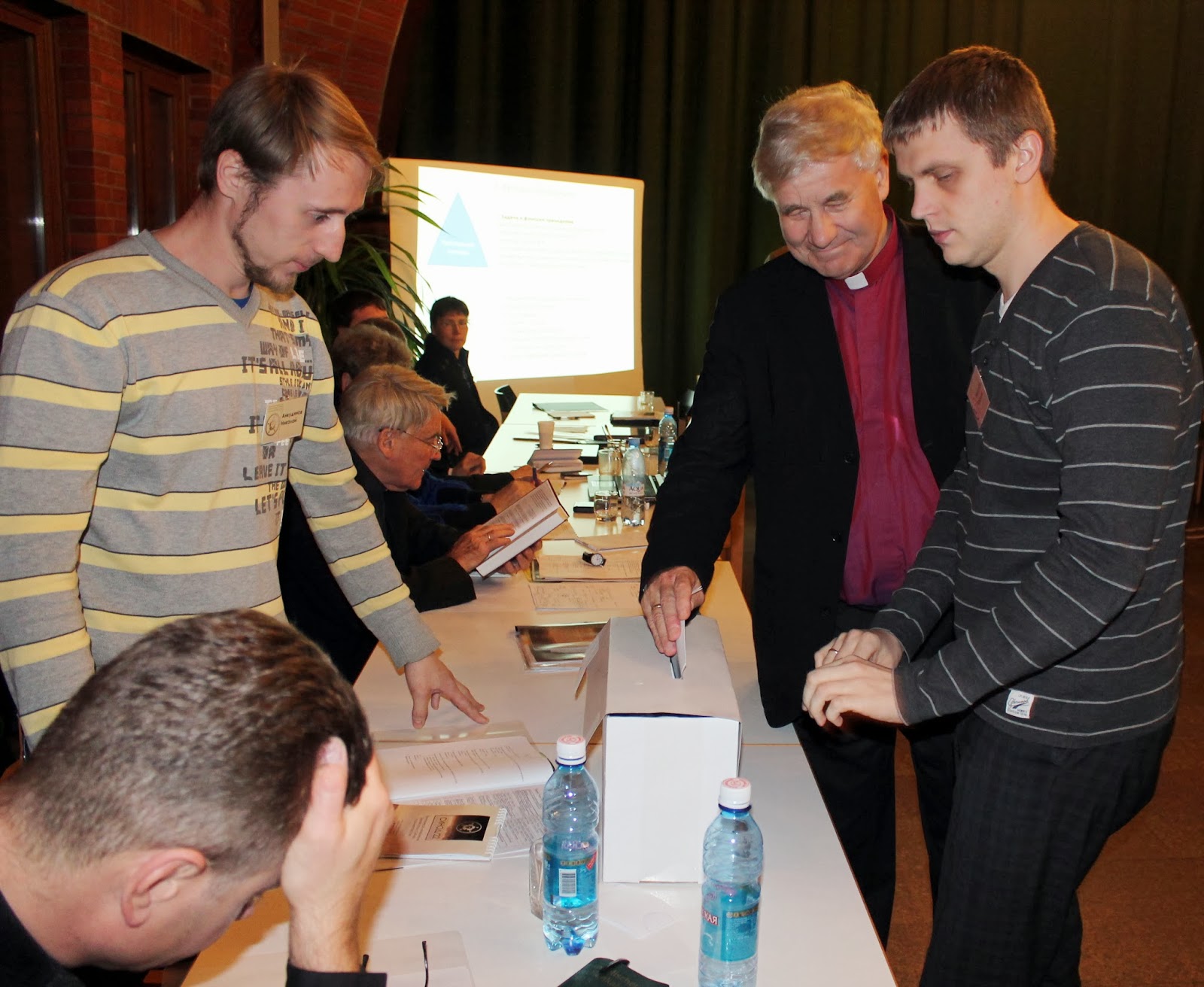
In my days (Sept 17-19) spent as a non-voting delegate at the General Synod of the Evangelical Lutheran Church of Russia, the church in which I serve, I was struck by two themes - peacemaking and mission. 

Bishop Alfred Eichholz from Kyrgyzstan, representing the Union of Evangelical Lutheran Churches (i.e., the association of Lutheran church bodies in most of the states of the former Soviet Union), spoke about peacemaking during the sermon at opening worship. Bishop Eicholz chose a timely theme, since all of us continue to be greatly concerned about the situation in Ukraine. It would not have been possible, I think, to find one common position among even the small number of delegates that attend the synod assembly, but it was at very least helpful to be reminded that as those who have been reconciled with God through Christ, we are to be engaged in the ministry of reconciliation. 

This was not unrelated, of course, to the theme of mission, which we spoke about more explicitly later in the day. Particularly important in this regard was the paper presented by the General Secretary of the Lutheran World Federation, Martin Junge. Dr. Junge gave a lecture that challenged synod delegates to think hard about the goals and limits of mission. Initial discussion seemed to indicate that there is a need to integrate at a deeper level that mission is not something we do, but that God does, not something that is one task of the church among many, but that in everything we do we would be seeking to work together with God to make God's love manifest.


A slide from Bishop Brauer's presentation on how
he imagined what our church could look like.

Such an understanding of mission, if I understand correctly, is held by Dietrich Brauer, my former student at the Novosaratovka seminary, Bishop of European Russia and recently the "Acting Archbishop" of the Evangelical Lutheran Church in Russia. Electing Bishop Brauer as Archbishop (without the limited time frame and scope of responsibilities that the word "Acting" suggested) will help this church go forward in a way that puts the theme of mission squarely in front of the whole church.  It was after hearing his report (not so much about the work that has been done as about his proposals for a common vision of our identity and call) that I realized that our church is making slow but significant steps forward, coming into its own, even as many long-term challenges remain with us for the time being. 


My responsibility at this synod was to speak about one of the ways we are addressing the church's long-term needs - education. I presented an initial report on my experience this year as the leader of the "Equipping for Service" project, an attempt to address the need for education in the church by organizing events (retreats, seminars, etc.) throughout this vast land. I've been blessed to have the opportunity to run this program so far, and am thankful for all of those (including some that might be reading this blog) who have helped support it.

My official commissioning as head of the "Equipping...." project.
Synod delegates, staff and guests

I will conclude this post by including here the note I wrote to Bishop Brauer on the day after his election as Archbishop. More than anything else it summarizes my feelings about the General Synod and my hopes for this church's future. 

* * *
Dear Bishop Brauer,

As a rule I usually feel quite awkward about either receiving or giving congratulations in the context of ministry in the church. It doesn't fit, somehow – after all, we acknowledge that our achievements here are not our own. We believe that successful ministry happens because in God's great mercy we have been provided with what is necessary to bring about that success – the right circumstances, the appropriate gifts, the proper skills, education, and character. Whether dealing with difficult situations or finding ways to take full advantage of new opportunities, we trust that the Spirit is guiding us. In moments like this, then, when we see before us a concrete manifestation of grace, my first reaction is to be thankful.

So instead of congratulating you, dear brother Dietrich, with your election as Archbishop of the Evangelical Lutheran Church in Russia, I would like instead simply to express my feeling of deep gratitude to God for providing you and others to help lead this church as it seeks to share the gift of Christ's love for a hurting world.

My thanks also goes out to you, personally. You have been a faithful steward of gifts that you have been given, setting an example (perhaps it is even appropriate to speak of a standard) of excellence in ministry. Your compassion, commitment, energy and vision for mission have already had a significant impact on the church here, and I consider it a privilege to have the opportunity to continue the journey of ministry together.

Yours in Christ,
Bradn


20 August 2014

Sanctions and Hope

It is an interesting and strange time to be living in Russia. While the country has changed much over my dozen years here, much of what has happened over the last weeks and months has surprised me a great deal. Many of the changes we have seen could be considered progress. For example while there was a time when it was difficult to find a good Internet connection, lately you could find free wifi in St. Petersburg's center; as of last
Our last jar of p.b.
week, though, in order to log on to that free network you'll need to provide your passport information. Another example - years ago I would have never imagined that you'd be able to easily find (American) peanut butter and marshmallows on the shelves...but even less would I have imagined a time when those items would disappear from store shelves (together with a number of other things our family enjoys, from Finnish cheese to Spanish oranges) as a result of Russia's answer to Western sanctions. A different selection in the supermarket is no big deal, of course; more significant is the change in atmosphere caused by this current conflict. Once again Russia has become a place for me that is not always predictable, and that's not always comfortable.... 

And as soon as that thought comes in to my head, I am reminded that being comfortable never was the goal. The goal was to be with the people, to both hear and share about our faith, whatever the circumstances. That means that it is particularly important for me at this time to stick with the country and with the small minority which is the Lutheran church here.

It can be challenging to continue the journey filled with hope. In fact much of the time I distrust even positive signs (e.g., those coming out of Ukraine right now?) and most of the time I feel powerless to bring about positive change. Thinking about the wider world (Iraq and Syria, Gaza and Ebola) can bring one right up to the edge of despair. 

Spending time together with Russian Christians has helped me find my center again. Over the past two weeks I have had the opportunity to teach at a seminar for our church entitled “Introduction to the Spiritual Life.” 14 participants from around European Russia have listened to me as I've taught about Christian spiritual practices, healthy congregations, a short history of Christian monasticism, and one of the writers that has most influenced me, Thomas Merton. (Finally, almost 15 years after taking a course on him in seminary I had an excuse to share my interest in Merton with sisters and brothers here!) Along the way they've shared with me their own thoughts about the church, theology and their own spiritual life. It was here, in and outside of the classroom, that hope was reborn, hope that by turning to central relationship of our faith, by seeking to affect positive change in the world from inside out, believers really can make a difference. Another way of putting this is to say that instead of concentrating on acting like a Christian, this course has reminded me that these efforts are likely to do little good (not to mention likely to burn us out) without inner transformation and renewal. 

Whatever direction Russia takes in the future, I know for certain now that hope will never be on a list of banned imports. There is no reason to import, after all, for God's renewing Spirit is at work here, bringing about positive change in the lives of individuals and, through them, in wider society.  
Participants from Ivangorod, Moscow and Yaroslavl. More pictures to come...


22 October 2013

Walking Together, Though the Road Stretches Seven Time Zones - ELCUSFE XXII Synod Assembly, 18-20 Oct 2013

 ELCUSFE Bishop Otto Schaude, in his opening report to the synod, noted that such assemblies always have to deal with a certain amount of official business. Yet for this church the most crucial thing at these annual gathers is to see that we are not alone, that we are really on the road (-od) together (syn-). While we constantly feel the enormous challenges that come with our being scattered over such great distances, there is a positive side - it is completely obvious that we need and have much to learn from one another. 
  We did engage in important practical questions - from next year's budget to a small-group discussion about new mission congregations, from the blessing of lay preachers to elections for the synod council. Yet the richness of our gathering was felt less in our (nearly unanimous most of the time) voting and more in our sense of being together on the way, despite our differences in pieties, priorities and experience. 
  Below you'll find pictures from our days together - days spent in listening to reports on various ministries (for youth, for women, for men; diaconal, educational, and musical) from our 4 deaneries. I can look at the official assembly minutes if I need to remember the details of one or another of the decisions we made. But the conversations I had with brothers and sisters in faith, their concern for one another and for their neighbor, will stay with me; they convinced me, more than ever, that we are on the road together.  


Nikolai, one of the delegates of our deanery (Krasnoyarsk.)
Bishop Schaude voting with a number of delegates from
our deanery in the foreground - Pastor Dimitry from Abakan
(bottom left), Nikolai and Vasily from Tomsk (far right).
Our small group proposed a variety of priorities 
for the development of ministries in our church. 
Synod President Pastor Evgeny Filipov and 
Assistant to the Bishop in the Evangelical Lutheran
 Church of European Russia, Norbert Hintz.
At synod assembly Sister Heidi (who usually serves
  in the Omsk region) and I agreed that she 
would visit  a few of the  congregations in 
my deanery that are dealing with pastoral vacancies.
"A Prayer for the Workplace" will return 
with Vladimir to his home in the Urals.  
Andrey (above) and Evgeny (below) shared the stories 
of their faith journeysbefore being blessed as preachers
 for Magadan (Far East) and Azovo (Omsk), respectively. 

Not just the obligatory group photo, 
but the family of faith, on the way together.  

* * *
  I'll add a few words here for those of you interested in news of the synod itself.
  On the first day of the synod the schedule called for a guest speaker. While Bishop Schaude gave an interesting report in its place, we were saddened not to have had this guest with us. I would usually give his name, but in this case I've decided to be extra cautious - you see, the Central Asian country that he is living in has forbidden him to leave. Our guest not being able to come (as well as the strict limits on his actions within the country) is just one example of how difficult it is for Christians right now in that part of the world. 
  In other news - delegates to the synod assembly are selected here for 5 year terms. This year was an election year, meaning that delegates began new terms and elected a new synod council. Zoya Gentse, the lay person in charge of congregations in the Khakasia region of our deanery, was elected secretary, while Pastor Evgeny Filipov was re-elected synod president.
  As usual we discussed the budget plan for next year; while progress is slow, I see that congregations here are making progress toward the goal of doing more in terms of financial stewardship. This is a particularly important issue here, since most of the staff working throughout the church are paid through the central offices. Offerings from congregations to support ministries continue to increase.
  Based on what I heard at the synod assembly, 2014 should prove to be a very interesting year for our church: recent positive developments in building projects (e.g., in Ekaterinburg and Shelekhov) could mean new walls going up in those two places; a number of church partners plan to visit us (including church and Scout groups on the train); the Omsk congregation will celebrate the 20th anniversary of the church center with a number of events (including a conference co-organized with the state university here - "300 Years of Lutheranism in Siberia"); and we can expect further developments in educational ministries (an area in which I hope to be involved). 

17 October 2013

Harvest Festival Pictures

In my last post I mentioned the Harvest Festival. Here are a few more pictures from celebrations in our church.

This is from my first congregation, St. Nikolai's in Novgorod
The rest of these are from Lutheran congregations in the Urals and Siberia.
Chelyabinsk
Chelyabinsk
Tomsk
Omsk

Omsk
Omsk