Showing posts with label Evangelical Lutheran Mission of Lower Saxony. Show all posts

25 February 2015

Tomsk in Winter


   Earlier this month my call to as the organizer of the "Equipping for Service" program took me to one of my favorite Russian cities, Tomsk. (It's a very photogenic city, so I'm going to scatter pictures around this post randomly. There the weather (freezing, windy, sunny) and food (meat-based everything) remind me of Montana. It made me miss home a bit...and I tried to cope with that by buying some ice cream Baskin Robbins for the first time in many years. I treated Lilia, the elderly women I was staying with, to some Old Fashion Butter Pecan. Although deep in my heart I would have preferred at that moment to be sharing ice cream with one of my one grandmothers, Lilia did as well as she could to make me feel home throughout the week.

St. Mary's Lutheran Church
In Tomsk there is the constant contrast of old and new


Yes, that is a wooden shovel he is using to clean off the roof in order that everyone can see the Apple ad.


   But the reason I'm writing this blog entry is not only to share my mood, but at least a little about the work I was doing there. My hope was to spend the week in Tomsk both with the congregation and with the wider community. One of the ways I hoped to do this was by offering a seminar - “Conflict: One Christian's View.”  The topic is one that is on the minds of many these days - why does conflict occur (on all levels, from personal to political) and what can people of faith do about it? I obviously wasn't going to solve the world's problems, but the hope was that it might be possible to have fruitful conversation and think of some initial steps that might be taken.

  This idea was very well received at a meeting that I thought would likely be peripheral in my time in Tomsk – a meeting of the Inter-religious Dialog group that meets at Tomsk State University. The group was kind enough to change their typical format a bit in order to accompany my visit, and the group's leader in particular asked for more contact with our church in the future.


Inter-religious dialog. Former church council President Ludmilla.  

  Unfortunately an attempt to cover similar themes with the wider community and with the congregation did not attract a significant number of participants. There might be various reasons for this, but I'm pretty certain that the topic itself is interesting for people here, and I'll be making more attempts in the year ahead to look at this theme (including a seminar in Novosaratovka in March, where I'll be teaching for a few hours together with the main teachers from Germany and Russia..more on that later.)
The Russian-German Cultural Center in Tomsk at night.
So while the seminar itself did not have the impact that I had hoped, there was a good turnout for morning Bible studies on Philippians, and there was a good crowd for Sunday worship.

...Or Saturday worship, as is the case when I visit the village of Kozhevnikovo, two hours away. In the early 1990s this town had a flourishing congregation, but now there are just a few elderly women left. They are few, but very faithful; they meet regularly for prayer and hymns, with or without a pastor. They try to pass on their faith to their children and grandchildren, so this year, like last, I was asked to baptize a young child. I hope that Tomsk's next pastor has the opportunity to work more with the children of the village; perhaps God will work a miracle there and bring alive the dormant faith of younger generations.
Rusalina, baptized 2/14/2015 in Kozhevnikovo
The pillars of the village congregation.

  The Tomsk congregation, too, had been waiting for Holy Communion since October, when my colleague Chris Repp visited the congregation. There we had another baptism, and both the newborn's family and the congregation came out in full force. It was a good sign of hope that the congregation has stayed together as they patiently awaited the arrival of their new pastor, an ELM-educated Russian-German, who should arrive in Siberia shortly. 
Polina, baptized 2/15/2015


16 February 2015

Installation of Dietrich Brauer as Archbishop of the Evangelical Lutheran Church in Russia (ELCR)

Just over a week ago, I had the privilege of being present at the installation of Dietrich Brauer as Archbishop of the Evangelical Lutheran Church in Russia. There was a really impressive number of guests - so many, that if I began to list them here, it would probably mean that you'd stop reading this post! I believe that such a show of support is a result both of the fellowship other churches in Europe feel with the Lutheran church in Russia and the good work that Bishop Brauer and his staff have been doing over the past years (when he was holding the job as “acting Archbishop.”) In his sermon for the installation, he showed the critical (and self-critical) spirit that is in such short supply in church life here. At the same time, he underlined the power of the Good News to change the lives of individuals and wider society.
St.Peter and Paul Lutheran in Moscow.
Participants in the installation receive instructions before the service.
Dean Elena Bondarenko (former staff at the Theological Seminary) and Viktor Weber (2010 seminary graduate, currently pastor in Moscow and head administrator of the office of the church in European Russia) led the liturgy.


I was asked by my boss, Asia Secretary for Evangelical Lutheran Mission in Lower Saxony (the Hermannsburg Mission) to represent ELM at the installation. As a pastor of the Evangelical Lutheran Church in America, I also was in some way representing American partners as well. It was a priviledge and a joy to see the continued growth of one my former students at the Theological Seminary in Novosaratovka, and my thanks goes out to all of you who have contributed to this important development in church life.  


05 November 2014

Fall Seminars

  The past months have been filled with new opportunities for the “Equipping for Service” educational program for which I am responsible. The core idea of the “Equipping...” project remains the same – “to maximize accessibility to quality educational opportunities in the Evangelical Lutheran Church through a program that is collaboratively planned, flexible, and decentralized,” but in marked contrast to the events of the first part of the year, recently I've been engaged not only in teaching, but also in organizing events.
  The first of these came together at the last minute – “Two Issues in Christian Ethics,” held
in the congregation in Krasnoyarsk. This is an active congregation that values educational opportunities, so I knew that it was possible to try an experiment there - we would talk about Christian ethics. In a society that leans towards either a legalistic or a nihilistic approach to ethical questions, Lutherans sometimes would prefer to avoid the question altogether. But given the conflict between Russia and its neighbors and the influx of refugees from Donbas that have come even to Siberia, it seemed important to me to help our congregational members use their faith to engage these questions. While I hoped to look at the question of "Peace and War," in our two evenings together we only had time to look at the more general question of whom we help and why, which lead us in to the underlying question of how we go about moral decision making in as Christians. The two evenings brought together a total of 24 participants, which I consider to be quite successful given that people needed to take public transport to the church after work in order to attend. I was also very pleased to see congregational members interested in applying their faith to concrete ethical and social questions that surround them. I plan on doing more work in this sphere.


  The second event was south of Krasnoyarsk, in the region of Khakasia.  The region has 10 congregations spread over a 150 mile radius; most of them get only monthly visits from their pastor, Dmitry Schweitz, who was instrumental in helping organize this retreat, which we called "I am a Servant." The
main idea was to support the team of people leading congregations on a week to week basis. We hoped to reach this goal both through fellowship and through thinking about the following questions together - “What does it mean to serve? When do I feel like a servant? How can one serve effectively?” In the process we talked about the way service is understood in society and in the Bible, Jesus as a model of service, love at the center of Christian service, the Lutheran understanding of internal and external call, and our communal call as the church in this place. A number of concrete ideas were raised that the leaders intend to bring to realization – e.g., fund-raisers to help those in acute need, printing fliers about Lutheranism for distribution, and a cooperative attempt to form a new youth group in one of the congregations.  


  And this last month I was very pleased to welcome Pastor Chris Repp back to Russia.Chris had been my mentor when I came to Russia at as a seminary intern in 2001. About 2 years later, he passed on to me the position of teacher of Church History, Systematics and Ethics at the Novosaratovka Theological Seminary. When the opportunity arose to invite him for participation in an academic conference co-organized by the church, we decided that it would be great if he could also have contact with others through the “Equipping...” program. Chris and I chose to lead two 3-day seminars, one in Omsk (Siberia) and one in Ulyanovsk (in European Russia on the Volga). We thought that the title, “Law, Gospel and the Lutheran Confessions Today,” would attract mostly pastors and students. We did have participants from these groups, but it turns out that the topic had wider appeal than we might have expected. In Omsk there were 9 full participants (along with 7 others who were in and out) and in Ulyanovsk a week later we had a very large number – always more than 20, and most of the time around 30. Although the theme of the seminar was the same, Chris and I had to seriously adapt our material to the different audiences we saw, but in both cases I believe that the time we spent together was meaningful. 
  In Omsk the main thrust of my teaching was to help participants see that we do have official confessional documents, though we are far from familiar with their contents and that we need to familiarize ourselves with them in order to decide for ourselves what role(s) they are to play in the life of our church. Chris Repp focused on the issue of Law and Gospel as address in the Augsburg Confession and the Apology, demonstrating why this was important and how it applies to the interpretation of Biblical texts. (In this he has been influenced by the theological approach of the Crossings Community). In Omsk Seminary President Anton Tikhomirov was also with us and he first spoke about the confessions as a textual expression of Luther's Reformation break-through and then traced the development of Western (especially Protestant) theology from that time forward. In Ulyanovsk we kept things simpler, giving the most attention to the uses of the law and Biblical interpretation. In both places local leaders (a special thanks to Tatyana Muramtseva in Omsk and Vladimir Provorov in Ulyanovsk) did an excellent job of solving logistical issues.
Seminary participants in Omsk. Seminary President Anton Tikhomirov is 2nd from left; Chris Repp far right.
Seminary participants in Ulyanovsk. Pastor Vladimir Provorov (red, center) was our host. 
  Many thanks to you for your prayers and support (through the Hermannsburg Mission and the ELCA.) If any of you or your congregations are interested in making a special gift to help cover the expenses related to the “Equipping...” project, you can learn more about that through the ELCA's “Always Being Made New” initiative.

31 October 2014

Ecclesia semper reformanda est - an article in Russian

In honor of Reformation Day, I've decided to post a only-slightly-modified version of the article I wrote for an issue of "Der Bote" magazine last year. If you read Russian and would like to give me critical feedback, I'd be happy to be in conversation with you! And if you can't read Russian, just tell me what a wonderful article it was. :)

* * * 
Классическое богословие, ссылаясь на разум и Писание (например Иак 1.17), утверждает, что Бог «неизменяемый». Но сотворенный Им мир не разделяет с Ним это свойство. Темп изменений в нашем веке технологий и потребления очень высок. Нам не просто справляться со этой нестабильностью; мы стремимся к Богу и Его Постоянству. Поэтому некоторые считают, что Церковь, в отличие от всего остального в мире, не изменяется. За эту опору они держатся. Но такое понятие Церкви не имеет твердого богословского обоснования. Как говорится, только пьяный человек думает, что столб уличного освещения стоит при дороге для того, чтобы за него держаться. Трезвый человек знает, что он там, чтобы лучше видеть дорогу.

Будучи в Церкви, мы находимся в дороге: как и весь мир, мы пребываем в движении. Это известно давно, и именно об этом говорит известная богословская формулировка ecclesia semper reformanda est («Церковь всегда реформируется»). Она существует в разных вариантах. Например, более полный вариант звучит так: ecclesia reformata, semper
reformanda secundum verbi dei. То есть реформированная Церковь всегда должна находиться в процесс реформирования в соответствии со Словом Божьим. Эта формулировка часто приписывается Мартину Лютеру, но имеет более позднее происхождение (XVII в., Нидерланды). На сегодняшний день даже в Римско-Католической Церкви говорят: «история подтверждает, что Церковь всегда принимала так называемый кальвиновский принцип постоянного реформирования, хотя она опасалась применить его либо слишком радикально, либо слишком поверхностно» (Catholic Encyclopedia. “Reformation, Theological Basis.”).

Причина экуменического признания этой фразы — осознание наличия постоянных изменении в церкви в ходе истории. Если задуматься, то ни первое, ни пятнадцатое,ни какое-либо другое столетие нельзя назвать «золотым веком» Церкви, отличающимся идеальной моралью и полной ясностью в христианском учении. Конечно, многие центральные утверждения вероучения остались непоколебимыми. Но, в тоже время, в глаза бросается множество перемен. В этике оставались неизменными общие направления («люби ближнего»), в то время как более детальные нормы (например, отношение к рабству) менялись. В зависимости от эпохи те или иные этические проблемы занимали различные позиции, находясь в центре внимания или же отодвигаясь на второй план.

Что касается вероучения, здесь четко прослеживается развитие: от первых веков существования Церкви (когда только сформировались такие ключевые моменты, как канон новозаветного Писания и учения о Троице) через Средневековье (когда развивались, например, учение о благодати и учение о Причастии) и до наших дней (когда христианское вероучение должно реагировать на бурно развивающиеся научные представления о мироздании, о человеческом организме и т.д.).

Мысль о том, что даже Церковь не является оплотом стабильности, может сильно разочаровать многих. Не исключение здесь и лютеране, ведь мы не менее других христиан подвержены искушению делать из того или иного периода церковной истории «золотой век», нормам которого мы должны соответствовать. Но не стоит расстраиваться. Меняется всё земное. Евангелист Лука показывает нам, что жизнь Иисуса не является здесь исключением: Иисус «возрастал и укреплялся духом, исполняясь премудрости, и благодать Божия была на Нем» (Лк. 2,40). Оставаясь Богочеловеком, Иисус претерпевал изменения. Мы в Церкви должны быть вдохновлены этим примером: развиваясь, мы не перестаем быть телом Христовым. Наоборот, если мы как тело не развиваемся, остается единственная альтернатива – умереть.

Если реформация естественна и необходима для Церкви, возникает проблема: как мы можем понять, какие изменения нужны и какие, наоборот, поставили бы под вопрос всю нашу христианскую веру? Ведь существует опасность «реформироваться» настолько, что можно вообще выйти за рамки христианства (например, как мормоны или свидетели Иеговы). Христианская община сталкивается с этой проблемой с самого начала своего существования. Мы видим это в пятой главе Деяний апостолов, где Гамалиил дает очень полезный совет синедриону относительно нового течения в иудаизме (именно так христианство воспринималось в начале): «если это предприятие... – от человеков, то оно разрушится, а если от Бога, то вы не можете разрушить его; берегитесь, чтобы вам не оказаться и богопротивниками». (Деян. 5,38-39). Также в посланиях мы видим, что не всегда было легко сохранить самое ценное (1 Тим. 6,20), не лишаясь при этом нового – того, что Бог хочет видеть среди верующих (1 Фес. 5,19-21).

Здесь нам поможет данное Ярославом Пеликаном определение: «традиция – это живая вера мертвых, традиционализм является мертвой верой живых. Традиция живет в общении с прошлым, не забывая при этом, где мы находимся и живем сейчас, и что мы – это те, кто должен принимать решение. Традиционализм исходит из того, что нельзя попробовать что либо впервые, считает, что решение любой проблемы можно найти в якобы единогласном свидетельстве однородной традиции» (The Vindication of Tradition). Другими словами, мы не должны делать идола из своего прошлого, но сохранение его ценностей является необходимым для правильной реформации в настоящем. Главное – неустанно спрашивать себя: как наши слова и действия сочетаются с Благой вестью о любви Бога к нам через Иисуса Христа? Евангелие – вот наше мерило. И нам следует применять Его ко всем аспектам нашей церковной жизни – от диаконического служения и регулярности принятия Причастия до музыки и вопросов управления.

Это значит, что нам надо быть готовыми говорить и действовать не «по накатанному», отказаться от своих привычек. Конечно, Церковь – не товар, который мы продаем миру, – «теперь в новой упаковке!», а реформация – не рекламный подход. Речь идет о настоящем
духовном обновлении, поэтому ради проповеди Евангелия придется, быть может, пожертвовать чем-то нам дорогим. Ведь всегда есть риск, что Церковь может «забыть о своей первичной функции, о служении. Она может развивать пассивность, монотонность, механичность. Церковь способна начать понимать себя... как явление тех обетований, которые она сохраняет». Реформация – это «постоянное обращение, которое... позволяет Церкви оставить поиск собственной славы». (Leonardo Boff. Church, Charism and Power). Только через постоянный процесс обращения Церковь может соответствовать своему призванию.

Безусловно, невозможно совершить реформацию только собственными силами. Поэтому мы молимся об обновлении Церкви Духом Святым, чтобы мы в Теле Христовом «возрастали и укреплялись духом, исполняясь премудрости». Используя критический подход ко всему, что мы делаем, мы ощутим, что «благодать Божья» сопровождает нас на пути. И тогда станет очевидно: хорошо, что ecclesia semper reformanda est, ведь и мир тоже меняется.


10 October 2014

News from the General Synod of the Evangelical Lutheran Church of Russia

In my days (Sept 17-19) spent as a non-voting delegate at the General Synod of the Evangelical Lutheran Church of Russia, the church in which I serve, I was struck by two themes - peacemaking and mission. 

Bishop Alfred Eichholz from Kyrgyzstan, representing the Union of Evangelical Lutheran Churches (i.e., the association of Lutheran church bodies in most of the states of the former Soviet Union), spoke about peacemaking during the sermon at opening worship. Bishop Eicholz chose a timely theme, since all of us continue to be greatly concerned about the situation in Ukraine. It would not have been possible, I think, to find one common position among even the small number of delegates that attend the synod assembly, but it was at very least helpful to be reminded that as those who have been reconciled with God through Christ, we are to be engaged in the ministry of reconciliation. 

This was not unrelated, of course, to the theme of mission, which we spoke about more explicitly later in the day. Particularly important in this regard was the paper presented by the General Secretary of the Lutheran World Federation, Martin Junge. Dr. Junge gave a lecture that challenged synod delegates to think hard about the goals and limits of mission. Initial discussion seemed to indicate that there is a need to integrate at a deeper level that mission is not something we do, but that God does, not something that is one task of the church among many, but that in everything we do we would be seeking to work together with God to make God's love manifest.


A slide from Bishop Brauer's presentation on how
he imagined what our church could look like.

Such an understanding of mission, if I understand correctly, is held by Dietrich Brauer, my former student at the Novosaratovka seminary, Bishop of European Russia and recently the "Acting Archbishop" of the Evangelical Lutheran Church in Russia. Electing Bishop Brauer as Archbishop (without the limited time frame and scope of responsibilities that the word "Acting" suggested) will help this church go forward in a way that puts the theme of mission squarely in front of the whole church.  It was after hearing his report (not so much about the work that has been done as about his proposals for a common vision of our identity and call) that I realized that our church is making slow but significant steps forward, coming into its own, even as many long-term challenges remain with us for the time being. 


My responsibility at this synod was to speak about one of the ways we are addressing the church's long-term needs - education. I presented an initial report on my experience this year as the leader of the "Equipping for Service" project, an attempt to address the need for education in the church by organizing events (retreats, seminars, etc.) throughout this vast land. I've been blessed to have the opportunity to run this program so far, and am thankful for all of those (including some that might be reading this blog) who have helped support it.

My official commissioning as head of the "Equipping...." project.
Synod delegates, staff and guests

I will conclude this post by including here the note I wrote to Bishop Brauer on the day after his election as Archbishop. More than anything else it summarizes my feelings about the General Synod and my hopes for this church's future. 

* * *
Dear Bishop Brauer,

As a rule I usually feel quite awkward about either receiving or giving congratulations in the context of ministry in the church. It doesn't fit, somehow – after all, we acknowledge that our achievements here are not our own. We believe that successful ministry happens because in God's great mercy we have been provided with what is necessary to bring about that success – the right circumstances, the appropriate gifts, the proper skills, education, and character. Whether dealing with difficult situations or finding ways to take full advantage of new opportunities, we trust that the Spirit is guiding us. In moments like this, then, when we see before us a concrete manifestation of grace, my first reaction is to be thankful.

So instead of congratulating you, dear brother Dietrich, with your election as Archbishop of the Evangelical Lutheran Church in Russia, I would like instead simply to express my feeling of deep gratitude to God for providing you and others to help lead this church as it seeks to share the gift of Christ's love for a hurting world.

My thanks also goes out to you, personally. You have been a faithful steward of gifts that you have been given, setting an example (perhaps it is even appropriate to speak of a standard) of excellence in ministry. Your compassion, commitment, energy and vision for mission have already had a significant impact on the church here, and I consider it a privilege to have the opportunity to continue the journey of ministry together.

Yours in Christ,
Bradn


20 August 2014

Sanctions and Hope

It is an interesting and strange time to be living in Russia. While the country has changed much over my dozen years here, much of what has happened over the last weeks and months has surprised me a great deal. Many of the changes we have seen could be considered progress. For example while there was a time when it was difficult to find a good Internet connection, lately you could find free wifi in St. Petersburg's center; as of last
Our last jar of p.b.
week, though, in order to log on to that free network you'll need to provide your passport information. Another example - years ago I would have never imagined that you'd be able to easily find (American) peanut butter and marshmallows on the shelves...but even less would I have imagined a time when those items would disappear from store shelves (together with a number of other things our family enjoys, from Finnish cheese to Spanish oranges) as a result of Russia's answer to Western sanctions. A different selection in the supermarket is no big deal, of course; more significant is the change in atmosphere caused by this current conflict. Once again Russia has become a place for me that is not always predictable, and that's not always comfortable.... 

And as soon as that thought comes in to my head, I am reminded that being comfortable never was the goal. The goal was to be with the people, to both hear and share about our faith, whatever the circumstances. That means that it is particularly important for me at this time to stick with the country and with the small minority which is the Lutheran church here.

It can be challenging to continue the journey filled with hope. In fact much of the time I distrust even positive signs (e.g., those coming out of Ukraine right now?) and most of the time I feel powerless to bring about positive change. Thinking about the wider world (Iraq and Syria, Gaza and Ebola) can bring one right up to the edge of despair. 

Spending time together with Russian Christians has helped me find my center again. Over the past two weeks I have had the opportunity to teach at a seminar for our church entitled “Introduction to the Spiritual Life.” 14 participants from around European Russia have listened to me as I've taught about Christian spiritual practices, healthy congregations, a short history of Christian monasticism, and one of the writers that has most influenced me, Thomas Merton. (Finally, almost 15 years after taking a course on him in seminary I had an excuse to share my interest in Merton with sisters and brothers here!) Along the way they've shared with me their own thoughts about the church, theology and their own spiritual life. It was here, in and outside of the classroom, that hope was reborn, hope that by turning to central relationship of our faith, by seeking to affect positive change in the world from inside out, believers really can make a difference. Another way of putting this is to say that instead of concentrating on acting like a Christian, this course has reminded me that these efforts are likely to do little good (not to mention likely to burn us out) without inner transformation and renewal. 

Whatever direction Russia takes in the future, I know for certain now that hope will never be on a list of banned imports. There is no reason to import, after all, for God's renewing Spirit is at work here, bringing about positive change in the lives of individuals and, through them, in wider society.  
Participants from Ivangorod, Moscow and Yaroslavl. More pictures to come...


04 March 2014

The Situation in Ukraine - a strange point of view

My experience in Ukraine is limited; much of it came many years ago. Yet one thing that
struck me about the country then that is, quite obviously, playing itself out now is the fact that the country is very complicated. It seemed like (as in the old joke about a different ethnic group) for every 2 Ukrainians you'd find 3 opinions about any given issue. Maybe that is why I always felt refreshed by my visits there - here to the east there is the tendency to push toward extreme positions, and if you find yourself in a minority position you tend to have a hard time.

So when the dominant voices in the Russia media cover events in the Ukraine, I'm frustrated and disappointed (to put it mildly), but not terribly surprised at what I hear - "The people on Maidan all fascists;" "They are given payments / training / arms by Western secret service agents;" "The new, so-called government in Kiev wants to forbid people from speaking Russian..."At the same time, I wonder why other media sources (from what I can tell about what is being read / said / seen in the U.S., for example) would be just as simplistic in their analysis - "The crowds on Independence Square oppose corruption and seek equal rights for all;" "Russia undermines the Ukrainian democracy movement;" "Putin planning Soviet Union Lite..." 

These approaches are not helpful. I see a much healthier search for understanding developing on social media among the pastors and other church leaders that I know, both in Russia and in Ukraine. (And, in fact, among Novosaratovka graduates throughout the former Soviet Union). While some are subject to the general patriotic feelings that tend to arise at such times, most tend to be self-critical of their own countries and to search for paths to help their sisters and brothers on the other side of the border.  

To say that the situation is complicated is not to say that every side is equally right or wrong.  I hope that all of those responsible for violence in this conflict will face trial, and that this will open up a new, peaceful chapter in the history of Ukraine. I hope that Ukraine, Russia and the other powers engaged in this situation will all learn to respect international law, to build democratic institutions and trust them, to reject the temptation to put aside rule of law for expediency's sake. 

I know that I'm not alone in these hopes. Yet the voices speaking in this way are not well heard. Perhaps part of the reason is that some lack (or have forgotten about) the unique point of view we can have when we really try to apply our faith to complicated situations. I, personally, am convinced that everything looks so much different in the light of the cross. When we consider our own, common, frail human state in contrast to the One who created us for so much more, how can we possibly busy ourselves with condemnation, with jockeying for power and influence? The cross puts into perspective the idiotic and dangerous games we play, pretending to be much more important than we actually are. The cross calls us to be thankful that we have no utterly drowned in our own faults, and calls us to strive toward a new point of view, and a new way of being. A way that has something to do with love.

(As a side note - as I was preparing this text, I found pictures on Facebook from a Pastor in Ukraine (who last month was beaten at a peaceful protest) whose congregation held an event showing an example of how games are not always negative, but can help us deal creatively with a situation. I'm sure the costume party they threw helped them to deal with the stress that they must all be feeling.)


22 October 2013

Walking Together, Though the Road Stretches Seven Time Zones - ELCUSFE XXII Synod Assembly, 18-20 Oct 2013

 ELCUSFE Bishop Otto Schaude, in his opening report to the synod, noted that such assemblies always have to deal with a certain amount of official business. Yet for this church the most crucial thing at these annual gathers is to see that we are not alone, that we are really on the road (-od) together (syn-). While we constantly feel the enormous challenges that come with our being scattered over such great distances, there is a positive side - it is completely obvious that we need and have much to learn from one another. 
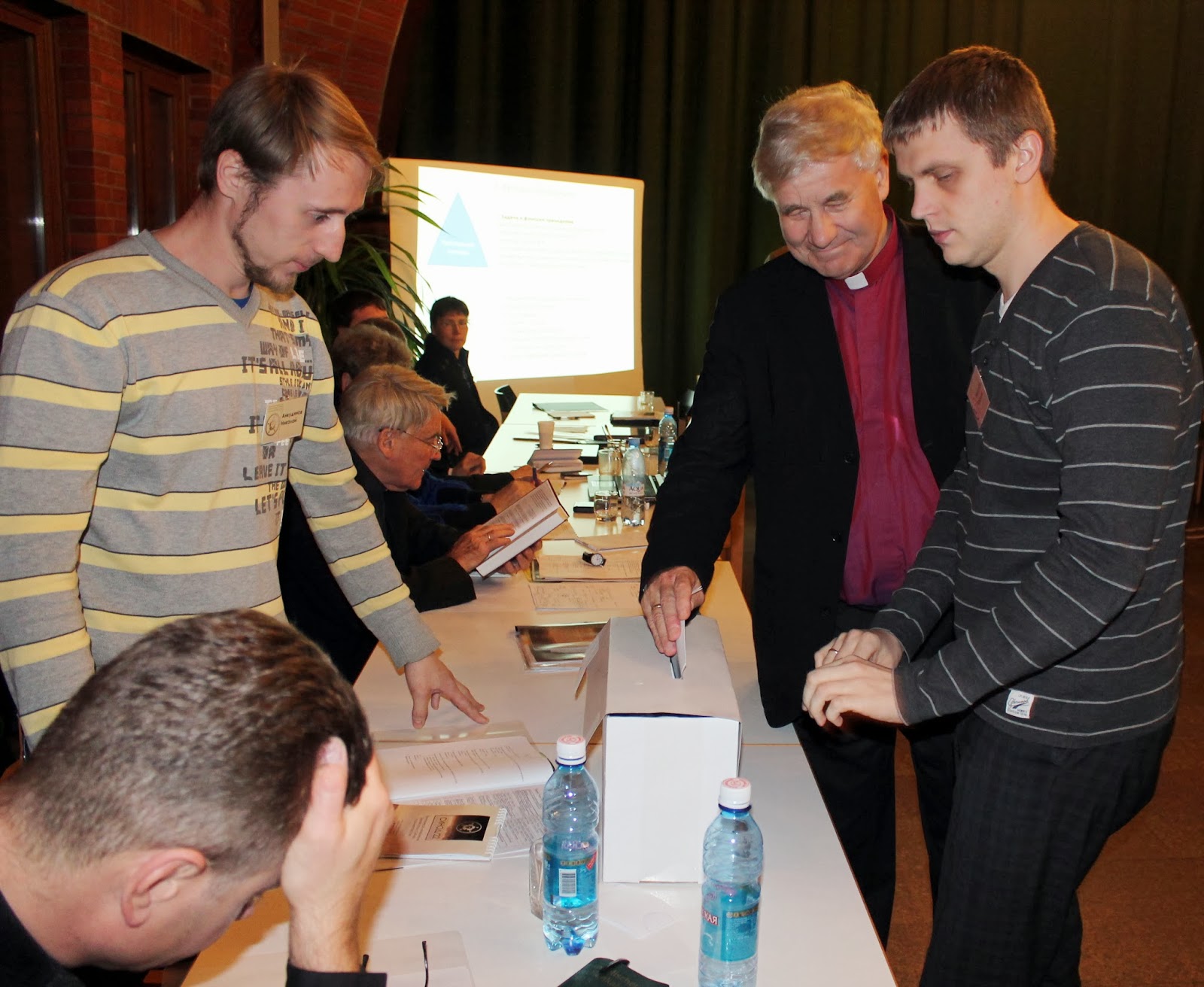
  We did engage in important practical questions - from next year's budget to a small-group discussion about new mission congregations, from the blessing of lay preachers to elections for the synod council. Yet the richness of our gathering was felt less in our (nearly unanimous most of the time) voting and more in our sense of being together on the way, despite our differences in pieties, priorities and experience. 
  Below you'll find pictures from our days together - days spent in listening to reports on various ministries (for youth, for women, for men; diaconal, educational, and musical) from our 4 deaneries. I can look at the official assembly minutes if I need to remember the details of one or another of the decisions we made. But the conversations I had with brothers and sisters in faith, their concern for one another and for their neighbor, will stay with me; they convinced me, more than ever, that we are on the road together.  


Nikolai, one of the delegates of our deanery (Krasnoyarsk.)
Bishop Schaude voting with a number of delegates from
our deanery in the foreground - Pastor Dimitry from Abakan
(bottom left), Nikolai and Vasily from Tomsk (far right).
Our small group proposed a variety of priorities 
for the development of ministries in our church. 
Synod President Pastor Evgeny Filipov and 
Assistant to the Bishop in the Evangelical Lutheran
 Church of European Russia, Norbert Hintz.
At synod assembly Sister Heidi (who usually serves
  in the Omsk region) and I agreed that she 
would visit  a few of the  congregations in 
my deanery that are dealing with pastoral vacancies.
"A Prayer for the Workplace" will return 
with Vladimir to his home in the Urals.  
Andrey (above) and Evgeny (below) shared the stories 
of their faith journeysbefore being blessed as preachers
 for Magadan (Far East) and Azovo (Omsk), respectively. 

Not just the obligatory group photo, 
but the family of faith, on the way together.  

* * *
  I'll add a few words here for those of you interested in news of the synod itself.
  On the first day of the synod the schedule called for a guest speaker. While Bishop Schaude gave an interesting report in its place, we were saddened not to have had this guest with us. I would usually give his name, but in this case I've decided to be extra cautious - you see, the Central Asian country that he is living in has forbidden him to leave. Our guest not being able to come (as well as the strict limits on his actions within the country) is just one example of how difficult it is for Christians right now in that part of the world. 
  In other news - delegates to the synod assembly are selected here for 5 year terms. This year was an election year, meaning that delegates began new terms and elected a new synod council. Zoya Gentse, the lay person in charge of congregations in the Khakasia region of our deanery, was elected secretary, while Pastor Evgeny Filipov was re-elected synod president.
  As usual we discussed the budget plan for next year; while progress is slow, I see that congregations here are making progress toward the goal of doing more in terms of financial stewardship. This is a particularly important issue here, since most of the staff working throughout the church are paid through the central offices. Offerings from congregations to support ministries continue to increase.
  Based on what I heard at the synod assembly, 2014 should prove to be a very interesting year for our church: recent positive developments in building projects (e.g., in Ekaterinburg and Shelekhov) could mean new walls going up in those two places; a number of church partners plan to visit us (including church and Scout groups on the train); the Omsk congregation will celebrate the 20th anniversary of the church center with a number of events (including a conference co-organized with the state university here - "300 Years of Lutheranism in Siberia"); and we can expect further developments in educational ministries (an area in which I hope to be involved).