10 April 2012

CPE Seminar in Omsk


Shortly after the end of the seminar in the Ingrian congregation, I traveled to Omsk for a seminar organized by the church I am working for, the Evangelical Lutheran Church of the Urals, Siberia, and the Far East.

In contrast to the previous seminar, I had no special job to do...nor did I find myself in tension with the theological positions of the presenter. Instead, I really felt "at home." There were a number of reasons for this - I would be in a familiar place, true, but more important was the fact that I'd be in a learning environment again with a number of people who had been my students - Gleb, Andrey, and Denis, now all pastors in the ELCUSFE.

Denis - pastor in Polevskoy, near Ekaterinburg.
Gleb, pastor in Krasnoyarsk.


Andrey, Pastor in Tomsk.

And while I'll have further opportunities to continue to work with these young men, the approach to education at this seminar was truly unique for this country. The leader of the seminar, C.K. Schmidt, is a highly experienced Clinical Pastoral Education supervisor in Germany. Those who serve as pastors in churches in the U.S. know CPE, since we all had to go through this training in order to attain our M.Div. I had a wonderful experience when I was in CPE in seminary, and the chance to renew my knowledge and expand my skills in pastoral care was very welcome...and very, very rare in Russia.


Pastor Schmidt


The seminar last an intense 10 days. Many in the group fought sickness - I was fortunate enough to remain healthy....but remaining healthy meant that I had to go through all the difficult personal reflection that goes into developing our abilities as pastoral care givers. I came out of the seminar feeling renewed, supported, and hoping to find the opportunity to put into practice that which I had begun to discover at the seminar. 


Despite the intense nature of the seminar, we were able to laugh together as well.


We explored Biblical drama as a technique both for understanding texts on a new level 
as well as learning more about ourselves.


Thomas Grote, the pastor in Irkutsk, helped coordinate the seminar. 


I was ready to soak up whatever the seminar had to offer...and it had a lot to offer. I'll be processing the experience in the months to come. 


Visit from Arden Haug

After returning from Omsk, I had the opportunity to host the ELCA's Regional Representative for Europe, Pastor Arden Haug for a few days. Arden was my supervisor for some of the time that I worked directly for the Evangelical Lutheran Church in America, and he played a significant role in helping to organize the ELCA's support for my service through the Hermannsburg Mission (ELM). 

Arden has made many trips to Russian in the past, but this was his first time so far east (and even then he only made it half way to the Pacific!) - below is a picture that Arden took of the chapel (built 12 years ago) that stands in the center of Novosibirsk...and the geographic center of Russia. In some ways this photo says a lot about modern Russia.


Arden accompanied me and Slava to our regular visit to the children's TB hospital outside of the city...

He met with the church council...


And preached at worship. 


Apparently, his sermon went over well, since the women in the congregation sang a special farewell song to him after the service had ended. 


Seminar of the Ingrian Church

The month of march gave me a number of educational opportunities...that's something I never pass up. Even better, these opportunities helped me understand more about the state of Lutheran congregations (and, most especially, their pastors) in Siberia. I can say that I felt privileged to have this chance. 


The first seminar I took part in was held locally - the Lutheran Church of Christ the Savior, part of the Evangelical Lutheran Church of Ingria in Russia (i.e., part of the Finnish tradition of Lutheranism in Russia) held a seminar for the pastors of their deanery called "The Red Thread of the Bible," based on the book and taught by a Finnish theologian, Leif Nummela. While at first it was planned that I would just participate with the rest of the pastors, preachers and other church workers that would attend, it eventually became clear that I'd have an important role to play - translator. No, I don't know Finnish! :) But Leif, like most Finns, speaks English very well, and I was able to translate for him into Russian. 


You can see some pictures and commentary below:


The Siberian Deanery of the ELCI stretches from Omsk in the west to the Transbaikal region in the East. Some congregations are served by Finnish missionaries, though most now have local, Russian leaders. 


Leif's lessons had us digging deep in Scripture....
Had it been my role, I probably would have debated with the teacher a bit about Biblical interpretation. Perhaps it was good that I had another job to do - translate!

Participants of the seminar. To the far right in the back row is Gennady Ivanovich, the leader of the Novosibirsk congregation of the Ingrian church. Second to left in the front row is Juha Sari, the Dean of Siberia for the Ingrian Church.


30 March 2012

A Month after the Election

Looking back at my last blog post, I realized once again that I am still more American than Russian - you'd be hard pressed to find a Russian with such a naive sense of optimism...rather, it is possible to find such people, but they tend to be pitied, rather than taken seriously.


Source: polittech.org
At any rate, the results of the presidential elections corresponded to what the polls had predicted - Vladimir Putin gained victory in the first round. Also as many had predicted, there were signs of a degree of election fraud. To be fair, though, it was clear that the voting process itself (if not the campaign period) was a significant improvement over previous years; it is also obvious that Mr. Putin would have won in the first round even if all the allegations of wrong-doing at the polls were confirmed.


What does this mean for the country? Russia is not a terribly predictable, so it is a bit hard to say. It is generally acknowledged that Mr. Putin's reputation has taken a hit in the last year, and many Russians have begun to show and be active in political processes. Although I may again be showing my naivete, I believe that this means that the government is likely to be more responsive to calls for reform; the government's steps in the direction of more direct democracy (easing of rules for registering political parts and especially re-establishing the election of state governors) give me reason to hope. 

02 March 2012

Two Days Before the Election

Limited internet access these days has been part of what has been slowing down the pace of my blogging. But I'm compelled by the upcoming presidential election (March 4) to share a few thoughts as the day approaches when the country will choose its leader for the next 6 years.

Media reports and anecdotal evidence seem to point to one, inevitable conclusion - Vladimir Putin will be elected president. Putting aside questions about the election's fairness (the government has taken a number of positive steps to secure a more transparent process than in the Duma elections in December), the majority of Russians feel like he Mr. Putin is the best choice. Many are also quite afraid of a revolution; they point to their own history in the 20th century and their neighbors' more recent history to show that revolutions tend to change the people in the leadership, but do little to get rid of authoritarian structures. The graffiti image below illustrates what most people are hoping and expecting from Mr. Putin's leadership. Yet, I thought that it might be appropriate to include here not just the graffiti itself, but the area surrounding it. The picture says a lot about modern Russia: Mr. Putin is in the foreground, while in the background there are signs both of society's economic development and of defensiveness and stagnation.


As regards to my own thoughts, I would say that, given the current situation, I also hope that Mr. Putin wins...but in the second round. In order for any candidate to win outright, they need to gain more than 50% of the vote. I feel like it would be really good for Russian society if the opposition candidates (4 of them) together where able to get more than half of the vote. Three of these candidates are political old-timers who have not been able to reach out and gain many new supporters; the fourth is Mikhail Prokhorov. He is certainly the most interesting candidate in the election, but his business-friendly approach, his enormous wealth, and his lack of political experience hinder him. When faced with a choice between any of those four  and Mr. Putin, the country will clearly choose their former leader....but if they have to vote a second time, it will feel like they really had a choice, and that ordinary citizens really can impact political practices. If people gain this confidence, this would be an important step to minimizing the corruption that so seriously affects society.

One piece of evidence that society has already benefited through the protests that have occurred - people are (more frequently, though not always) actually able to exercise the freedom of assembly that is promised to them in the Russian constitution. In years past city governments would go to extremes to be sure that protesters felt threatened and intimidated; in the February protest (pictured below) I saw that the police were few in number and did not bother the protesters at all.


There will be protests, too, after the presidential election. Those who go out in to the streets will be right to want to voice their opinion and to continue to criticize the electoral system. I deeply hope that these concerns are heard and heeded by the government. At the same time, I share the hope of the people of my congregation that the country can avoid a revolution. 

The Last of the Siberians

Since arriving in Novosibirsk, I've been interested in trying to learn a bit about the native inhabitants of this place. After all, Novosibirsk is just over one hundred years old, and it wasn't much earlier than that the Russians began moving to the area in large numbers. Who lived here before and where did they go?

I still have much to learn in this area, but I thought that I'd share with you what I found out so far. One of the surprising things I've found out is that there is little evidence that west-central part of Siberia was ever densely inhabited. In fact, when it was inhabited at all, it appears that no one group dominated for long. It is very hard, then, to determine who the “native peoples” are. As the historian Vladimir Usupov put it, “the majority of the peoples of Siberia are just as much new-comers [to the area] as Russians are.” “Now that there are fewer and fewer [Slavs] here, it is possible that new peoples will come in their place,” continues Usupov.

While the histories of the peoples of neighboring Altay and Krasnoyarsky Krai are relatively well known and point to well-developed civilizations with a degree of continuity and stability, the Novosibirsk area was, apparently, less attractive for long-term settlement.

 
There are still arguments about who first settled the territory of the Novosibirsk oblast (state). It is known that the mysterious Pumpokol people lived here at one time, but that they assimilated into other groups by the 18th century. Three groups are currently considered native peoples in the area - teleuts (known by early Russian settlers as the “white kalmykians,” they were the upper crust of society and shared many customs similar to Europeans), and two tatar groups - Orskiy Chaty и Baraba tatars.
In the last census (2010) 14 people in the Novosibirsk oblast identified themselves as teleuts; linguists say that there are about 8000 baraba tatars and 100 orskiy chaty in the region, though no one identified themselves that way in the last census. Some members of these groups were able to maintain their traditional ways of life (gathering and fishing), but most are apparently merging with a larger ethnic group, their relatives, the Kazan Tatars.

The importance of these peoples is felt in everyday life here through geographic names, e.g., the river “Inya,” which means “mother;" the river Chik - “edge; Yurt-Akbalyk - “house of the white fish.” The origin of the name of Novosibirsk's main river, the Ob, is still a mystery – it means either “snow drift” in Samoyedic (a language from the Urals) or “water” in Farsi (Iran's language).

This last example shows the large degree of moment among people in Siberia throughout the centuries...and this makes a lot of sense, given the fact that western Siberia was right along the path of the Mongols as they swept through northern Asia and into eastern Europe.  

(material in part from the Novosibirsk news site ngs.ru. “The Last Siberians”)

24 January 2012

Ecumenical Worship Service during Week of Prayer for Christian Unity


This past weekend, I had the privilege of preaching at the ecumenical service during the Week of Prayer for Christian Unity at the local Roman Catholic cathedral.

Father Dariusz (to my right) led the liturgy; Father Alexander
(to my right) also gave a sermon. Father Corrado
(Franciscan) and Archpriest Alexander (Russian Orthodox
Church) in the second row. 
The theme of the week first struck me as rather strange - “We will all be changed by the victory of our Lord Jesus Christ.” (1 Cor 15:51-58). First of all, it seemed odd that a passage about the resurrection would be used to talk about something else entirely – Christian unity. Second, there were a couple of words in the theme that immediately raise red flags for Lutherans - “victory” and “change.” (OK, the second is a joke. Sort of.) About what victory could we speak if we look at the state of the church today? And if we were to think of victory as strictly eschatological (that is, that the victory will be ours only at the end of time), what impulse would that give us for praying and working for the unity of the church now?

After thinking about the text and getting acquainted with the very-well-done preparatory and liturgical materials (you can find them on the site of the Vatican, if you didn't have a chance to participate in the service yourself), I realized that the key to understanding the Biblical passage and the week as a whole was verse 57 - “but thanks be to God, who gives us the victory through our Lord Jesus Christ.” God gives us the victory. Victory is a given...and that means our standard way of achieving victory (hard work through competition) is annulled; instead the hard work comes after the victory, in our attempts to live in accordance with that gift which we have been given. That thought was at the heart of my sermon.

Women from our congregation in front and other friends
behind as we shared bread as part of the service.
For those of you who know me, you can imagine that I was a might bit nervous when I got up to preach. But the atmosphere was warm (even if the building was cold), the acoustics were great (and that means I didn't have to worry about not being heard), and there were a number of congregation members and friends there – I calmed down quickly.

 After the service, we all gathered in the congregation's parish hall (a.k.a. basement) to hear about an ecumenical project based on the principles of the L'Arche movement. You can read about L'Arche here. You'll see that it is a rather radical form of faith-based living even for the West; in the Russian context it is very unusual and very brave.

I didn't have much chance to mingle after tea, because I immediately got into a rather intense and long conversation with the newly ordained Greek Catholic (Uniate) priest in the city, Father Pavel. It became clear that he and I will continue to have a lot to talk about, so I promise to blog more about him (and about the Greek Catholic church in general) in the future.
Father Pavel speaking about his experience as an intern
 in the ecumenical project based on L'Arche.
All pictures from: sibcatholic.ru

20 January 2012

Entering the Jordan


The longest season of the year in Russia has passed its midpoint; despite unseasonably warm temperatures throughout much of the country, apparently there were no problems in experiencing the extreme-sports-like celebration of the Baptism of Christ (January 19th according to the Orthodox calendar). This year I join the crowds that jump into various bodies of blessed ice-water, “entering into the Jordan,” as they call it here. 
I must admit that deep, spiritual meaning behind this event is still a bit foggy to me - I've learned in the last few days, that many in the Orthodox church consider this tradition a bit suspect, too - the Metropolitan Tikhon* of Novosibirsk said he didn't see it as necessary; one local Orthodox priest who went to the river to bless the water did go in, but when he came out he said - "it's very cold. I don't recommend it." 
Here I am "in the Jordan".....
OK, that's not really me. Thankfully, no one was around to take my picture.

What, after more than a decade in Russia, is pushing me to participate in this rather unusual practice? Was it that I hope to improve my prayer life as I asked the Lord to help me survive? Was it sermon research (since this week's text is the story from 2 Kings 5 about Naaman's healing from leprosy after washing in the Jordan?) Was I trying, in my own way, to imitate President Medvedev, who took a swim in the river Jordan yesterday? 

No, actually it was none of these things. Instead, it was jumping out a window. That's right. I've started jumping out a window regularly in the past few months. It has part of my weekly trip to the banya (the Russian version of a sauna) ever since winter started – there's a window from the shower room that gives you direct access to a snowbank, and I've found that going out into the snow after sitting in the heat makes the banya even better than before. While there was no banya on the 19th (there was, thankfully, a heated tent for changing your cloths - they even distributed hot tea inside), going "to the Jordan" was simply stepping it up to the next level.
Local news reported that many thousands of Novosiberians went into the water
at one of the 7 official sites around the city.
(Changing tents in the background - I must say that the  whole experience
 would have been much less pleasant without them).


The "prorub" or "ice-hole"...at one of the few moments
when no one was waiting to get into the water.

The reason I write about these rather insignificant and personal experiences is that, for me, they are symbolic of what I want 2012 to be. The last few months have been a time of moderation: the situation in the congregation is stable; the ecumenical situation in Novosibirsk has also been generally positive; the church structure in which I am working (ELCUSFE) shows positive signs, and even the situation in the country as a whole has improved, insofar as people have started to come together to make their voices heard and to push for change.

I realize that it would be easy to be content in each of these areas – in some ways, it is already better than one could reasonably expect. Yet, thanks to the snowbank outside of the banya, I've been reminded not to start the year ready to settle for “good enough.” Instead, I'm going to try to start it by taking it to the next level, even if that means diving in to the shocking cold. 

*Tikhon had been an Archbishop until a few days ago. Patriarch Kirill is making significant changes in church structures including, in this case, elevating the status of the church and its leaders in Novosibirsk.

Christmas celebrations in Novosibirsk

This year our congregation was fortunate to have the opportunity to celebrate Christmas (according to our western, Gregorian calendar) on a weekend; when the 24th and/or 25th fall on a workday, they appear to be days just like any others in the lead-up to the big holiday here, New Year's. But having the opportunity to come together Saturday and Sunday meant that we were able to simply enjoy worship (including more German liturgy than usual and a number of German hymns in order that the older people might feel as "at home" as possible) and fellowship in a harmonious and relaxed atmosphere. Below you'll find a few photos from Novosibirsk taken during the the last days of Advent and Christmas. 
4th Sunday of Advent

Christmas Trees being sold near the apt. where I live

Christmas Tree on Lenin Square

Prayer house decorated for Christmas
In our prayer house
Christmas Tea


20 December 2011

20 Years of Religious Freedom


The Cathedral of the Transfiguration Diocese
in Novosibirsk. Spring 2011.
 On the evening of the December 16th, the Roman Catholic Church sponsored a roundtable discussion - “20 Years of Religious Freedom in Russia.” At the Mass held in the Cathedral before the meeting and at the roundtable itself, Bishop Joseph Wert spoke of his own experience as an underground Jesuit and priest in Central Asia and Siberia. He spoke of the sacrifice that were necessary in order to be involved in the church and of the way Catholics at that time experienced great longing to be fed spiritually. Believers scattered throughout villages on the steppe would dream, he said, that somehow a priest might lose his way and happen upon them. Then, after years or even decades of waiting, they might be able to receive the Sacrament. Every opportunity to gather together and to hear the Word and to celebrate Eucharist was considered an amazing gift of grace.


The diocesan center is in the foreground
 
In the past two decades the situation has changed radically. The Catholic church went from having 3 priests in all of the Asiatic part of the former USSR to having more than 100 in Siberia today; Mass is celebrated at numerous Catholic congregations around Novosibirsk, including in the impressive Cathedral; the roundtable was held in a brand new diocesan center, and this building will be the home for many other public and outreach events in the future. For the Catholic Church, even more significantly for the Orthodox Church, and also (even if in a more limited way) for the other denominations represented at that meeting, the conditions of church life have improved tremendously. Even our small Lutheran congregation, despite its radically reduced numbers, is in many ways better off than it was before the 1990s.

Yet, as the Bishop pointed out and as stories from my congregation's members have confirmed, external repression did not always results in a loss of inner freedom. Bishop Wert knew why he was running through the forest to escape detection – it was to serve those who were waiting for them. The parents and grandparents of my congregation's members knew the value of the Bible and their spiritual traditions when they had to hide the Scriptures under floorboards and could sign hymns only by candlelight in isolated basements.

Church life today, in contrast, shows that external freedom does not always lead to a full flowering of the spiritual life. Twenty years after the fall of the Soviet Union, the conditions have now been met so that a believer can be “perfectly free lord of all, subject to none.”1 2 Being free from is a reason for great joy and celebration – I hope and pray that in all Christian churches (whether here or in the West) this is something that is not taken for granted. At the same time, a challenge before churches wherever they are – to focus our ministry on freedom for. Quoting Luther again, “a Christian is a perfectly dutiful servant of all, subject to all.”
Bishop Wert is to my left at the roundtable

The roundtable that night brought together Christians from Novosibirsk, but in reality, the circle is much bigger. Wherever we are, we are called to put our faith into action in works of love, to be our neighbors servants, both in these Advent days of waiting and in all the days that are to come.


1 Martin Luther. “On the Freedom of a Christian.”
2 The degree to which there is true freedom of religion in Russia is a matter of debate. My own personal experience is that there is still quite a bit of prejudice in society against any group that is not the Russian Orthodox Church. On the other hand, the law grants freedom of religion, and I personally have not had any experience with government officials breaking the law in that regard. Going on my own experience, then, it seems that there is not much of a problem, even if there are on occasion cases when government officials become too open in their aggression against other faiths (for example, the news story that has been coming out today about the banning of the Bhagvad Gita  in a neighboring state). However, if one reads the reports of an expert on religious freedom in Russia, Sergei Filitov, it seems that it is not possible to generalized based on my experience: “The last year and half or ttwo has been a time of constant growth in discrimination and pressure on the legal rights of religious minorities, especially Protestants. In all of Russia it has become unbelievably hard for Protestant to receive land for the construction of church bulidngs and renting space has become quite difficult. Persecution of Christians continues on all fronts – government officials create all sorts of difficulties for the work of protestant churches with children, campaigns are put together against drug rehab centers, missionary work is limited. Protestant congregation are en masse refusing to get registered since registration simply provokes problems with 'law' enforcement agencies. Official statistics about the number of members in protestant congregations are so distorted by government officials that it is impossible to come to any conclusions about their quantity.” (translation mine). http://www.keston.org.uk/_russianreview/edition49/01-autumn-2010-review.htm

12 December 2011

Russian Elections - One Week Later

When I said last week that I don't usually respond quickly to current events, I thought that it would be quite reasonable to make an exception in this case – Russian opposition parties had made serious gains in elections for the Duma; considering the country's recent political history, this was already news...and it seemed unlikely that there would be any more.
I was wrong, and I was not alone. Even expert political commentators seemed shocked by what followed. Not only did many people complain about electoral fraud (making this election similar to many others here), but, using social networking sites, they also actually acted together in coordinated way to protest the official election results. In the past, those opposed to the governing party were splintered into a various movements that spent as much time squabbling with one another as they did with those in power – their protests were relatively easily put down by overwhelming police power. This time, though, thousands of people in Russia's major cities gathered to criticize the government and demand a new election.


In Novosibirsk at least 3000 people turned up for protests.


And in Moscow tens of thousands of protesters went to the streets.
The only thing remotely similar I've seen in the 10 years that I have been here were the protests related to the monetization of pensioner’s benefits in 2005. Yet even here the differences are greater than the similarities. At that time the protesters were almost all elderly, and their anger was directed at a single government policy. Many of those gathered at protests this time around would disagree with one another about nearly every political issue. Yet, they were able to put aside their differences and make their voices heard. This time around the protesters were, to a large extent, also much younger. I've been very surprised to see that many acquaintances my age or younger have suddenly shown an interest in politics, whereas in previous years these same people either gave the government no thought or felt that they were powerless to make change.1

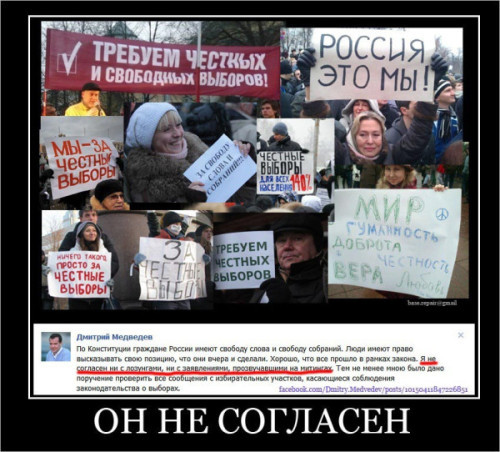
That is not to say that those who went to the protests are likely to achieve the cancellation of previous election results. Much more likely is that the government will find a few “exceptional cases” where election laws were broken, but make clear that these had little effect on the final results. This seems to be the sense, in any case, of President Medvedev's annoucement on his Facebook page that said:
“People have the right to express their position, which is what they did... [but] I agree neither with the slogans, nor the statements voiced at the protests. Nevertheless, I have ordered checks into all the reports from polling stations regarding the compliance with the election laws.”
This has already generated an interesting response in the internet: 

Most of the signs from the protest read: “we're for fair elections.” “He doesn't agree,” reads the caption.

If nothing more is done by the government, protest organizers plan to go out on the streets again in two weeks time. The situation has suddenly become quite unpredictable, yet in a way that many here are approaching (contrary to the country's traditional instincts) with a degree of optimism. If those dissatisfied with the current domination of United Russia and Prime Minister Putin can find an attractive alternative (it doesn't seem at the moment any of the leaders of the opposition parties fit that bill), there is, surprisingly, a chance that the presidential election this coming March will be interesting for the first time in more than a decade.

1 No less surprising is the fact that officials from the  Russian Orthodox Church have called for “more public control” over the electoral system. In the past years the Orthodox Church has almost without exception supported the government currently in power.

05 December 2011

Russian Duma Elections 2011


“Siberia Put on a Red Belt” 
That's the headline from a local paper today. “Red,” of course, being the color of the Communist Party.

While the Communist party actually did not received a plurality (not to mention a majority) of the vote anywhere in the region, the move away from the heretofore dominant “United Russia” party of Prime Ministry Vladimir Putin and President Dmitry Medvedev was quite noticeable. In Siberia, the votes for representatives for the lower house of parliament were generally split between United Russia and the Communists (with the split in Novosibirsk being about 30%/30%, while other regions had United Russia leading the Communists by 10% or so), with two smaller parties (the Liberal Democratic Party and A Just Russia) each getting a little less than 15% each. It's clear that the results of this election mean that United Russia will lose its constitutional majority (i.e., they will not be able to change the constitution at will anymore), though they will have the simple majority necessary to elect a prime minister and pass laws.

Preliminary results - 2011 election
Dark blue: United Russia. Bright red: Communist Party,
Dark red: A Just Russia. Light Blue: Liberal Democratic party.
The other parties did not receive enough votes to win a place in parliament.
Source: http://english.ruvr.ru/

About 57% of registered voters took part in elections, a bit less than in the previous election cycle. There is quite a bit of anecdotal evidence of unfair election tactics, though Russian election officials (and observers from the former Soviet Union) claim that there were no serious problems. This differs from the preliminary report from observers from the Organization of Security and Co-operation in Europe, which states:

"This result shows that voting can make a real difference in Russia, even when the playing field is slanted in favour of one party. However, any election needs an impartial referee – and until now, it has not had one. This needs to change. Yesterday, Russia showed that it is technically able to organize fair elections – now it is up to the parties to use this opening for real politics and make it a reality,” said Tiny Kox, Head of the delegation of the Council of Europe’s Parliamentary Assembly.

"These elections were like a game in which only some players are allowed on the pitch, and then the field is tilted in favour of one of the players. Although the choice was limited and the competition lacked fairness, voters were able to come out and have their voices heard,” said Ambassador Heidi Tagliavini, the Head of the Election Observation Mission of the OSCE Office for Democratic Institutions and Human Rights.1

I usually don't like to come to quick interpretations of news stories, since I'm not sure that it is possible to come to a good understanding of current events so quickly. On the other hand, though, some of you might be hearing about the Russian elections now on the news, and I thought that I'd share my first reaction.

One thing is clear – United Russia won the elections. Another thing is also clear - there is really quite a bit of dissatisfaction with United Russia just now. The reasons for this are many and (perhaps surprisingly for Westerners) are not readily associated with the financial crises the world has been going through in the past few years. Instead, it seems that people may be somewhat tired of a political scene dominated by one party, especially when it is very difficult to say what this party stands for. This, I suppose, does a lot to explain the relative success of the Communist party in this election – they have clear (if usually quite unrealistic) positions on social and economic questions. In Novosibirsk, I'd imagine that there is a certain degree of sincere support for the Communists, insofar as there are so many people here tied with science and research, and they have reason to believe that if the Communists were in control, their institutes would be better funded. But for the most part it seems like the Communists draw attention, not for their policies, but because it is thought that they are they only party that can realistically challenge United Russia. The majority party, on the other hand, enjoys the support of two groups of people (as far as I can tell): first, those whose main approach to life is to hope that it won't get worse (the 2000s saw greater economic stability and growth than the 1990s, and so we should stick with the people who were in charge in the 00s) and, second, those who received concrete help with their problems thanks to Presidents Putin or Medvedev. A quick example – after church yesterday, people were talking about the elections. One of the people in our congregation said that they she would be voting for United Russia since President Putin helped solved a problem she ran into a number of years ago. The land just next to their apartment building had been illegally seized and construction of a parking garage had begun. This women gathered signatures protesting construction from her neighbors, and they wrote to the President. The president then wrote to the local DA, who took steps to stop the construction and return the land. While I was happy that this woman had been helped with her problem, it must be noted that United Russia controlled every level of government in the past years. So while the President solved a problem and this is good, the President was also responsible for helping to build and strengthen a system in which one needs to write to Moscow in order for a local problem to be solved.
Presidential elections are scheduled for March. Polls show that Vladimir Putin has lost a lot of support in the past months, but at present it seems highly unlikely that a candidate will be found that will even give Mr. Putin a run for his money. But the political scene in Russia, despite its stability stagnation in recent years, can also be pretty volatile. Perhaps the relative success of this parliamentary election will inspire the minority parties to come together to support one strong candidate for president. If that happens, you can expect more blog posts on Russian politics in the future.

01 December 2011

It's beginning to look a lot like Christmas


Despite the fact that at least 90% of those Russians who celebrate Christmas do so on January 7th 1, that doesn't mean that the country is far behind the West when it comes to preparing for the holiday season. Christmas decorations have been up in some stores since early November, and Christmas trees are starting to go up in squares and parks around the city. I plan on writing more later about the winter holidays here, but for now, I'll just share a few reasons why it's beginning to look a lot like Christmas.

  • First of all, the snow. It is really, truly winter. After many years of freezing rain and slush in St. Petersburg at this time of year, it is a bit of relief that we know that the snow is here to stay. Until April. Or May. And shoveling snow from the church courtyard has been a good way to work off frustration, I've found...though I'll admit that by spring I might be feeling differently.
  • Christmas Bazaar. This past weekend, the local German cultural center (together with the German consulate) hosted their annual 1st Sunday of Advent Christmas Bazaar. Our congregation always has a table there were we talk with the guests (there were over 1000!) and sell crafts and baked goods. We had fun and raised a bit of money for the church, which the council intends to use towards repairs for our building's foundation next spring. 

  • Midweek Advent services. Our church building is quite isolated – you can't really just happen upon it. In addition, most people in the congregation live in other parts of the city (or even outside of it). For that reason, there usually isn't a lot of reason for the pastor to be located in the church building much. But I decided that for Advent, I would start every Wednesday with morning prayer and end with evening prayer, inviting congregational members to come at any time to pray together or just to talk. It is still too early to say whether or not this will meet the spiritual needs of those in the congregation, but yesterday morning a few of us did pray together, followed by and almost hour-long hymn sing. Fellowship time is important, so I hope that people continue to come.
  • “It's the most wonderful time of the year”. “Wonder” in the sense of “miracle.” The news here lately has frequently reported on the astounding number of people who have made their way to the Church of Christ the Savior in Moscow to visit the “the Belt of the Theotokos.” This Orthodox relic, supposedly woven from camel hair by the Virgin Mary herself so that she might wear it during her pregnancy, is usually found on the monastic mountain of Athos in Greece2; in the past month, however, it has traveled through Russia so that the faithful could venerate it.3 When the Belt was in the capital, lines stretched to incredible lengths, with reports that some people waited 15-20 hours and with more than 80 people needing hospitalization after standing out that long in the cold. The Belt went back to Athos this week, but miracles (especially healings and restored fertility) are already being reported. I think I'll leave it to respected journalist Nikolai Svanidze to comment on this phenomenon, even if his commentary is perhaps a bit too harsh: “It testifies to the fact that people long for a miracle. It does not testify to depth of faith... In Russia our religiosity is very peculiar, because since the time of the Baptism of Rus I cannot say that the country became Christian. We have a peculiar understanding of the Orthodox faith; there is a lot of paganism in it. And this longing for miracle in and of itself has, I'd say, an indirect relationship to [Christian] faith.”4
    Waiting in line to see the "Belt of the Theotokos."
    Originally from the site bogoslava.ru

1The Russian Orthodox Church follows the Julian calendar which is (at present) 13 days behind the standard Gregorian calendar we use. A significant number of Protestant churches have also decided to celebrate Christmas and Easter together with the majority here, though Lutherans and Roman Catholics tend to follow the western practice.
2Where women are not permitted to visit under any circumstances. 80% of those who came to see the Belt in Russia were women.
3Strangely enough, certain parts of the Belt (and, among other things, part of the hem of Christ's robe) are in Moscow churches permanently, but none of these relics draw so much attention.
4On the radio program “Special Opinion” on the Echo of Moscow radio station. Nov 25.