Showing posts with label Russian Duma elections 2011. Show all posts

02 March 2012

Two Days Before the Election

Limited internet access these days has been part of what has been slowing down the pace of my blogging. But I'm compelled by the upcoming presidential election (March 4) to share a few thoughts as the day approaches when the country will choose its leader for the next 6 years.

Media reports and anecdotal evidence seem to point to one, inevitable conclusion - Vladimir Putin will be elected president. Putting aside questions about the election's fairness (the government has taken a number of positive steps to secure a more transparent process than in the Duma elections in December), the majority of Russians feel like he Mr. Putin is the best choice. Many are also quite afraid of a revolution; they point to their own history in the 20th century and their neighbors' more recent history to show that revolutions tend to change the people in the leadership, but do little to get rid of authoritarian structures. The graffiti image below illustrates what most people are hoping and expecting from Mr. Putin's leadership. Yet, I thought that it might be appropriate to include here not just the graffiti itself, but the area surrounding it. The picture says a lot about modern Russia: Mr. Putin is in the foreground, while in the background there are signs both of society's economic development and of defensiveness and stagnation.


As regards to my own thoughts, I would say that, given the current situation, I also hope that Mr. Putin wins...but in the second round. In order for any candidate to win outright, they need to gain more than 50% of the vote. I feel like it would be really good for Russian society if the opposition candidates (4 of them) together where able to get more than half of the vote. Three of these candidates are political old-timers who have not been able to reach out and gain many new supporters; the fourth is Mikhail Prokhorov. He is certainly the most interesting candidate in the election, but his business-friendly approach, his enormous wealth, and his lack of political experience hinder him. When faced with a choice between any of those four  and Mr. Putin, the country will clearly choose their former leader....but if they have to vote a second time, it will feel like they really had a choice, and that ordinary citizens really can impact political practices. If people gain this confidence, this would be an important step to minimizing the corruption that so seriously affects society.

One piece of evidence that society has already benefited through the protests that have occurred - people are (more frequently, though not always) actually able to exercise the freedom of assembly that is promised to them in the Russian constitution. In years past city governments would go to extremes to be sure that protesters felt threatened and intimidated; in the February protest (pictured below) I saw that the police were few in number and did not bother the protesters at all.


There will be protests, too, after the presidential election. Those who go out in to the streets will be right to want to voice their opinion and to continue to criticize the electoral system. I deeply hope that these concerns are heard and heeded by the government. At the same time, I share the hope of the people of my congregation that the country can avoid a revolution. 

12 December 2011

Russian Elections - One Week Later

When I said last week that I don't usually respond quickly to current events, I thought that it would be quite reasonable to make an exception in this case – Russian opposition parties had made serious gains in elections for the Duma; considering the country's recent political history, this was already news...and it seemed unlikely that there would be any more.
I was wrong, and I was not alone. Even expert political commentators seemed shocked by what followed. Not only did many people complain about electoral fraud (making this election similar to many others here), but, using social networking sites, they also actually acted together in coordinated way to protest the official election results. In the past, those opposed to the governing party were splintered into a various movements that spent as much time squabbling with one another as they did with those in power – their protests were relatively easily put down by overwhelming police power. This time, though, thousands of people in Russia's major cities gathered to criticize the government and demand a new election.


In Novosibirsk at least 3000 people turned up for protests.


And in Moscow tens of thousands of protesters went to the streets.
The only thing remotely similar I've seen in the 10 years that I have been here were the protests related to the monetization of pensioner’s benefits in 2005. Yet even here the differences are greater than the similarities. At that time the protesters were almost all elderly, and their anger was directed at a single government policy. Many of those gathered at protests this time around would disagree with one another about nearly every political issue. Yet, they were able to put aside their differences and make their voices heard. This time around the protesters were, to a large extent, also much younger. I've been very surprised to see that many acquaintances my age or younger have suddenly shown an interest in politics, whereas in previous years these same people either gave the government no thought or felt that they were powerless to make change.1

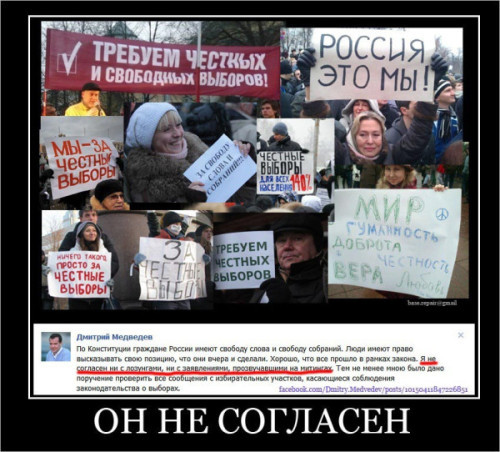
That is not to say that those who went to the protests are likely to achieve the cancellation of previous election results. Much more likely is that the government will find a few “exceptional cases” where election laws were broken, but make clear that these had little effect on the final results. This seems to be the sense, in any case, of President Medvedev's annoucement on his Facebook page that said:
“People have the right to express their position, which is what they did... [but] I agree neither with the slogans, nor the statements voiced at the protests. Nevertheless, I have ordered checks into all the reports from polling stations regarding the compliance with the election laws.”
This has already generated an interesting response in the internet: 

Most of the signs from the protest read: “we're for fair elections.” “He doesn't agree,” reads the caption.

If nothing more is done by the government, protest organizers plan to go out on the streets again in two weeks time. The situation has suddenly become quite unpredictable, yet in a way that many here are approaching (contrary to the country's traditional instincts) with a degree of optimism. If those dissatisfied with the current domination of United Russia and Prime Minister Putin can find an attractive alternative (it doesn't seem at the moment any of the leaders of the opposition parties fit that bill), there is, surprisingly, a chance that the presidential election this coming March will be interesting for the first time in more than a decade.

1 No less surprising is the fact that officials from the  Russian Orthodox Church have called for “more public control” over the electoral system. In the past years the Orthodox Church has almost without exception supported the government currently in power.

05 December 2011

Russian Duma Elections 2011


“Siberia Put on a Red Belt” 
That's the headline from a local paper today. “Red,” of course, being the color of the Communist Party.

While the Communist party actually did not received a plurality (not to mention a majority) of the vote anywhere in the region, the move away from the heretofore dominant “United Russia” party of Prime Ministry Vladimir Putin and President Dmitry Medvedev was quite noticeable. In Siberia, the votes for representatives for the lower house of parliament were generally split between United Russia and the Communists (with the split in Novosibirsk being about 30%/30%, while other regions had United Russia leading the Communists by 10% or so), with two smaller parties (the Liberal Democratic Party and A Just Russia) each getting a little less than 15% each. It's clear that the results of this election mean that United Russia will lose its constitutional majority (i.e., they will not be able to change the constitution at will anymore), though they will have the simple majority necessary to elect a prime minister and pass laws.

Preliminary results - 2011 election
Dark blue: United Russia. Bright red: Communist Party,
Dark red: A Just Russia. Light Blue: Liberal Democratic party.
The other parties did not receive enough votes to win a place in parliament.
Source: http://english.ruvr.ru/

About 57% of registered voters took part in elections, a bit less than in the previous election cycle. There is quite a bit of anecdotal evidence of unfair election tactics, though Russian election officials (and observers from the former Soviet Union) claim that there were no serious problems. This differs from the preliminary report from observers from the Organization of Security and Co-operation in Europe, which states:

"This result shows that voting can make a real difference in Russia, even when the playing field is slanted in favour of one party. However, any election needs an impartial referee – and until now, it has not had one. This needs to change. Yesterday, Russia showed that it is technically able to organize fair elections – now it is up to the parties to use this opening for real politics and make it a reality,” said Tiny Kox, Head of the delegation of the Council of Europe’s Parliamentary Assembly.

"These elections were like a game in which only some players are allowed on the pitch, and then the field is tilted in favour of one of the players. Although the choice was limited and the competition lacked fairness, voters were able to come out and have their voices heard,” said Ambassador Heidi Tagliavini, the Head of the Election Observation Mission of the OSCE Office for Democratic Institutions and Human Rights.1

I usually don't like to come to quick interpretations of news stories, since I'm not sure that it is possible to come to a good understanding of current events so quickly. On the other hand, though, some of you might be hearing about the Russian elections now on the news, and I thought that I'd share my first reaction.

One thing is clear – United Russia won the elections. Another thing is also clear - there is really quite a bit of dissatisfaction with United Russia just now. The reasons for this are many and (perhaps surprisingly for Westerners) are not readily associated with the financial crises the world has been going through in the past few years. Instead, it seems that people may be somewhat tired of a political scene dominated by one party, especially when it is very difficult to say what this party stands for. This, I suppose, does a lot to explain the relative success of the Communist party in this election – they have clear (if usually quite unrealistic) positions on social and economic questions. In Novosibirsk, I'd imagine that there is a certain degree of sincere support for the Communists, insofar as there are so many people here tied with science and research, and they have reason to believe that if the Communists were in control, their institutes would be better funded. But for the most part it seems like the Communists draw attention, not for their policies, but because it is thought that they are they only party that can realistically challenge United Russia. The majority party, on the other hand, enjoys the support of two groups of people (as far as I can tell): first, those whose main approach to life is to hope that it won't get worse (the 2000s saw greater economic stability and growth than the 1990s, and so we should stick with the people who were in charge in the 00s) and, second, those who received concrete help with their problems thanks to Presidents Putin or Medvedev. A quick example – after church yesterday, people were talking about the elections. One of the people in our congregation said that they she would be voting for United Russia since President Putin helped solved a problem she ran into a number of years ago. The land just next to their apartment building had been illegally seized and construction of a parking garage had begun. This women gathered signatures protesting construction from her neighbors, and they wrote to the President. The president then wrote to the local DA, who took steps to stop the construction and return the land. While I was happy that this woman had been helped with her problem, it must be noted that United Russia controlled every level of government in the past years. So while the President solved a problem and this is good, the President was also responsible for helping to build and strengthen a system in which one needs to write to Moscow in order for a local problem to be solved.
Presidential elections are scheduled for March. Polls show that Vladimir Putin has lost a lot of support in the past months, but at present it seems highly unlikely that a candidate will be found that will even give Mr. Putin a run for his money. But the political scene in Russia, despite its stability stagnation in recent years, can also be pretty volatile. Perhaps the relative success of this parliamentary election will inspire the minority parties to come together to support one strong candidate for president. If that happens, you can expect more blog posts on Russian politics in the future.