18 November 2011

Sophiology

What better way to approach systematic theology than to use the writing method they taught us in junior high – the 5 w's?1

The first sentence of the Wikipedia article on Sophiology can act as our starting point. Sophiology – “from Greek Σοφία Sophia (wisdom)(in Bulgarian and Russian: София) is a philosophical concept regarding wisdom as well as a theological concept regarding the wisdom of God.

Why?
I didn't set off to be living proof that dissertation topics are obscure – I really didn't! In choosing my theme for further study in the field of theology, I hoped to bring to light a relatively unknown idea that could be a resource for contemporary theologians. I felt that these voices from the East (both tied to church tradition and yet free to engage their mind and interact with contemporary thinkers) might just hold a key for bringing Wisdom out of her marginalization and into the lexicon of the wider church. I hoped that this the concept of Sophia might lead not only to a re-thinking of certain preconceived notions about God and God's relationship to the world, but that it could also lead to changes in contemporary practices in the realms of ethics, inter-faith and ecumenical relationships. In short, I had hoped that my work might find some resonance with readers today.


Vladimir Solovyov (on a good hair day)
Now, two years in to my research, I understand better both the problematic areas of Sophiology and the resources that it offers for those who both desire to remain within the framework of orthodox (though probably not Orthodox) Christian thinking and yet come to new interpretations of the church's teachings for the modern world.

Regarding my desire to find something useful for ethical questions, because of the limits of writing a dissertation at a state-sponsored university, I'm having to put these sorts of “practical” questions aside for the moment. While early versions of my dissertation outline were full of attempts to apply my research in concrete ways to wider questions, I eventually came to understand that this will need to remain outside of the bounds of my dissertation as such. For now, these ideas sit in folder on my computer, waiting for proper attention until after I get the major work (in the area of theology as such) done.


When? / Where? / Who?


Pavel Florensky and Sergei Bulgakov in the painting
 "Philosophers" by Mikhail Nesterov
The theological movement that I'm studying is rooted in the intellectual environment of late 19th and early 20th century Russia. The concept of Sophia, the Wisdom of God, permeated the philosophy, theology and even poetry of the period; part of my task is to describe why it was an attractive idea at the time. I'll then be then tracing the concept through the lives and thought of three fascinating individuals - one of Russia's most famous philosophers, Vladimir Solovyov, one of Russia's most gifted and unusual talents, Father Pavel Florensky, and Archpriest Sergei Bulgakov, the former Marxist economics professor whose entire worldview in his mature years was formulated around Divine Wisdom and who, therefore, developed Sophia as a full-fledged philosophical-theological concept.

What = Wisdom?
Theologian, Bulgakov scholar, and Archbishop of Canterbury, Dr. Rowan Williams, has said that “Father Bulgakov's thought has often seemed impenetrable to the casual Western reader, or even the not so casual Western reader.”2 Sometimes Dr. Williams' works can feel the same way, so as you can imagine, I have my work cut out for me. That's even more true if another Bulgakov scholar, Catherine Evtukhov, is right that Bulgakov was careful never to give a complete and final definition of who/what Sophia was.


I think that Evtukhov is wrong, though, and my dissertation sets out to show Bulgakov really does have a well-defined theology of Divine Wisdom that flows through every major area of systematic theology he touches (and he touches them all.) Yet, saying that Sophia is important for these thinkers is not the same as saying who or what she is. And here I'll do my best to give a short summary. The best starting point from which to understand Wisdom in Sophiology is through a rather unusual Biblical text, from Proverbs 8 and 9. (NIV. Particularly important verses for the Sophiologists are in italic):

8.1 Does not wisdom call out? Does not understanding raise her voice? 

2 At the highest point along the way, where the paths meet, she takes her stand; 
3 beside the gate leading into the city, at the entrance, she cries aloud: 
4 “To you, O people, I call out; I raise my voice to all mankind. 
5 You who are simple, gain prudence; you who are foolish, set your hearts on it.
6 Listen, for I have trustworthy things to say; I open my lips to speak what is right. 
7 My mouth speaks what is true, for my lips detest wickedness. 
8 All the words of my mouth are just; none of them is crooked or perverse. 
9 To the discerning all of them are right; they are upright to those who have found knowledge. 
10 Choose my instruction instead of silver, knowledge rather than choice gold, 
11 for wisdom is more precious than rubies, and nothing you desire can compare with her.

12 “I, wisdom, dwell together with prudence;  I possess knowledge and discretion. 
13 To fear the LORD is to hate evil; I hate pride and arrogance evil behavior and perverse speech. 
14 Counsel and sound judgment are mine; I have insight, I have power. 
15 By me kings reign and rulers issue decrees that are just; 
16 by me princes govern, and nobles—all who rule on earth.
17 I love those who love me, and those who seek me find me. 
18 With me are riches and honor, enduring wealth and prosperity. 
19 My fruit is better than fine gold; what I yield surpasses choice silver. 
20 I walk in the way of righteousness, along the paths of justice, 
21 bestowing a rich inheritance on those who love me and making their treasuries full. 
22 “The LORD brought me forth as the first of his works, before his deeds of old;  
23 I was formed long ages ago, at the very beginning, when the world came to be. 
24 When there were no watery depths, I was given birth, when there were no springs overflowing with water; 
25 before the mountains were settled in place, before the hills, I was given birth, 
26 before he made the world or its fields or any of the dust of the earth. 
27 I was there when he set the heavens in place, when he marked out the horizon on the face of the deep, 
28 when he established the clouds above and fixed securely the fountains of the deep, 
29 when he gave the sea its boundary so the waters would not overstep his command, and when he marked out the foundations of the earth. 
30 Then I was constantly at his side. I was filled with delight day after day, rejoicing always in his presence,  
31 rejoicing in his whole world and delighting in mankind....
9.1 Wisdom has built her house; she has set up its seven pillars. 
2 She has prepared her meat and mixed her wine; she has also set her table. 
3 She has sent out her servants, and she calls from the highest point of the city, 
4 “Let all who are simple come to my house!” To those who have no sense she says,“Come, eat my food and drink the wine I have mixed. 
6 Leave your simple ways and you will live; walk in the way of insight.”


After reading this passage, you might ask - "What is this Wisdom?" Is it some sort of being? If so, is the being created or Divine? Perhaps it's not a being at all, but simply a poetic personification of one of God's attributes? While Biblical scholars tend to lean toward that last answer today, that does not mean that there is universal agreement. The situation is even more complicated for the Russian thinkers mentioned above because they also have a multifaceted tradition of Wisdom in the Orthodox church to deal with, along with (at least in some cases) their own (mystical) experience of Sophia (Yes, for them Wisdom is “She”).


For the Orthodox, theology
can be captured in icons. So
when two icons of Sophia  
(such as these two here) 
have such different symbolic
meanings, this indicates a
 lack of theological clarity.
Where do the Sophiologists end up in their theological development? Well, we cannot really say except in the case of Bulgakov.4 Still, I'll be writing perhaps 200 pages on that question. But, to put it very succinctly, Bulgakov interprets Sophia as the essence of God (the divine substance or “ousia” for those of you interested in Trinitarian theology,) at the same time both part of the Godhead and (in its created, as opposed to Divine, aspect) the substance of the world (this is panentheism, for those of you interested in developments in later 20th century theology).5


This approach to theology was quite controversial at the time, though political concerns (related to the divisions of the Russian church's representatives abroad that occurred because of the Revolution) were of at least as important here as theological ones. I know that I am certainly not fully convinced by the approach of the Sophiologists. Yet, on the other hand, I'm impressed by Father Bulgakov's devotion to challenging an ossification of the church that equates orthodoxy with teaching that is wholly static. At the same time, Bulgakov had no interest in joining those hypercritical of the church, rejecting its teachings outright. Bulgakov shows himself to be a true modern moderate who can make, with a creative approach that rejects long-out-dated stereotypes, orthodox Christianity intellectually interesting and engage in mutually-enriching dialog with the modern world.


That's why I'm continuing my work. And since I find Bulgakov interesting not just when he deals directly with Divine Wisdom, in the coming months I hope to finish a side project that I've been working on for a long time. Bulgakov wrote a small book called On the Gospel Miracles that has yet to be translated into English. If I can figure out the technical side of things, I'll be publishing this annotated translation on Amazon in early 2012.
* * *
1With a 6th added on for good measure...and without the “h” since writing about the “how” of Sophiology, the methodology, is giving me headaches. I wanted to spare you that pain.
2 “Creation, Creativity and Creatureliness.” Speech for the Wisdom of Finite Existence Study Day organized by the St Theosevia Centre for Christian Spirituality, Oxford. 2005. http://www.archbishopofcanterbury.org/99
3 Sergei Bulgakov. Philosophy of Economy. trans. and ed. Catherine Evtukhov. Yale 2000.  10-11.
4Solovyov died without having systematized his thought. Florensky's life was cut tragically short when he was executed under Stalin.
5In highlighting some of Bulgakov's major themes, I see one more reason why I was attracted to Sophiology – these same topics are quite important to one of my favorite contemporary theologians, Jürgen Moltmann.   

15 November 2011

Ministry Inside and Out


 Writing for this blog has taken a back seat for the last couple of weeks - I've spent quite a bit of time on the road or in preparation for being away. Now that I've returned to Novosibirsk, I hope to make up for my absence by posting a couple of different entries this week. The second will be related to one of the reasons I was away – to go to Helsinki to meet with my dissertation adviser and other doctoral students about my research. Since from time to time some of you have asked about my studies, by Friday I'll haven written a summary of the work I am doing there in the area of “Sophiology.” (Don't be scared! It's not as bad as you think!). :)
But for now, though, I'll return to church and its situation here in Siberia.
Our congregation building on October 30.
It's whiter still there now.
Rather, I'd like to return to the church. Instead, though, I feel like the church on the congregational level is still a bit too puzzling to be able to be write about it in a way that is understandable. Instead what I feel like I can do is write about my confusion. For example: just before worship began on the 30th of October, I was told by a member of the church council that there would be funeral after the service. It would be held in the home of a very elderly woman who had not been able to attend church for the past 6-8 years. I was invited to come and to preside. This took me by surprise, to say the least. The last and only time I had presided at a funeral was 9 years ago in Novgorod; though I have my own materials prepared for such a situation, they were at home (and I certainly would have brought them had I been informed earlier!) I was tempted for a minute to say that I wasn't prepared and therefore wouldn't lead the service, but this seemed to me to be the worse of the two options before me. When we arrived we found the typical situation after an elderly person dies here – family and friends were gathered in the living room around the coffin, taking turns paying last respects. Four women from the congregation lead the singing (with some of the hymns proclaiming a word of hope for the deceased and others (the greater number) reminding those gathered that they, too, will die some day and that they'd better get their spiritual houses in order), and I did my best to lead prayers and give a short homily. After the service ended, a few people present (none of whom had ever been to a Lutheran service) address some rather unexpected questions to us, so as “Does your guardian angel stay with you in heaven or come back to help someone else?” and“How should we bury Maria, with her head or her feet at cross?” I took my time in answering, and one of the women jumped in – her answers surprised me as much as the questions themselves. Part of me wanted to react immediately – to make clear that I should be told immediately if someone dies (and that I should have a list of the home bound to visit so that I can provide spiritual care to the elderly before they die), that the answers given to the questions do not really have a good basis in the teachings of our church. And, as pastor, I actually have a certain responsibility to make such these things clear. Yet, our relationship has not yet developed to such a point that my “corrections” are likely to bring about the desired effect. So, I'm trying to follow a course of “responsible inaction” by patiently and consciously developing relationships with congregational members such that I can eventually influence the congregation's life in positive ways.
The situation is quite different for me outside of the congregation, where I have no direct responsibility and, therefore, fewer limitations on the way I work. In exploring ministry outside of the congregation, it has become clear to me just how important it is that we keep a wide definition of what and were the church is. While the congregation is important, it perhaps is not where I will focus most of my energy right now.
Together with Deacon Vyacheslav (Slava)
 at the Reformation Day Service
I've been able to become acquainted with one very interesting sphere of ministries outside of the congregation thanks to the help of a deacon in the local Finnish-tradition church, Vyacheslav (Slava, for short). Slava has spent many years engaged in prison ministry. While this aspect of his work is practically inaccessible to me – every time a foreigner wants to visit a prison, permission must be received from Moscow - there are many prison-related fields in which I might be able to take part.
Slava's work is not limited to what happens behind prison walls. His work there led rather quickly to the realization that there was a whole complex of social issues related to those who had been incarcerated. First, it brought him into contact with the families of the men he had been visiting; he found that most were suffering, and that many had been infected with tuberculosis, which is a wide-spread problem in Russian prisons. Their children (if diagnosed properly) would be sent to a special hospital complex for a minimum of six months of therapy. In fact, the situation was very close to one in an orphanage – relatives visit rarely and staff are occupied with caring for the physical needs of the children but have no resources for providing more. Slava gathers donated toys, cloths, diapers and other materials for these children and brings them to the hospital at least once a month. He also gets together special gifts for those who had birthdays that month, and he presents them and other special treats to the kids at the afternoon tea break. He usually does a short program with the older kids to help them see God's love for them.
In addition, when following-up with the men who had been released from prison, Slava found that a large number were suffering from substance abuse and in need of rehabilitation. Eventually a rehab center in Novosibirsk that was looking for some spiritual support approached Slava for help, and since that time he makes weekly visits there for Bible study as well as providing counseling at other times. He and another man from his congregation have worked closely with this rehab center and hope to open a Lutheran church-based center in the near future.
Men at the rehab center.
Picture taken with their permission (or, rather, at their request)
And this reminds me of another rehab center I had the opportunity to visit in the last days of October. This center was about an hour outside of Novosibirsk in an isolated village. I traveled there with a group of friends working on HIV prevention. Since about 70% of new cases of HIV here come about through the sharing of infected needles, these friends are trying to increase awareness among former or current drug users about HIV. On the one hand they hope that this will allow HIV positive people to have the opportunity to receive treatment at these centers (instead of being forced out because of a fear about the “dangers” of being around HIV positive people), and on the other they want to encourage those in the centers to get an HIV test so that they might know their status and take appropriate steps if needed. Of the people I traveled with to this center, two of them came to faith in Christian rehab centers....unfortunately, by the time they started to heal from their drug addiction, they had already become HIV positive. That these two friends (we'll call them Ivan and Anna) were able to kick the habit is really a bit of a miracle – the recovery rate at rehab centers (including at Christian ones) is disappointingly low, and some Christian organizations use the rehab centers as a for-profit business, whereas others make membership in their church a condition for continued help with recovery. On the other hand, there are few alternatives accessible to addicts, and so these church centers are the best option at the moment. And for folks like Ivan and Anna, they were crucial in their recovery...and now this effect is being multiplied by their engagement in trying to bring help to others.
I feel very privileged to have had the opportunity to see the church beyond the borders of the congregation in these past few weeks. But I don't want to leave the impression that nothing new is possible in the congregation. Just recently, in fact, we did something that would be typical in the U.S., but which is rather innovative here – we gathered 3 congregations (our church, the Finnish-tradition Lutheran congregation, and a local Baptist congregation) together to celebrate Reformation Day. While I realize that in the context of the West there is the danger of simply glorifying the past on this day, for us here it was not only an opportunity for education (since not that many people are familiar with the Reformation), but was also one of the few chances we have here to see a concrete example of churches working together. There were not many of us at the service (it was a Monday night, after all), but I believe that all three congregations felt strengthened spiritually by our evening together, and I hope that in time we'll find more ways that we can continue to strengthen one another....perhaps in social service projects and youth work? I'll let you know how our efforts in those directions work out.
Reformation Day Service at the Lutheran Church of Christ the Savior (Evangelical Lutheran Church
of Ingria in Russia). Gennady Moskalin (center) is in charge of that parish; Presbyter Russell Phillips
 from the Baptist congregation is just left of center.  


19 October 2011

A Wider Vision of the Church in Siberia - Synod Assembly

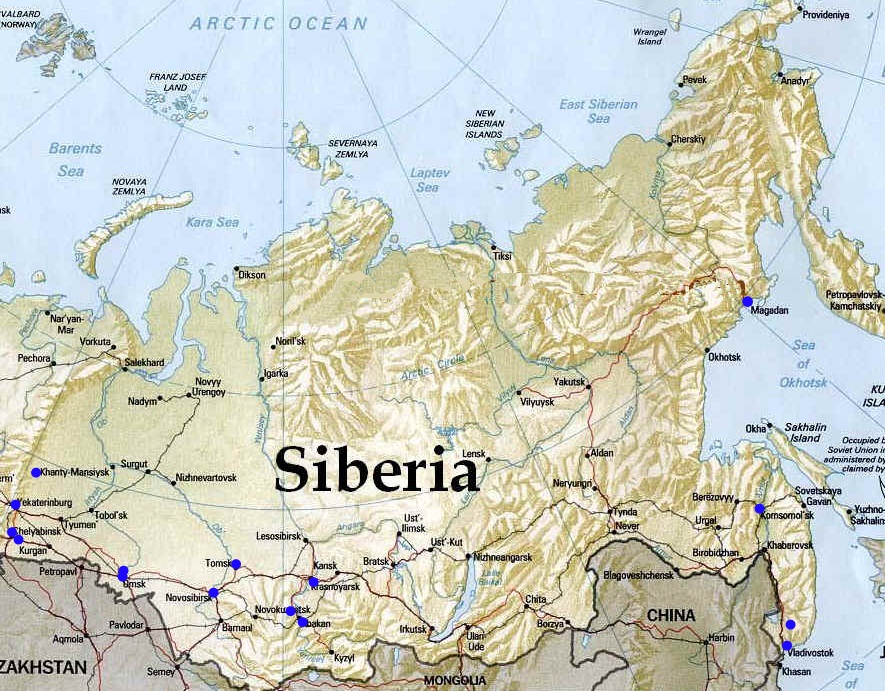
This past weekend I was fortunate to have the opportunity to attend the 20th annual synod assembly of the ELCUSFE in Omsk. Just over 20 delegates from the “largest Lutheran synod in the world”1 considered both practical and theological issues; the positive tone of the assembly was set by Bishop Otto Schaude and reinforced by a wonderful facility, excellent weather and common worship.
I should probably apologize – the above sounds more like a press release
than a blog entry. At the same time, it is a sincere reflection of the events of the weekend.
But now, back to the beginning - as soon as I arrived in Omsk, I was reminded of the great variety of congregational life in Lutheran churches in the region. A few congregations are working more or less like a “normal” congregation would – they have a pastor, a building, and are striving to be the best stewards of what they've been given and to build up ministries that meet the needs of their congregations and the wider community. A few have something in common with new mission starts in the U.S. - they are building their congregations from the ground up and are, as a rule, small, yet experiencing a fruitful spiritual life. A third group of congregations are in the process of re-development, moving from German to Russian or trying to overcoming some other significant challenge. These congregations tend to be very small and a bit depressed. But even having the opportunity to be together and to realize that we're not in that boat alone was quite helpful.Events of particular interest for me included a theological presentation by Dr. Jürgen Schuster from the Bad Liebenzell mission. Missionaries from this evangelical mission organization have been working in the Ural region for quite some time, and the influence of their missiological approach and piety have certainly been felt throughout the years. At the same time, it has been my experience that our sense of mission has serious differences, so I cannot say that I was the most unbiased of listeners when Dr. Schuster began. It was to my great pleasure that my prejudices were found to be false. Dr. Schuster's presentation itself was very helpful; even if the information presented was not particularly new for me (much of the same ground had been covered in a Missiology class taught by Dr.Richard Bliese then at LSTC, by focusing on the book of Acts (and in particular on the events leading up to and surrounding the “Apostolic Council” in Acts 15), we were all reminded that the church has always had to think about its relationship to culture. This has been important because for all of my years here I've been a participant in the process of trying to understand how Lutheranism applies to the Russian context. In particular, I've been a big proponent of doing what I can to help the church “russify,” as opposed to remaining so very close to its German (Finnish, etc.) roots. Now, after 10 years, I'm a little bit uncertain. The more I think about it, and especially the more I see the everyday life of congregations here, the more I realize that the Lutheran church needs to retain a certain degree of distance from the culture if it is going to find an audience here. What I mean is this – if the church were to strive to be “typically Russian,” then it would clearly do this in a less successful way than the bigger, stronger, more experienced churches in this regard (especially the Orthodox, but also Baptist and Charismatic, in their own way) will. Instead, the Lutheran church will find its place here if it realizes that it's “target” is not to be in the broad center of the culture, but around the culture's margins, among those who either do not wish to or cannot participate in the dominant culture. This is not to say that I want the church to remain an ethnic ghetto - not by any means! Instead, though, I hope that the Lutheran church can become a spiritual home for those who do not see the church as addressing their situation. A relatively successful example of such an attempt is the ministry of the Probst (Dean) of the Far East, Manfred Brockmann.Pastor Brockmann will have been in Russia 20 years by this time next year. In his particular context of Vladivostok, he's been able to support a congregational ministry that uses culture (for example, they have a very large program of German culture events every year as well as a very active ministry of free, classical music concerts) as a means to demonstrate a different way of being church than is common in wider society. St. Paul's in Vladivostok is a unique congregation with an experience that is not likely to be repeatable elsewhere. At the same time, despite all my respect for the Eastern Orthodox tradition, by looking at their work I become even more convinced that we cannot and should not try to become a second Orthodox church.

The youth choir from the congregation in Omsk singing at closing worship. 

It is not only our German-rooted church that is going through this struggle. This weekend I also had the opportunity to meet the Probst of the Finnish-rooted Ingrian church, Juha Saari. Like me, he is a long-time missionary in Russia, and we both easily agreed that we would like to do what we can so that the Lutheran congregations in the region would come together. It seems that I have yet to mention the fact that there are actually four (!!!) different Lutheran church bodies in Novosibirsk and a 5th is also represented in the region. Many of the congregations are small and struggling, while their divisions sometimes reflect either “foreign” conflicts (“liberal” Lutherans vs. LCMS vs. WELS) or battles over personal leadership. It is my hope, then, that we can do a lot of work together both on a local and a region-wide level. Already later this week I'll be joining one of the deacons of the local Ingrian congregation on a visit to a children's Tuberculosis center, and Probst Saari has already invited me to a seminar for ministers of their church that will take place early next year.

Closing worship led by Synod President, Pastor Evgeny Philipov
This contact with the Finnish-tradition church brings me back again to the central question of our synod assembly – the church and culture. As the Finnish Lutherans have enculturated, they've decided not to follow the practice of some of their western partners and have rejected women as preachers and pastors. At synod assembly, though, one of our differences from the surrounding dominant culture was highlighted when two women (former students I know from seminars I taught) were blessed as preachers for their congregation in Krasnoturinsk. I have full confidence that these women will be engaged in the very important ministry in making Christ known to their neighbors, even if it is not "culturally correct."  


The synod assembly highlighted for me both the opportunities and challenges that come with a wider vision for the church, a vision that will make us question again the ways we interact with surrounding cultures. 
_ _ _ _ _
1 Only geographically the largest, of course.  Blue dots on the map below represent ELCUSFO congregations that had delegates at the synod assembly.
Synod assembly delegates and guests

11 October 2011

Same Old Russia

In one of my earlier posts (“Another Russia”), I wrote about the ways that Siberia seems to be different from European Russia. I was trying to be clever with the title - “Another Russia” is also a name of an opposition political party. Yet, the past few weeks have shown me that there is some reason to doubt that “another Russia” will arise anytime in the near future.


The immediate reason that caused me to think about this was my experience of buying train tickets earlier this week. I'll be attending the ELCUSFE (Evangelical Lutheran Church in the Urals, Siberia and Far East) synod assembly this weekend, and in order to do that I need to travel between two of Siberia's largest cities, Novosibirisk and Omsk. At the ticket office I was confused about the time of departure and arrival until I clarified with the ticket agent that the times printed on the ticket are not local but “Moscow time.” “What does Moscow have to do with anything?” you ask. So do I. It's a bit hard for me to imagine a ticket from Denver to Seattle that would show arrival and departure in “Eastern Standard Time.”....


The focus of this country's political and economic life around the capital has been something I've enjoyed talking about with my new acquaintances here. For fun (and because I also sort of believe it), I've been arguing a political position that reflects my states'-rights-flavored upbringing. “We're living in the Russian federation,” I say, “which assumes that the central government has limited powers. What do the bureaucrats in Moscow” (=Washington) “know about what's best in Novosibirsk” (=Fallon County...ok, there are more people that live within a 3 minute walk of my apartment than in Fallon County, but you get the picture), “anyway?”


While I really do think that the people of this vast land would be better off if they had stronger local democratic institutions, it's not that I see this as a panacea. It probably wasn't in Moscow, after all, that the decision was made to improve the conditions of the neighborhood by first laying down a nice, brick sidewalk...and then, a month later, to tear part of that sidewalk up in order to make another improvement (adding street lights). I know that if I were a citizen of this country, I'd feel a large degree of ambiguity about this use of tax dollars – even really nice improvements to quality of life are done in such a way that it is hard to be completely happy.


And this brings me directly to the topic of national politics. In the last weeks, we first learned that there will be no real alternative to the party that unilaterally holds power in the central government


Posters with Prokhorov were everywhere for a couple of weeks...
 (“United Russia”); this became clear when the intriguing but short-lived political career of oligarch and New Jersey Nets' owner Mikhail Prokhorov came to an end. The most common explanation of why he was not given the chance to head an opposition political party was because he became too independent of the Kremlin “sponsors” who originally supported him.


After that, it became clear that Prime Minister Vladimir Putin would be running for President again. Despite many reports in the press that support the idea that Mr. Putin is overwhelmingly popular, I personally know few Russians who sincerely consider Putin's candidacy a happy surprise. While many respect his accomplishments in his first terms in office, at the same time many sense that stagnation has set in since then. (Comparisons with the time of Brezhnev are everywhere, including here.) While for a time there was some question about whether President Medvedev might not actually be taking the country on a different course that might help the country deal with some of its most chronic ills (corruption and the lack of rule of law being primary), now his entire terms is seen as a buying of time before Mr. Putin could officially take the lead again. Yet, as with previous elections, in the months leading up to the vote there is a wave of pseudo-activity on the political front. Earlier this year a group gathered around Putin's personal leadership in the “People's Front;” this group is using every trick in the book (“the book,” by the way, seems to include many chapters from the experiences of the ruling elite in the Soviet times, while at the same time also making use of modern, western political technology) in order to exclude any possibility of doubt that Mr. Putin will be in power until 2024. Important aspects of the plan apparently include a popularism (see the “People's Front” sign below) and nostalgia for the country's imperial past (see the following article on Putin's proposal to create a “Eurasian Union” of former Soviet states).

"The People's Program" of the "People's Front" with a description of how the people support everything good  (utilities control, entryway renovations, road repair, school repair, schools, and pedestrian streets, new kindergartens, accessible public transport, playgrounds, modern clinics, new jobs, accessible housing).... I'd assume that they have billboards elsewhere explaining how "the people" will make these things appear. 
The Russian question to ask about this situation - “what is to be done?” The assumed answer - “nothing.” 


The Lutheran question to ask about this situation - “what does this mean?” The assumed answer - “we are to fear and love God...”; in this particular case, though, the conclusion of the answer will not be found in the text of the catechism. Instead, it will be found as our people strive to act on the basis of our faith for the good of our neighbors.

04 October 2011

Celebrating Harvest and Remembering Famine


Harvest Sunday was celebrated in early October this year; were it not for the unseasonably warm fall temperatures, we might have had to buy imported vegetables to decorate the church. Instead, though, most of the women brought a sack of goods from their gardens (the last of this year's harvest – the rest having been either consumed, canned, or stored away) to bring color and to share with one another.

Harvest Sunday has always been a day when I've taken the opportunity to talk about the bounty of creation, about the wide variety of reasons we have for giving thanks, and about the importance of the stewardship of that which we have been given.

This year, though, the sermon text1 for the day pushed me in another direction. The reading, from the prophet Isaiah, started like this:

Share your food with the hungry and open your homes to the homeless poor. Give clothes to those who have nothing to wear, and do not refuse to help your own relatives.2

On the one hand, this text speaks clearly to the people in the congregation, since they are all too familiar with most of the the social ills that were facing the chosen people at the time of their return from Babylonian exile. On the other hand, what was I to say to the congregation when they themselves have very few resources? Could I really encourage them toward more generosity when, in fact, this particular congregation shows an already impressive level of stewardship when compared with other congregations in our church?

Yet, the text kept challenging me:

If you put an end to oppression, to every gesture of contempt, and to every evil word; if you give food to the hungry and satisfy those who are in need, then the darkness around you will turn to the brightness of noon. And I will always guide you and satisfy you with good things. I will keep you strong and well. You will be like a garden that has plenty of water, like a spring of water that never goes dry.3

And so, I tried to use the opportunity to counter the popularly held notion here that “no good deed goes unpunished,” and I asked those gathered to think realistically about the ways they could extend their care to those around them, to apply their faith in a practical manner to the problems of society.

I used an example that my son, Matvey, suggested. Last year as we traveled around St. Petersburg, he would ask me about the people we would see sleeping on the street or begging for money. He wanted to help them, and we discussed how we might do that. Giving money might not be the best thing, I said, since those who beg here are frequently not allowed to keep the money themselves, but are instead being misused by others. Matvey thought that it might be a good idea to give them food instead, and our experience was that he was right. Instead of taking one apple or pastry with us when we left home, then, we'd take two – one for Matvey and the other for someone begging on the street. I thought that we could do the same thing in the congregation that day – we'd share the fruits on the table with one another, but we'd also take some as we left church – we would distribute it to those in need that we'd meet on the way home (and since all of us take public transport, all of us would see the needy).

I left a bag of fruit out in the prayer house courtyard, then, for folks to take. I didn't know how they would respond, though, until I saw that all the fruit was gone even before everyone had left.

I was surprised and happy that the experiment had worked out so well. Yet, as frequently happens here, I found that there was more to the story.

I got a hint of that on my way back home. On the bus I stood next to one of the older (yet also one of the feistier) members of the congregation, Sister Valentina. She told me that Harvest festival was always important to her, since she knew what it was like to go hungry. She had very vivid memories of that day in the fall of 1941 when, as a little girl of 7, her family was told that they would have 2 hours to pack, that they would were being deported. Valentina was the oldest of 4 children, and her efforts were key to the family's survival in the next years, especially since her father was exiled to another, still harsher climate than the Siberian steppe that was home for Valentina, her mom and siblings. She told me that she never learned to read because she was immediately engaged in helping to feed the family. At that age, that meant searching for whatever might be edible - berries, mushrooms, roots. No less important was going through the fields after harvest time, giving her a personal understanding of the Old Testament's command that “when you reap your harvest in your field and forget a sheaf in the field, you shall not go back to get it; it shall be left for the alien, the orphan, and the widow, so that the Lord your God may bless you in all your undertakings.”4

As a result of the deportation from the Volga River region in 1941, 200,000-300,000 German Russians met their deaths. Valentina, despite the suffering she has gone through, survived and helped others to survive. With many similar stories among the elderly women in the congregation, it is no surprise that they are willing to feed the hungry, having once been hungry themselves.

Can a small, poor, and mostly elderly congregation solve Russia's social problems? Certainly not. But I pray that God will give us year-round the thankful and generous hearts he gave us at Harvest, so that we might know the joy of having a connection between our faith and our living, and that we might feel that we truly are “like a garden that has plenty of water, like a spring of water that never goes dry.”

1 The lectionary here is based on a German system; there are two readings (one Gospel and the other from elsewhere in Scripture) for every Sunday in addition to a sermon text. While the two readings remain the same from year to year, the sermon texts are based on a 6 year cycle. I must admit that in my years here I've really missed our Revised Common Lectionary for a number of reasons: 1. there is always both and OT and a NT reading 2. there is flexibility when it comes to choosing which of the 3 texts works best for the sermon on a given Sunday (meaning I can't even wiggle out of preaching on Lamentations this coming Sunday!). 3. there is such a wealth of resources for those using the RCL for preaching. 
2 Isa. 58.7. Good News translation; used here since in this case the text most closely parallels the Russian translation.
3 Isa. 58.9b-11. GNT.
4 Deut. 24.19 NRSV.

30 September 2011

Installation


While attending college and seminary, I worked in tech support. Since then I've fallen far behind on the technology curve, but the word “installation” is still more associated in my mind with software and hardware than with church. And so, as I prepared for my installation as pastor here in Novosibirsk, I began to reflect on what the church is doing when it publicly acknowledges a new call in this way.

And I've come to the conclusion that I certainly wouldn't call it “installing.”* In our current usage, installation usually relates to a thing (OpenOffice, a headlight, new carpeting) not a person. And if you look at the roots of the word, it is clear that the reference is to putting something into a specific place. I do not suppose that many pastors would much like to be “in-stalled;” even in rural places no one wants to feel like they've been put into cramped quarters for cattle. The “stall” root also brings to mind other negative connotations, for example a car that has broken down and is going nowhere...

While “installation” is a word with many mechanical associations, what the church is trying to do, I hope, is something more organic. To a degree this is reflected in the way “installation” is said in the church in Russian: введение в должность (vvedenie v dolzhnost'). The first two words are translated as “introduction to,” implying a beginning, a making of new acquaintances, and movement from the outside in. The next word means “appointment” or “official capacity,” but here, too, the root indicates something more than simply a job, it is an “obligation” or “duty.”

For me this new call to Siberia has nothing to do with getting “plugged in” like some new memory module for increased performance. Instead “installation” is a movement towards carrying out a set of holy duties in relationship to the community of faith. In my particular case, in being called to the pastor in Novosibirsk I've been given a fragile gift – a small and rather isolated congregation that is becoming aware of the transitions it is going through now and are yet to come. We do not have a computer for new software or a car for new parts or a building where new carpet would be appropriate. Instead, we have only the seed of faith, our relationships with one another, and our hope that the Spirit will stir new life within us for the good of our neighbors.

Here are a few pictures from the celebration of our new relationship, our faith and our hope.
In the center is a friend of the congregation, Brother Corrado from the Franciscan monastery. To his right is Andrey Filiptsov, my former student and pastor in Tomsk. In the first row is Svetlana, a Bible study leader in the congregation and soon to be a seminarian.  
With the bishop of the Evangelical Lutheran Church in the Urals, Siberia and Far East, Otto Schaude.

22 September 2011

Observation and Action


While teaching at the seminary outside of St. Petersburg, I would frequently tell students that after they receive, they will need to spend a lot of time observing - the congregation's inner dynamics and spiritual values, the hidden conflicts as well as the hidden potential for growth. I thought that I was giving them good advice that could easily be applied to their situations in congregations. I did not realize just how difficult it would be to be patient....and I've only been here three weeks! Did I mention that I told the students that this applied to their first year?

In some ways the congregation in Novosibirsk is ready for change. As I've mentioned elsewhere, my predecessors did much to lay the groundwork for change; when I visited the congregation in May, the council decided that we would take the big step of starting to worship in Russian this fall. While I'm sure it will take a number of months for everyone to get used to this new arrangement, it is clear that they're making their best effort. I'm especially impressed by the congregation's older members, the ones that really want the German language to be a part of their spiritual life. These older women (and they are all women) could easily say - “I can read my prayers at home in German instead of taking taking a hour or two to ride on two or three buses in order to get to church. I've had enough of this.” Or, instead, they could still come to the prayer house because of the role it played in their past, but could engage (either actively or passively) in resisting the move into Russian. For example, they could show their resistance simply by saying, “We're old, and we can't see very well.  We're not even going to try to follow the worship service.”  They wouldn't even be making excuses, they'd be telling the truth! Instead, though, they search for the words and the notes that are still unfamiliar to them. Their effort really impresses me and witnesses to the fact that their faith and being a part of the worshiping community are more important to them than questions of language or ethnicity.

That said it really will take a lot of time to change the way folks think about the church and their participation in it. Time will need to go by before they are willing to respond to my offers to help them in their gardens, to come over for tea and fellowship, or to attend Bible study. A large part of me wants to be doing these and other new things (more Christian education, congregational involvement in social justice issues, talking with the council about the stewardship of our resources, getting a team together for visits to the sick and the homebound, etc.) in order to feel useful. But I need to keep reminding myself that at this point my feelings of usefulness are not what is most important. Instead, I need to allow time for relationships to develop, and that will do much to improve the likelihood for success of new ministries.
The congregation's prayer house before the congregation arrives
In the meantime, I'm trying to fulfill my need to feel useful in other ways, outside of the official boundaries of the congregation. Besides learning my way around Novosibirsk (you can find a few street scenes below), I'm also trying to develop as many contacts as possible outside of the congregation. Since community and special interest groups are significantly fewer here than in the U.S., I cannot necessarily start with those things I already know or am good at, but instead must try to determine what the needs are here and what efforts are already being made. As it turns out, in a country where new infection rates remain among the highest in the world, HIV prevention is a priority. Later in the week I'll be attending a roundtable discussion to see about participating in an intensive new testing effort in October and November.  

Next week I'll let you know more about how the roundtable went, as well as say a few words and provide a few pictures from my official installation service this coming Sunday. Until then, here are a few pictures from around the city.


One of my favorite scenes in Russia - playing chess in the park. I'm glad to see that they do it in Siberia, too.


This is the "Composer's House" in Novosibirsk. I think it is cool that there is a building specially dedicated for composers to meet and work.


The fountain in front of the Russian Academy of Sciences of library where I do research for my dissertation when I have time.


A typical street scene in the center of Novosibirsk - the enormous, Soviet-era "Theater of Ballet and Opera" is the background while a tram makes its way down the street at about the same speed as pedestrians. On the right is a building under construction.


A picture of the first person in space, Yuri Gagarin, at the subway station named in his honor.


Ascension Cathedral. Russian Orthodox Church.