01 July 2016

Justice for Russia

  In recent weeks Russian media has been actively reporting efforts by the World Anti-Doping Agency, various sports federations and athletes from other countries to try to get the entire Russian Olympic team disqualified. The accusations against coaches, athletes and sports bureaucrats (most damningly from the Mclaren Report) are very serious, so much so that it is understandable that all those concerned about clean sports and fair competition would seek a way to insure that those responsible would be punished and that others would think twice before cheating.
  And yet... Russian athletes are in Rio. Some of them. The clean ones. Maybe. But probably not. Probably we will find out later that one or another or half a dozen others had been taking some forbidden substance. And we will find out similar things about other athletes from other parts of the world. So far no method has been found to exclude all those who refuse to abide by the rules of fair play. 


  But this is not what concerns me. What concerns me is the large number of clean athletes (including the entire track and field team, many of whom have never even been suspected of doping) who have become the victims of the inconsistent and unjust search for a scapegoat in this situation. Russian athletes do not train together as one national team, nor do the sports federations (e.g., track and field) even spend that much time together. Even if Russia's problems with doping are worse than anyone else's (and that has yet to be proven) that still does not mean that the only solution was to exclude athletes from the Games. 
  And now, as of yesterday, the entire Paralympic team has been disqualified. This despite the fact that most of the problems with the Russian Paralympic team had to do with athletes for the Winter Games, and so these athletes have nothing to do with that situation.  
  From my perspective this reminds me of first grade, when our teacher, Ms. Helt, punished the whole class because someone knocked down one of her posters. Now sometimes such an approach might be necessary, but there should be no illusions about this having anything to do with justice. In fact this sort of punishment undermines the very idea that a just solution can be found. 
  I reflect upon this situation in particular as a person who attempts to teach Christian ethics in Russia. This has been one of the more interesting (and, to be honest, frustrating) parts of my ministry. When teaching for the full-time program at the Theological Seminary I taught two courses for all of our students, and it remains a relevant topic for my work with laity in my current call – I look forward to returning to the theme this winter, for example, when I visit congregations in south-central Siberia this winter. 
  One of the central aspects of any course on ethics is “justice.” Usually I approach the subject in this way: in coming to understand whether or not or judgments are just, we begin with the basic equality of all people. We then consider consider rewards and punishments based on actions, and finally take into account relevant qualifiers. Of course this relatively-easy-sounding formula becomes quite complicated when applied to concrete situations, but this framework can at least help us to sense where grave injustices lie and can help lead us into the theme of personal responsibility.
  And it is when we approach responsibility where I ran into serious challenges as a teacher, especially with the younger students in Novosaratovka. (As an aside, I must say that many people in our church understand responsibility quite well – in fact, this is especially true among the laity with whom I work; they are grown adults who have had to make many responsible decisions, including the responsibility of being a member of a church that is not well understood in their society.) Many of the full time seminary students had serious doubts about the initial premise of my approach to justice – equality. Their own experience frequently confirmed what the older generation had learned after the disillusionment following the Communist period – even when everyone is equal, some are more equal than others. 
The smallest fish says "there is no justice in the world."
The middle fish says,"you can't say that the world is completely injustice."
The largest fish says, "the world is just."
  In terms of justice as it relates to their own person and own interests, many seem resigned to Fate. But when it comes to international affairs (and this can bee anything to visa rules to the results of Eurovision to world politics) many people here have a heightened sense of lack of justice in regards to their country; they are convinced that the world has it “out for them.” Sometimes these concerns seem to me as an outsider to be unfounded, but other times (and the scandal around doping seems to be one of those times) it seems that if the country involved were not Russia (but some country with a better reputation or, lacking that, more clout, worldwide) the reaction to the problem would be quite different. In this case, if there is no basic equality, any conversation about merits or faults becomes meaningless. How can we say that the standard is “innocent until proven guilty” when the case with the Russian Olympians has been just the opposite? How can we talk about personal responsibility when just for being a paralympic athlete with a Russian passport, you are immediately disqualified from competition? 
  This is not just about a country, but about real individuals. There is a “human cost” for those whose countries are disqualified from competing, as the Washington Post pointed out. The story of this athlete is from Kuwait, but there are dozens of similar stories from here.  


Pole Vaulter Elena Isinbaeva, one of the those athletes whose dreams were shattered
 by the decisions made about the Rio Olympics.  
  I do not claim to have a perfect solution to the problems raised recently about doping in Russian sports. But what I do know is that the current actions of those in the West fighting for Russian disqualification should realize that such an approach undermines efforts to be seen as fair and unbiased and instead reinforces the sense of many here that justice is at best an illusion and at worst a tool the powerful use against their opponents. 
  And that makes it not only more difficult to teach Christian ethics, it also hinders the Christian churches' efforts to work for justice in this place. Perhaps the world should be less concerned with justice for Russia and more concerned about justice for Russians

Learning in the Northern Caucasus

      It all felt vaguely familiar, until it felt not that familiar at all. The rolling hills, the scrub brush, the empty roads... Yet roaming this landscape were Saiga Antelope instead of the Western Pronghorn of my Montana home.
 

When we did see people, it became clear that not only was I far from the American West, I was far from the Slavic-majority parts of Russia. Instead of the churches (many of them new) dotting the landscape over the previous hundreds of kilometers from St.Petersburg, here the places of worship were Buddhist temples - Kalmykia is the only region in Europe where Buddhism is the most widely practiced religion.

Buddhist temple in Elista, the capital of Kalmykia
     As daylight faded away, we moved further south and west, closer to the Caucasus. It didn't feel like the mountains yet, but as we drove through Budyonnovsk in the pitch dark, we felt close to the region's recent, violent past; we have family friends that witnessed the terrorist occupation of a maternity hospital there in 1995. In the coming week again and again we would find ourselves in places which caused cognitive dissonance when we met with peaceful people in idyllic surroundings (Nalchik, Beslan), knowing the horrible tragedies that had happened there. We wondered frequently – have things really called down, or is it dangerous? Have the peoples of the Caucasus really decided that they feel better as a part of Russia than outside of it, or is the whole region a powder keg?

       But my family and I weren't there primarily to learn about politics; we had come to the Northern Caucasus at the invitation of area Dean Sergei Maramzin in order to take part in congregational events...and only second to get acquainted with the region's nature and culture. We arrived in the small city of Prokhladny (“cool” as in “cool weather”) in Kabardino-Balkaria in time to get settled and have some rest before guests began to arrive for the deanery gathering. That first morning two of our stereotypes were confirmed – yes, there really were a lot more Ladas (Russia-made cars) in the south than in the north. And, yes, Caucasians really know how to do hospitality – the congregation had a refrigerator full of food waiting for the guests who had come from afar. Reflecting back, however, it seems to me that it was only on the roads (where traffic police seem less informed about anti-corruption campaigns than in other parts of the country and where drivers tend to have rather vague understands of the traffic laws) where our stereotypes of the Caucases were once again confirmed. As a rule, we found ourselves surprised...
     One of the ways was through getting acquainted with the congregation in Prokhladny. 
While I knew that some German Russians had formed colonies in the N.Caucasus, I hadn't known that the foothills of Kabardino-Balkaria had become a gathering point for those who wanted to leave their places of Stalin-imposed exile in Siberia, Kazakhstan and Central Asia.
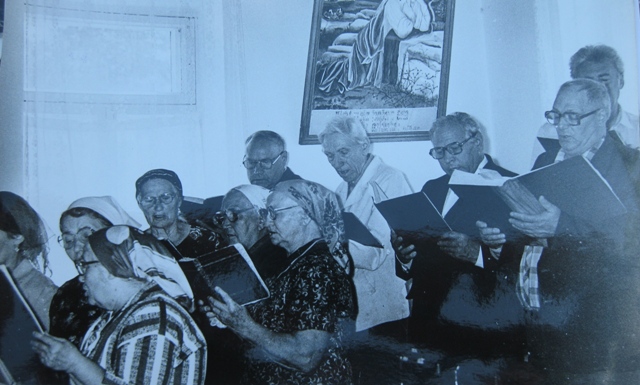
Caucasian generosity on display among Russian Germans in this picture
from the congregations annual harvest festival. 1970s.
The congregation was apparently visited by Bishop Kaunis from Latvia (center).


     The congregation that formed upon their return was strong in the pietist “brother” tradition, much like the congregation I served in Novosibirsk; when it was registered in 1971, it was the biggest Lutheran congregation in the Russian part of the USSR. It had become a gathering point for ethnic Germans since many found it impossible to return to their homelands (especially on the Volga). In Prokhladny Russian Germans purchased a single-residency home and transformed it into space for worship where probably 150 people could sit if they were willing to be stuffed in; they built on and added places for another 50 or so, but old timers told us that many times people would not find a place in the building and would participate in the service while standing in the courtyard. 
     Today the congregation, celebrating 45 years of existence, is small. They were hit hard by a very early wave  of emigration (already in the 1970s), but they did their best to remain true to what they knew. With time they moved the worship service into Russian (with the exception of the hymns, which still are usually taken from the Wolga Gesangbuch), and they try to be good stewards of what they have – taking care of the elderly, of their buildings (including a parsonage – very important if they are going to have a chance to attracting a full-time pastor), and their faith. One advantage they have over “brother” congregations in other places is that that in the Northern Caucasus valuing one's elders and one's heritage is considered very important. For that reason many more young people show up in church than in other comparable congregations; from my short contact with people there, I think that some of them are there to stay. It was a privilege to have a chance to talk with them (and with guests from neighboring Maisk and from other congregations in the region) about critical aspects of Reformation history that might be relevant for congregational life today.


Valery with the older boys at the amazing feast of local, Chechan
food that our new friend and host Said arranged for us.
     Part of long weekend together with believers in the region was a day trip to into mountains; our guide for the day (and our family's great helper for the rest of the week) was Valery Fogel, the head of the congregation in Maisk. Valery has played an important role in the region (and as a synod council member for the whole ELC-ER) for decades; he was born in Kazakhstan and still loves his hometown of Almata, but he's come to appreciate life as in the Northern Caucasus. He has great respect for those who take their faith seriously – whether they be Lutheran, Orthodox or Muslim. He knows the region and its people well; he showed us many sides of life in the region – from the Tsey glacier on the border with Georgia to the moving (beyond words moving, actually) monuments in Beslan (where over 300 children and adults where killed when terrorists occupied the school) to the quaint beauty of Nalchik to Grozny, the pride of the Chechen people as their republic is being rebuilt after the war. I learned much from each of these visits, and I also had a wonderful time growing to know Valery as a brother in faith. 
    A week's visit, though, certainly couldn't give me a clear and full impression of the Northern Caucasus. I was confused (and remain so) about how in Grozny there is now no sign of or memorial to the war that flattened the city just over a decade ago; in Northern Ossetia I wondered about the revival of traditional (shaministic?) forms of faith at the expense of the Orthodox church... I noticed time and again the tensions among the  Caucasian peoples – is there a chance for long-term peace when people have such heightened awareness of tradition (including traditions of disliking certain neighbors)? Why did we see so many positive images of Stalin in the region (on vodka bottles, car stickers, mountain murals) when so many of these very peoples who honor him were targets of repression?… On a less serious note, I still don't know what to think about all the drinking of and bathing in mineral water that seems to be a big part of local understandings of health...
A museum in downtown Grozny with tradition clan defense towers.
It seems that it, and everything else in the city, is brand new.
Martin testing out a mountain
mineral water bath.
     I'm not sure thaat I gained a handle on what is going on in the Northern Caucasus, but after visiting there I'm happy to join Dean Sergei Maramzin's encouraging words - “I wish you a happy upcoming Reformation anniversary, dear Church! You are young, fresh and fit, like a daughter of the Caucasus mountains!” With God's blessing, Sergei, Valery, and others will continue to work so that the message of peace and God's steadfast love continues to echo throughout the mountains and foothills of this beautiful and very interesting region. 

27 June 2016

Not “A Faith of Protest and Mere Denial” - Lutheranism for the Post-Soviet World

Yesterday I had the opportunity to participate in and read a paper at a conference entitled “The Churches of the Reformation in their Moral and Political Responsibility for the One World,” held in Hermannsburg, Germany, at the University of Applied Sciences for Intercultural Theology (FIT)A number of people in attendance asked that I share the text of my presentation, and so I decided it might be interesting to put up here, too. If all goes well next year a modified / expanded / footnoted version of this paper will be published together with the contribution of the scholars from around the world who took part in this conference. In addition to the text itself, I've added a small afterward in order to eliminate one possible misinterpretation of the intent of this paper.

Not “A Faith of Protest and Mere Denial” - Lutheranism for the Post-Soviet World
The Churches of the Reformation in Their Moral and Political Responsibility for One World Conference, Hermannsburg. 25 June 2016.
Rev. Bradn Buerkle

Greetings to you on this significant day in the history of our tradition, The Day of the Presentation of the Augsburg Confession! Perhaps in 14 years time we'll come together again, to once more look backwards and forwards about the ways the Reformation has affected our world.

I see this presentation as an opportunity to reflect on my experience and to share my thoughts about the influence of the Reformation on the world's largest country. I must say at time it has been frustrating. I don't know how often I've explained that Martin Luther and Martin Luther King are two different people. I've been in the odd situation of trying to convince someone that no, Martin Luther did not hang himself, but died an ordinary death, etc. Such misunderstandings are not that surprising given that objective information on religion (and, in particular, Western Christianity) was hard to find in the not too distant past. But one would expect that practicing Lutherans would have a sense of crucial aspects of the Reformation. However, even here there are problems. For example, when speaking with one lay preacher in Siberia, I learned from him the difference between Orthodox, Baptists and Lutherans: the first drink and baptize babies, the second neither drink nor baptize babies, while “we” don't drink but do baptize babies.

In preparing for this paper, I thought about why this should this be the case. One of the goals of this conference is to speak about the responsibility of our tradition for the one world, but it seems that the Russian Protestant churches have not ever been able to look beyond the walls of their own church, even within their own country. Instead, to a large degree, believers throughout the world have been caring for (or attempting to care for) them rather than the other way around. At various times in history political and church leaders from Germany, Denmark, and the United States (to name a few) have intervened with Russian authorities on behalf of Christians in general or Protestants in particular. Because of its diaspora or quasi-diaspora status and its place as a minority in an Orthodox-dominated country, international ties have been mostly about Russia Christians receiving support from abroad, the exception being Russian-Germans who emigrated to other parts of the world and helped support the Lutheran churches in their new homeland, whether that be in the Americas or in Europe.

But to return to the central question of this paper, I ask once again – why has the influence on the Reformation in Russia been so small? Why does the author who drew me to Russia, Fyodor Dostoevsky, see Lutheranism as “a faith of protest and mere denial,” offering nothing positive to the Christian world?1 Shouldn't it have been clear to him, as it is to me, that the churches of the Reformation and the Orthodox churches have a lot to learn from each other?

It would be one thing if Dostoevsky and other Russian thinkers only had limited experience with Lutherans during there visits to the West or through literature. Then their superficial and negative impression would be understandable. Dostoevsky, though, lived in a country where the Lutheran church was a state church, the second largest Christian confession in the empire. It's congregational buildings and members were prominent in the capital of St. Petersburg, the city Dostoevsky called home.2 Certainly Dostoevsky knew of Lutherans in Omsk, where he was imprisoned; there was even a Lutheran congregation in the small city of Staraya Russa in the Novgorod region, where he wrote “The Brothers Karamazov.”
By Dostoevsky's lifetime, Russian Lutherans had made great contributions to country and society. For centuries foreigners had come to Russia to serve the country in various capacities. While some of these found it in their interests to convert to Eastern Orthodoxy3, many preserved their faith – from engineers and miners in the Altay region to farmers on the Volga and the Black Sea, from artisans and craftsman in Moscow to officers in the military serving in the Far East, from architects in the capital to governors in Siberia, the Lutheran presence in the country was significant and stretched back to the 16th century. Names every Russian knew – the painter Karl Brullov,

 Franz Lefort - Peter the Great's ally in reforming the Russian military, 

the jeweler Karl Faberge,

Prince Michael Andreas Barclay de Tolly, whose status stands prominently on Nevsky Prospekt, the first Field Marshal and Minister of War during the war with Napoleon 

– were Protestant. If one looks carefully, it is relatively easy to see that the influence of Protestants on the country was not, in fact, small, it was significant. As citizens of the Russian empire, their positive influence was high, disproportionally high given their numbers.

Why, then, was there so little interest in the Reformation in Russia among its intellectual leaders? My proposal is that the root of the problem here lies in the kind of influence that mainline Protestants (Lutheran and Reformed) had on Russian society. More to the point – they saw they had something to contribute (and contributed very generously) as citizens of the country, but they acted as if the Reformation had no positive role to play in the spiritual / intellectual / mental and religious environment of the country.

What might explain that? There could be various reasons. One that seems obvious to us today is that Lutherans might have experienced a deep respect for the Eastern church and its traditions and did not want, as immigrants and ethnic minorities to the country, to disturb the traditional faith of the country. Unfortunately, from a historical point of view, this is unlikely to have been the case. Among some Protestants, yes, respect for Orthodoxy probably played a certain role. However, many more foreigner visitors to Russia at this time were incapable of understanding why Orthodoxy might be attractive, instead dismissing Eastern Christianity as a superstitious form of faith reflecting the relatively uneducated status of the Russian masses.

The reluctance of Protestants to spread their spirit to Russia, then, seems to lie not with the relationship of Protestants to Orthodoxy but with finding their own place as a minority in the country. Here it is important that we briefly think about the status of the Lutheran church in Russia throughout its history.

It is difficult to do this briefly, but I will make the attempt.

Lutherans came to Russia at first with embassies to the Russian tsar to see if they might find an ally in the fight against Rome; secretly, they hoped to try to convert him. That some of them had hope shows quite clearly that foreigners have a hard time understanding Russia – there was not the slightest sliver of a chance that Ivan IV (“the Terrible”) would consider changing his faith. While Ivan could treat Lutheran guests politely from time to time, at other times he would get enraged, even hitting one theologian on the head with a whip when the he spoke poorly of an Orthodox leader. Lutherans were allowed to build a church building in Moscow in 1574/5, but 3 years later the German neighborhood of the city (together with the church) was burned down upon Ivan's order.
St. Michael's Lutheran in Moscow as it looked on the eve of the Revolution

During the 16th and throughout the 17th centuries, the Lutheran church grew, but had to deal with a high degree of instability related to the place of foreigners in the Russian state. Many new foreigners were coming in to the country, some invited related to needs of the state, others as refugees. On the one hand, they experienced a degree of religious tolerance that was on a fairly high level compared to other places at the time; on the other hand, they could have very little confidence in their status, since everything depended on a particular tsar's particular needs.

Under Peter I and his successors in the 18th century there was an explosion of foreign influence in the country, both in terms of numbers (thanks to territorial expansion and immigration) and in terms of prominence. Great changes in the life of the Orthodox church were undertaken by Peter, who saw that conservative forces tended to gather there to resist his reforming projects. Peter's opponents were right to see that Protestant church-state relationships served as models for these reforms, even if they were carried out by the Orthodox theologian Feofan Prokopovich.

Foreigners continued to play a over-sized role throughout the century, though this was a mixed blessing. By the reign of Catherine II (1762-96) this issue became particularly prominent. In her years the number of Lutherans grew exponentially thanks to her invitation extended to farmers from Germany to settle the Volga region. The growth of Lutherans (and a smattering of other Western Christian groups, too) was such that they (and Catherine!) had to be particularly careful not to be seen as misusing their position to the disadvantage of the Orthodox population.


The 19th century was characterized by attempts to bring stability to the position of Protestant churches in Russia. The high point of this was the establishment of a constitution for the Evangelical Lutheran Church in Russia in 1832. This, too, was a mixed blessing. On the one hand, Lutherans had less to worry about in terms of their long-term status in the country. They would be protected by the state, to a large degree, even sponsored by it. At the same time, there were very clear boundaries drawn for the church (e.g., mixed marriages only if the children were Orthodox, very difficult to convert to Lutheranism, until the late 19th century – worship not allowed in the Russian language.) The Lutheran church was to be insulated as much as possible; this gave them stability and order from within, but completely took away from the church any opportunity for independent action apart from the state. The whole point was that the Russian state strove to submit the Lutheran church to it and eliminate its possibility for influencing Russians.

The Lutheran church, then, even after obtaining state status, remained completely foreign. By the early 20th century, a leading actor on the Russian religious scene, the Ober-procuror Constantine Pobedonostsev, could say: “In the Protestant faith there is something cold and inhospitable to the Russian person. More than that – if a Russian believer were to say of a Protestant church building that it was 'mine,' it would be the same for him as dying.”

To summarize the position of Protestants in pre-Revolutionary times, we can say that the church was “trained” to see that it is to its advantage to remain firmly within the walls of ministry among “traditionally Protestant” groups. As long as the church acted as a spiritual home for Germans, Finns, Latvians, Estonians, Swedes and other foreigner immigrants, it would be tolerated. But if it were to reach out to other peoples, let alone to Russians, or if it were to try to make a stand as a church in regards to some social or political issue, it would be punished.
It is no surprise, then, that the Evangelical Lutheran Church in Russia was shocked by the October Revolution and, as an organization, could provide no resistance to Soviet repressions. Thanks to heroic efforts of individual believers and church leaders, Lutherans were able to contribute to efforts to eliminate the effects of famine in 1922-3, but other than that simply tried to re-negotiate the church's relationship to the state in a way that it had done in the preceding centuries, i.e., in a way that it would allow the church to survive as an isolated group within Russian society.

The rest of the 20th century was full of dramatic and tragic history for all Christians in Russia, including for those from the Reformation tradition. After the elimination of Lutheran church structures in the Soviet Union by the end of the 1930s and their humble re-emergence in the second half of the century, after the hope-filled growth of the church in the late 80s and early 90s and the disappointment related to the emigration of many of Lutheran heritage in the decades since, where does that leave us? What is the heritage of the churches of the Reformation in Russia today, and what might be its contribution toward others in Post-Soviet societies?

Today we are obviously dealing with a different problem than before – in pre-Revolutionary Russia the issue was a church that was walled in. Now – we are dealing with a church that is very, very small. Is it really possible for such a minuscule church to occupy an important place in building society? Only time will tell. But in the meantime, the church is seeking to answer the question in the affirmative, to show with its efforts to contribute to the country's intellectual and spiritual life here and now that it believes that the Reformation tradition has something important to say for 21st century Russian society.

How is it doing so? One important factor is the church's attempt, especially under its young Archbishop Dietrich Brauer, is the use of the church's position as a “historical” church to get its voice heard. Archbishop Brauer and other leaders from Moscow have gained a place at the table in the government's dealing with religion in recent years. The Archbishop addressed a Duma committee earlier this year, for example, and representatives of the Moscow office of the church frequently take part in government-led round table discussions and conferences dealing with various societal issues. By frequently using the opportunity to send women (lay or ordained) to these meetings the church is already witnessing something about our Reformation heritage.

But the efforts of the church today are not primary about looking back at a “glorious” history as Russia's second Christian confession. The current leadership of the church is trying to help its members forge, for the first time, an identity that is both Russian and Lutheran. In that regard there are many attempts to utilize the "heritage of the Reformation" and to contextualize it for post-Soviet society. This is visible in the church's main publication - “Der Bote.”


There we can see how the church is trying to develop its own thought by learning more both about Lutheranism (thanks to sermons and theological articles in every issue) and, lately, also more about Orthodoxy. Last year, for example, I wrote an article about the theology of icons, while a member of the publication staff wrote a piece about the place of the “holy fool” in the Orthodox tradition.

While these efforts are important for a general audience, for those interested in deeper theological thinking, there is the possibility of participating in seminars run through the “Equipping for Service” program in which I am in charge. More interesting still, perhaps, are the works by Seminary President Dr. Anton Tikhomirov, whose two small books “Dogmatics Without Dogmatism” and “The Truth of Protest” are unparalleled in terms of expressing the values of the Reformation with an authentic Russian voice. The latter's subtitle is “The Spirit of Evangelical Lutheran Theology,” and it is this way of thinking theologically, probably more than concrete theological positions, that is so new and fresh here. Together with Archbishop Dietrich Brauer, Tikhomirov wrote “And You Will Be Free Indeed!”, summing up the Lutheran understanding of freedom and responsibility in a way that has obvious implications for the context.

In other ways the Lutheran church strives to be a small, quite voice of reason – this alone is enough to carve out a special place in the Russian religious environment. This was particularly visible in the past two years, when the relationship between Russia and the West has deteriorated. The pressure on Russian religious groups to support the policies of the Kremlin is high. In church declarations and publications the ELC shows a commitment to refuse to “toe the line” in terms of official positions. The church is too small to show outright opposition, but by declining to repeat the “right words,” the words expected of them by the Kremlin, and by asking questions and shifting attention to other issues, the Lutheran church in Russia is staking out unique ground. History has shown that even remaining silent during controversial questions is punishable.4 Yet, in “Der Bote” articles in the past two years on peacemaking and on refugees, a voice was given to believers in Ukraine and Georgia; again, this approach makes the Lutheran witness unusual.

In summary I'd like to say that the Reformation heritage in Russia was never one of “protest and mere denial,” but its isolation from Russian society in the Imperial period means thats its influence on society was severely limited. Today, despite limitations, there is a new chance for the Lutheran church to be authentically Russian voice expressing the core values of the Reformation in a way that has the potential to have positive impacts on the religious and social environment of the country.

Afterward
In this paper it may seem that I have taken it upon myself to judge the way the Lutherans in Russia lived out their faith in the first nearly 350 years that they resided in the country. Accusation, however, was in no way my intention. At nearly every step along the way it seems clear that making a move towards “localizing” the faith would have had significant consequences, many of which might have turned out to have negatively affected the witness of the church in the country. At the same time, the relatively obvious fact that Lutheranism remained a foreign element on Russian soil demands some explanation. It won't do, either, to condemn the religion policies of the tsarist governments. politics of the tsarist government instead. It would be anachronistic, after all, to fault the tsars for a lack of religious tolerance. After all, where else in 18th century Europe would there be such a wide variety of religious attitudes tolerated in one country? In what other capital city could Lutheran, Catholic, Armenian and Orthodox churches be seen, nearly side by side, on the main street of the capital? While one might wish that the situation had been different and that the country wouldn't have been caught up, from time to time, in a degree of xenophobia, what country's history is free of such moments?

Through analyzing the history of the Lutheran church in Russia, I hope to emphasize just how special this moment is, and, for all those who pray and work for the church, to thank God for the opportunity that has arisen to be a new kind of witness in this country.


1F.M. Dostoevsky. “A Writer's Diary,” January 1877.
2 As much as 10% of St. Petersburg was Lutheran at the time.
3In particular the tsars of German heritage, including Paul III and Catherine II. The latter, it is said, was a true Christian who struggled with her decision to become Orthodox or not. In the end she decided to become Orthodox because she sees “no real difference between the Greek and Lutheran faith.” If this quite is fairly attributed to her, it shows that she remained Lutheran in spirit!

4 E.g., Pastor Ganzen, the only pastor to refuse to sign the letter of greeting to the Bolshevik government at the church synod in 1924, was later sent to the GULAG, and his refusal to sign the letter was named as one of the reasons.

24 February 2016

“Just because you're paranoid doesn't mean they aren't after you.”


“Just because you're paranoid doesn't mean they aren't after you.”
― Joseph Heller, Catch-22

These words have been in my head quite a bit in the past 6 months. It was in early fall that I began the dreaded process of renewing my Russian residency permit, and at the beginning it did not look like things would go well. Immigration officials in different offices told me different information about the process; it seemed like I was getting funny looks as they noted my country of citizenship. I heard various stories – of the Polish journalist who was deported, of the American pastor whose family was allowed to cross the border...while he was stuck in Finland.

Not that I have anything against Finland, mind you, but I was already imaging the various ways the application process could end badly – I could be denied on some technicality; I could be denied without even a technicality. I would have to live in Estonia and get three-month visas. We would need to move with the family to America...

The expiration date of my residency permit grew closer and closer. “My” immigration official in Rostov had been moved to another department. I no longer knew anyone. Days passed. “Wait,” I heard. And “wait” again. There must be something wrong. They must be finding a way to make a good show of exiling an American. “Just because you're paranoid doesn't mean they aren't after you.” 

And then, as the working day was ending on the very day when my permit was to expire, I still didn't have my document. I was waiting outside of the office. I was told that I would get the stamp I need. But I didn't have it. It was 5.15 pm on a Friday. It seemed that my paranoia was going to live on through at least another weekend. Unless I was made to leave the country sooner. Or worse...

When you speak with your cat, that's not paranoia.
Paranoia is when you're afraid to say too much
while your cat is around.


And then, the “higher-up” who signs such documents came out of a meeting and, instead of heading home (as he could have done when the working day is officially over), he took the time to grab my folder, look it over, and sign my Vid na zhitelstvo. The process was over; I could legally remain in the country for another five years.

I can't explain why there were so many delays. But I can say that this country is changing. In years past, you wouldn't expect a bureaucrat to steal even a minute of his weekend for you. Not unless he was getting rewarded.

In my experience, this is not the case anymore. There is a chance, even a relatively good chance, that you might be treated as a human being by the bureaucratic machine. I wouldn't go so far as to say that the pressure of the “system,” is decreasing (that would not be the case), but on the other hand more and more frequently, when I push paranoia aside, I see that my interactions with government officials has taken a better turn.

Take the case of my meeting with a traffic police officer just a few days ago. He stopped me as I drove home from Matvey's skating practice; they were stopping everyone driving without their headlights on to warn them that there is a new rule about having your dims on even in the daytime. Besides my headlights being turned off, though, I had a more significant infraction - it turned out that I had left my documents (licenses, insurance and registration!) at home. Now home was just a few minutes away, but it was situations like these just a few years ago, where you felt fully vulnerable to the whim of the police. I was in the wrong, so, was the policeman going to ask for a bribe? Was he going to expect that I offer one? Was he going to tow the car to a safe place (at significant cost of time and money) while I go fetch the documents? I allowed myself only to hope that he might allow me to leave the car with him as I took the bus home to get the documents. But what did this policeman do instead? He allowed me to drive home in the car and return to him to show him the documents! Instead of letting distrust rule the day, he treated me as a human. And I was so thankful I almost wanted to bribe him (almost).

Like many of society's changes here in the past 15 years, this was actually a bit stunning. But it is also reflective of larger changes.

And it makes me wonder – maybe all of us are used to being a bit too paranoid. Whatever concerns the West has with this country (and I understand that there are significant and legitimate concerns) and whatever concerns Russia has with the West (and here, too, I can sometimes see the point) it would be helpful for everyone if we stopped treating each other as though the other is out to get us. Such thinking boxes us in to situations of either us or them, of over-emphasizing one side's being in the right while doing the same for describing the way the other side is in the wrong.


The government here, the one I was paranoid about a few months ago, has given me the right to remain here for 5 more years. I hope that in that time we can all move away from the Cold War environment that created “Catch-22” in the first place...and I hope that I have the wisdom to make my own, small contribution to that change, leading to a greater peace.  


Paranoia - sometimes we overdo it.

12 February 2016

Exploring Eschatology

The more challenging the times, it seems, the more apocalyptic themes come to the forefront of our thoughts. Given Russia's current economic difficulties and problems on the international scene, it was no coincidence,then, that eschatology was the topic of our latest seminar for distance and extension students in Novosaratovka. And even if the timing of the seminar meant that we had somewhat few participants that we would have liked (it was hard for many to get off of work in late January when the New Year's / Christmas holidays ended on the 11th), the ground we covered will serve them (and our church) well, in times of high tension and in times of peace.

It was with this in mind that I approached the two topics I led during this seminar - "Theology of Hope" and "Pastoral Care of the Dying and Grieving." The latter set of lectures was a very basic introduction that probably only raised the curtain a bit on questions of our own mortality; these issues, of course, affect our ability to give pastoral care in end-of-life situations. A number of students expressed that even this short introduction was enough to give them a new approach based upon God's love shown to the suffering through listening, presence and empathy, instead of always trying to provide "answers."
As a part of this class we read from Lev Tolstoy's "The Death of Ivan Ilyich." It has been quite some time since I've used my own preferred method for thinking about theology - through great literature - in the classroom setting. But in my lessons of "theology of hope," too, literature was very useful. When explaining the context of the birth of Jurgen Moltmann's theology, we spoke about the difficulty of doing theology "after Auschwitz," and read from Elie Wiesel "Night." But to emphasize that the problem of enormous suffering that we humans cause one another is not specific to Germany, we also read from 2015 Nobel Literature Prize winner Svetlana Alexievich's "Second Hand Time," which tells many sad, sad stories from the point of view of ordinary people in Soviet (and post-Soviet) Russia.

Faced with headlines predicting total economic collapse and/or World War III, I find it particularly important to hold fast to a vision of God's coming reign and to use that vision to inform our daily lives. I hope that I was able to pass on this aspect of Moltmann's theology in my lessons. From the response of the students and the eagerness to which they responded to the news that (finally!) one of Moltmann's major works will be translated into Russia - our own Anton Tikhomirov is working on "The Coming of God" - I believe that I was successful. 

Students were also inspired in another way by studying eschatology - they saw the degree to which doing theology is a creative process. As one student told me, during this course she saw that theology is not simply about finding new ways to defend old dogmas, but that it rises out of our own experience interacting with Scripture and with the experiences of others. I am encouraged when I see people in this still emerging church ask new questions and welcome one another on the road of exploration.